
- Guías de estudio, Notas de estudios & Resúmenes
¿Buscas las mejores guías de estudio, notas de estudio y resúmenes para ? En esta página encontrarás 6 documentos de estudio para .

Examen
NBEO Optometry Board Review Unit 2 Optics, Refraction, Contact Lenses and Binocular Vision — Questions & Answers
NuevoNBEO Optometry Board Review Unit 2 Optics, Refraction, Contact Lenses and Binocular Vision — Questions & Answers 1. What is the refractive index of a medium in which light travels at two-thirds its speed in a vacuum? A. 0.67 B. 2.0 C. 1.5 D. 3.0 Answer: C. 1.5 Rationale: n = c/v. 2. Which law relates angles of incidence and refraction? A. Prentice's rule B. Snell's law C. Knapp's law D. Listing's law Answer: B. Snell's law Rationale: n1 sin θ1 = n2 sin θ2.
 StuviaTutors

Examen
NBEO Optometry Board Review Unit 6 Systemic Disease, Pediatrics, Low Vision and Clinical Practice — Questions & Answers
PopularNBEO Optometry Board Review Unit 6 Systemic Disease, Pediatrics, Low Vision and Clinical Practice — Questions & Answers 1. Which retinal sign is classic in systemic lupus erythematosus? A. Bone spicules B. Drusen C. Sea fans D. Cotton wool spots Answer: D. Cotton wool spots Rationale: Microvascular occlusion; also hydroxychloroquine screening. 2. Which ocular finding is common in rheumatoid arthritis? A. Retinitis pigmentosa B. Keratoconjunctivitis sicca C. Coloboma D. Keratoconu...
StuviaTutors

Examen
NBEO Optometry Board Review Unit 3 Microbiology, Immunology, Pathology and Ocular Pharmacology — Questions & Answers
NuevoNBEO Optometry Board Review Unit 3 Microbiology, Immunology, Pathology and Ocular Pharmacology — Questions & Answers 1. Which hypersensitivity type causes seasonal allergic conjunctivitis? A. Type II B. Type III C. Type IV D. Type I (IgE-mediated) Answer: D. Type I (IgE-mediated) Rationale: Mast cell degranulation. 2. Which hypersensitivity type underlies contact dermatitis from eye drops? A. Type IV (delayed) B. Type I C. Type II D. Type III Answer: A. Type IV (delayed) Ration...
StuviaTutors

Examen
NBEO Optometry Board Review Unit 1 Ocular Anatomy, Neuroanatomy and Physiology — Questions & Answers
NuevoNBEO Optometry Board Review Unit 1 Ocular Anatomy, Neuroanatomy and Physiology — Questions & Answers 1. How many bones form the orbit? A. Seven B. Five C. Nine D. Four Answer: A. Seven Rationale: Frontal, zygomatic, maxilla, ethmoid, sphenoid, palatine and lacrimal. 2. Which orbital wall is thinnest? A. Lateral wall B. Roof C. Medial wall (lamina papyracea of the ethmoid) D. Floor of the zygoma Answer: C. Medial wall (lamina papyracea of the ethmoid) Rationale: Infection spread...
StuviaTutors

Examen
NBEO Optometry Board Review Unit 5 Glaucoma, Retina and Neuro-Ophthalmology — Questions & Answers
NuevoNBEO Optometry Board Review Unit 5 Glaucoma, Retina and Neuro-Ophthalmology — Questions & Answers 1. Which trial showed that lowering IOP in ocular hypertension reduced conversion to glaucoma? A. ETDRS B. AREDS C. ONTT D. Ocular Hypertension Treatment Study Answer: D. Ocular Hypertension Treatment Study Rationale: About 9.5% vs 4.4% at 5 years. 2. Which OHTS finding identified an important risk factor for glaucoma? A. Thinner central corneal thickness B. Thicker corneas C. Hypero...
StuviaTutors
Examen
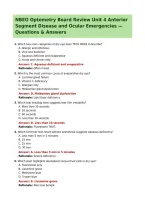
NBEO Optometry Board Review Unit 4 Anterior Segment Disease and Ocular Emergencies — Questions & Answers
NuevoNBEO Optometry Board Review Unit 4 Anterior Segment Disease and Ocular Emergencies — Questions & Answers 1. Which two main categories of dry eye does TFOS DEWS II describe? A. Allergic and infectious B. Viral and bacterial C. Aqueous deficient and evaporative D. Acute and chronic only Answer: C. Aqueous deficient and evaporative Rationale: Often mixed. 2. Which is the most common cause of evaporative dry eye? A. Lacrimal gland failure B. Vitamin C deficiency C. Allergies only D. ...
StuviaTutors