- Guías de estudio, Notas de estudios & Resúmenes

¿Buscas las mejores guías de estudio, notas de estudio y resúmenes para ? En esta página encontrarás 11 documentos de estudio para .

All 11 resultados

Ordenador por:

CHEM 210 Biochemistry Module 1 to 8 Exams' & Final Exam (2025 / 2026) Portage Learning Questions and Verified Answers, 100% Guaranteed Pass ||Complete A+ Guide
  • Examen

    CHEM 210 Biochemistry Module 1 to 8 Exams' & Final Exam (2025 / 2026) Portage Learning Questions and Verified Answers, 100% Guaranteed Pass ||Complete A+ Guide

  • CHEM 210 Biochemistry Module 1 to 8 Exams' & Final Exam (2025 / 2026) Portage Learning Questions and Verified Answers, 100% Guaranteed Pass ||Complete A+ Guide
  • LECTJOE
    $16.99 Más información
Portage_Learning_Chem_210___Module_1_Problem with Answer
  • Examen

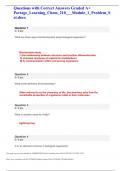
    Portage_Learning_Chem_210___Module_1_Problem with Answer

  • What are three ways that biochemists study biological organisms? Biochemists study 1) the relationship between structure and function ofbiomolecules, 2) chemical reactions of organisms (metabolism) 3) 3) communication within and among organisms. Question 2 0 / 0 pts What is the definition of biochemistry? Often referred to as the chemistry of life, biochemistry asks how the remarkable properties of organisms relate to their molecules. Question 3 0 / 0 pts What is another name for firefl...
  • Clayjohnson
    $6.99 Más información
Portage_Learning_Chem_210___Module_1_exam
  • Examen

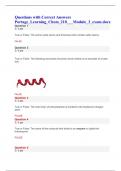
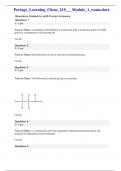
    Portage_Learning_Chem_210___Module_1_exam

  • True or False: According to the Module, a compound with a molecular mass of 3,000 g/mol is considered a macromolecule. FALSE Question 2 3 / 3 pts True or False: Biomolecules can have only two functional groups. FALSE Question 3 0 / 3 pts True or False: The following functional group is an amide. FALSE Question 4 3 / 3 pts True or False: In a eukaryotic cell, the organelles called peroxisomes serve the purpose of digesting macromolecules.
  • Clayjohnson
    $6.99 Más información
Portage_Learning_Chem_210___Module_7_exam with correct answers
  • Examen

    Portage_Learning_Chem_210___Module_7_exam with correct answers

  • Question 1 3 / 3 pts True or False: The ΔG value for a particular reaction is -78kJ/mol. This value indicates the reaction is NOT spontaneous. FALSE Question 2 3 / 3 pts True or false: A biochemical metabolic pathway is a single reaction that converts starting material into products. FALSE Question 3 3 / 3 pts True or false: Three ATP molecules are used in the energy-investing stage of glycolysis. FALSE Question 4 3 / 3 pts True or False: The citric acid cycle occurs in the absence...
  • Clayjohnson
    $8.49 Más información
Portage_Learning_Chem_210___Module_6_Problem with Correct Answers
  • Examen

    Portage_Learning_Chem_210___Module_6_Problem with Correct Answers

  • What is the difference between a nucleoside and nucleotide? A nucleoside is formed from the covalent bonding of a base, purine or pyrimidine, to either ribose or 2-deoxyribose. Nucleotides are built from a nitrogen-containing organic base, a monosaccharide, and phosphate. Question 2 0 / 0 pts What characteristic makes purines and pyrimidine heterocyclic? Each has a ring with nitrogen in the ring instead of all carbon atoms in the ring. Question 3 0 / 0 pts Is this molecule ribose or 2-d...
  • Clayjohnson
    $4.99 Más información
Portage_Learning_Chem_210___Module_6_exam with Correct Answers
  • Examen

    Portage_Learning_Chem_210___Module_6_exam with Correct Answers

  • Question 1 3 / 3 pts In RNA, guanine always pairs with . Thymine Guanine Cytosine Uracil Both A and B CYSTOSINE DNA is built from which of the following? Nucleosides Genes Purines Nucleotide Codons NUCLEOTIDE The Z-form helix of DNA is stabilized mainly by . Ionic bonds Covalent bonds Hydrogen bonds Ion-dipole bonds Hydrogen covalent bonds HYDROGEN BONDS
  • Clayjohnson
    $8.49 Más información
Portage_Learning_Chem_210___Module_5_exam with Correct Answers
  • Examen

    Portage_Learning_Chem_210___Module_5_exam with Correct Answers

  • Glycerol contains how many alcohol functional groups? 1 2 3 4 None of the above 3 Question 2 3 / 3 pts Which of the following are derived from or made from fatty acids? Cholesterol Carotenoids Phosphoglycerides Both A and B Both A and C PHOSPHOGLYCERIDES Question 3 3 / 3 pts Triacylglycerols are made from: A glycerol backbone Three fatty acids Amide linkages between fatty acids A glycerol backbone and three fatty acids All of the above A GLYCEROL BACKBONE AND THREE FATTY ...
  • Clayjohnson
    $8.49 Más información
Portage_Learning_Chem_210___Module_4_exam with Correct Answer
  • Examen

    Portage_Learning_Chem_210___Module_4_exam with Correct Answer

  • Which of the following monosaccharides is a ketose? Dihydroxyacetone Galactose Glucose Glyceraldehyde Idose Dihydroxyacetone Question 2 3 / 3 pts When two carbohydrates are epimers: One is a pyranose, the other a furanose One is an aldose, the other a ketose They differ in length by one carbon They differ only in the configuration about one carbon atom They react differently with iodine THEY DIFFER ONLY IN THE CONFIGURATION ABOUT ONE CARBON ATOM Which pair is anomeric? A) D-gluc...
  • Clayjohnson
    $8.99 Más información
Portage_Learning_Chem_210___Module_3  Actual Problem with Answers
  • Examen

    Portage_Learning_Chem_210___Module_3 Actual Problem with Answers

  • Question 1 0 / 0 pts Name three different functions of proteins. Transport, hormones, catalysis, structure, and protection Question 2 0 / 0 pts What function does a protease have? catalysis. It degrades proteins. Question 3 0 / 0 pts What is the function of hormones? These proteins communicate from one cell to another Question 4 0 / 0 pts What are the functional groups common to all amino acids? amine and carboxylic acid This study source was downloaded by from CourseH on :17:35 G...
  • Clayjohnson
    $8.49 Más información
¿Quiere recuperar sus gastos?
¿Cuánto te has gastado ya en Stuvia? Imagina que sois muchos más los que estáis ahí fuera pagando por apuntes de estudio, pero esta vez TÚ eres el vendedor. ¡Ka-ching!