
- Guías de estudio, Notas de estudios & Resúmenes
¿Buscas las mejores guías de estudio, notas de estudio y resúmenes para ? En esta página encontrarás 8 documentos de estudio para .
Examen
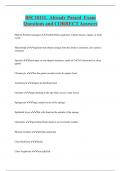
BSC1011L Already Passed Exam Questions and CORRECT Answers
Phylum Porifera (sponges) multicellular organisms without tissues, organs, or body cavity Heterotroph organism that obtains energy from the foods it consumes; also called a consumer Spicules hard spear or star-shaped structures; made of CaCO3 (limestone) or silica (glass) Choanocyte line the gastrovascular cavity & capture food Amoebocyte digest & distribute food Osculum large opening at the top where excess water leaves Spongocoel large central cavity of the sponge
 STANFORDGRADESS

Examen
BSC1011L TOP Exam Questions and CORRECT Answers
PopularBasic Cell Type- EukaryotesContain an NUCLEUS. Include plants, animals, fungi, and protists. Cell size is about 10 times compared to average cell. Proteins are more complexed with DNA into multiple chromosomes. In cell division their micro-tubules pull chromosomes to opposite poles during cell division process, called mitosis. Flagella are complex structures that whip back and forth, rather than rotating. Basic Cell Type- ProkaryotesNo Nucleus. Basically single-celled . Bacteria Shapes...
STANFORDGRADESS
Examen
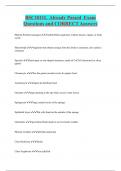
BSC1011L Already Passed Exam Questions and CORRECT Answers
Phylum Porifera (sponges) multicellular organisms without tissues, organs, or body cavity Heterotroph organism that obtains energy from the foods it consumes; also called a consumer Spicules hard spear or star-shaped structures; made of CaCO3 (limestone) or silica (glass) Choanocyte line the gastrovascular cavity & capture food Amoebocyte digest & distribute food Osculum large opening at the top where excess water leaves Spongocoel large central cavity of the sponge
 WIZGrades

Examen
BSC1011L TOP Exam Questions and CORRECT Answers
Basic Cell Type- EukaryotesContain an NUCLEUS. Include plants, animals, fungi, and protists. Cell size is about 10 times compared to average cell. Proteins are more complexed with DNA into multiple chromosomes. In cell division their micro-tubules pull chromosomes to opposite poles during cell division process, called mitosis. Flagella are complex structures that whip back and forth, rather than rotating. Basic Cell Type- ProkaryotesNo Nucleus. Basically single-celled . Bacteria Shapes...
WIZGrades

Examen
BSC1011L UPDATED Exam Questions and CORRECT Answers
Angiosperm A flowering plant which forms seeds inside a protective chamber called an ovary. annual a plant that completes its life cycle, from germination to the production of seeds, within one growing season, and then dies. annulus an arc or a ring of specialized cells on the sporangium Anther the part of a stamen that contains the pollen. Antheridia Structures in plants that produce male gametes Antibiotics Drugs that block the growth and reproduction of bacteria
WIZGrades
Examen
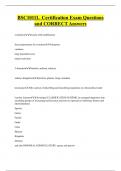
BSC1011L Certification Exam Questions and CORRECT Answers
evolutiondescent with modification four requirements for evolutionmutation variation large population siza natural selection 3 domainsbacteria, archaea, eukarya eukarya kingdomsprotista, plantae, fungi, animalia taxonomythe science of describing and classifying organisms in a hierarchical order Carolus Linnaesdeveloped CLASSIFICATION SCHEME; he arranged organisms into ascending groups of increasing inclusiveness and tries to represent evolutionary history and interrelatedness
WIZGrades

Examen
BSC1011L UPDATED Exam Questions and CORRECT Answers
Angiosperm A flowering plant which forms seeds inside a protective chamber called an ovary. annual a plant that completes its life cycle, from germination to the production of seeds, within one growing season, and then dies. annulus an arc or a ring of specialized cells on the sporangium Anther the part of a stamen that contains the pollen. Antheridia Structures in plants that produce male gametes Antibiotics Drugs that block the growth and reproduction of bacteria
STANFORDGRADESS

Examen
BSC1011L Certification Exam Questions and CORRECT Answers
evolutiondescent with modification four requirements for evolutionmutation variation large population siza natural selection 3 domainsbacteria, archaea, eukarya eukarya kingdomsprotista, plantae, fungi, animalia taxonomythe science of describing and classifying organisms in a hierarchical order Carolus Linnaesdeveloped CLASSIFICATION SCHEME; he arranged organisms into ascending groups of increasing inclusiveness and tries to represent evolutionary history and interrelatedness
STANFORDGRADESS