

University Of Wisconsin - Madison
Las últimas cargas en University Of Wisconsin - Madison. ¿Buscando notas en University Of Wisconsin - Madison? Tenemos muchas notas, guias de estudio y notas de estudio disponsible para tu escuela.
-
311
- 0
-
30
All courses for University Of Wisconsin - Madison
-
Anatomy And Physiology 337 14
-
Bio 101 BIO 101 1
-
Chemistry 103 CHEM103 1
-
CSD 201: Speech Science csd201 1
-
ECE 532: Matrix Methods in Machine Learning ECE532 1
-
ENGLISH 216 1
-
Environmental Science 1
-
Math 340: Elementary Matrix and Linear Algebra MATH340 3
-
PHARMACOLO 1202 1
-
Political Science 104 PoliSci104 1
-
Post-op Pain Management Case Study CNP 317 1
-
Social Work 105 SOC105 2
-
SURGERY 929 SURGERY 929 2
Libros populares University Of Wisconsin - Madison
David T. Canon, John J. Coleman, Kenneth R. Mayer • ISBN 9780393926187
Último contenido University Of Wisconsin - Madison
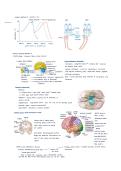
1. Know how the brain processes and integrates information from multiple sensory systems, to different areas in the brain responsible for each. 2. Understand the two cortices responsible for coordinating a physical response via our muscles. 3. Understand how your brain rewards pleasurable experiences via a complex pathway that reinforces that pathway. 4. Apply your understanding of learning to understand positive feedback. 5. Understand the connection between sleep and learning. Forebrain...
- Notas de lectura
- • 3 páginas's •
-
University Of Wisconsin - Madison•BIOL 151
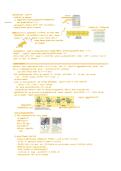
1. Identify a glycosidic linkage and a peptide bond. 2. Name some polysaccharides and their biological roles. 3. Define the characteristics and bonds that give proteins their primary, secondary, tertiary, and quaternary structures. Hydroxyl and carbonyl groups, glycosidic linkage, starch, glycogen, cellulose, chitin, polypeptide, carboxyl and amino groups, peptide bond, alpha carbon, R group, amino (N)-terminus, carboxyl (C) terminus, primary, secondary, tertiary, and quaternary protein str...
- Notas de lectura
- • 3 páginas's •
-
University Of Wisconsin - Madison•BIOL 151
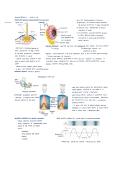
1. Know which of our senses rely on mechanotransduction, chemotransduction, and phototransduction. 2. Understand how hair cells convey information about gravity, movement, and sound by physically opening ion channels when activated. 3. Describe the role of the outer, middle, and inner ear and what forces are being generated in each portion. 4. Recognize how sound perceived by an ear conveys information about pitch by stimulating different portions of the cochlea and volume by stimulating the ...
- Notas de lectura
- • 4 páginas's •
-
University Of Wisconsin - Madison•BIOL 151
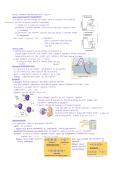
1. Use your understanding of Gibb’s free energy, endergonic reactions, and exergonic reactions to predict whether a chemical reaction occurs spontaneously or requires energy input. 2. Use rules of thumb about anabolic and catabolic reactions to predict whether a reaction is exergonic or endergonic. 3. Explain how the energy of activation slows some chemical reactions, and how this barrier can be overcome by an enzyme. 4. Explain the roles of dehydration and hydrolysis reactions in the forma...
- Notas de lectura
- • 2 páginas's •
-
University Of Wisconsin - Madison•BIOL 151
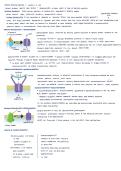
1. Differentiate between chemo- mechano- and photoreception in general including the specialized proteins responsible for receiving the different environmental signals. 2. Know the process of sensory transduction in general, from detection to signal transmission to the brain. 3. Understand how action potentials convey information about intensity, location, and duration, and enhance edge and border detection. 4. Know which of our senses rely on GPCRs for signal transduction and why. 5. Descri...
- Notas de lectura
- • 3 páginas's •
-
University Of Wisconsin - Madison•BIOL 151
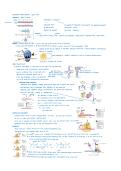
1. Describe the process of Translation; what is the purpose? 2. What are the steps involved in Initiation of Translation? 3. What are the steps involved in Elongation of Translation? 4. What are the steps involved in Termination of Translation? 5. What are some differences between Prokaryotic and Eukaryotic Translation? Translation, Initiation, Elongation, Termination, Ribosomes, Transfer RNA (tRNA), Aminoacyl tRNA Synthetases, E, P, A sites on the Ribosome, Codon, AUG Codon, Stop Codon, ...
- Notas de lectura
- • 2 páginas's •
-
University Of Wisconsin - Madison•BIOL 151
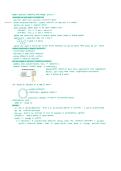
1. Recognize the difference between an inorganic and an organic molecule. 2. Understand different representations of an organic molecule. 3. Predict whether an organic molecule is hydrophilic, hydrophobic, or amphipathic. 4. Understand how conservation of mass and energy work in chemical reactions. Hydrophilic vs Hydrophobic vs Amphipathic, Plasma membrane, Intracellular, Extracellular, Organic molecule, inorganic carbon, Conservation of mass, First, second laws of thermodynamics, Entropy,...
- Notas de lectura
- • 1 páginas's •
-
University Of Wisconsin - Madison•BIOL 151
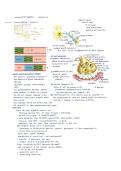
1. Predict whether ion movement across a postsynaptic membrane will generate an EPSP or IPSP based on its effect on membrane potential relative to threshold. 2. Know that the CNS and PNS work together to sense and respond to the environment, coordinate movement, and regulate internal bodily functions, via afferent & efferent signals. 3. Compare and contrast the Sympathetic and Parasympathetic control over bodily functions. 4. Describe how the nervous system helps regulate body temperature via...
- Notas de lectura
- • 4 páginas's •
-
University Of Wisconsin - Madison•BIOL 151
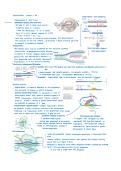
1. Describe the process of Transcription; what is the purpose? 2. What are the differences between DNA and RNA? 3. What are the enzymes and proteins involved in Transcription and what do they do? 4. How is Transcription initiated? 5. How is RNA synthesized? 6. Explain some of the critical differences between DNA replication by DNA polymerase and RNA transcription by RNA polymerase. 7. How is the primary RNA transcript processed to create mRNA? The Central Dogma, Differences between DNA an...
- Notas de lectura
- • 3 páginas's •
-
University Of Wisconsin - Madison•BIOL 151
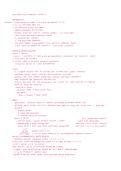
1. Describe how data from fossils and new environments argue for the evolution of new species from old species. 2. Outline the theory of natural selection. 3. Describe how diffusion of solutes results in the movement from regions of high to low concentration (down a concentration gradient). 4. Outline how electron sharing or electrical attraction differ between covalent bonds (non-polar and polar), ionic bonds, hydrogen bonds, and van der Waals interactions. 5. Draw a set of water molecules ...
- Notas de lectura
- • 2 páginas's •
-
University Of Wisconsin - Madison•BIOL 151