

University Of Wisconsin - Madison
Las últimas cargas en University Of Wisconsin - Madison. ¿Buscando notas en University Of Wisconsin - Madison? Tenemos muchas notas, guias de estudio y notas de estudio disponsible para tu escuela.
-
311
- 0
-
30
All courses for University Of Wisconsin - Madison
-
Anatomy And Physiology 337 14
-
Bio 101 BIO 101 1
-
Chemistry 103 CHEM103 1
-
CSD 201: Speech Science csd201 1
-
ECE 532: Matrix Methods in Machine Learning ECE532 1
-
ENGLISH 216 1
-
Environmental Science 1
-
Math 340: Elementary Matrix and Linear Algebra MATH340 3
-
PHARMACOLO 1202 1
-
Political Science 104 PoliSci104 1
-
Post-op Pain Management Case Study CNP 317 1
-
Social Work 105 SOC105 2
-
SURGERY 929 SURGERY 929 2
Libros populares University Of Wisconsin - Madison
David T. Canon, John J. Coleman, Kenneth R. Mayer • ISBN 9780393926187
Último contenido University Of Wisconsin - Madison
1. Describe the ways that microtubules and microfilaments assemble, and changes in assembly and their associated motor proteins can anchor or move cellular components and organelles. 2. Diagram how microtubule sliding changes the shape of cilia and flagella. 3. Provide examples of how microfilaments and their associated myosin motor proteins can change cellular shape and movement. 4. Describe how the intermediate filaments provide structural support for membranes. 5. Provide evidence in favo...
- Notas de lectura
- • 2 páginas's •
-
University Of Wisconsin - Madison•BIOL 151
1. Outline some unique ways in which membranes are used in eukaryotic cells. 2. Describe how a protein is selected to move into the rough ER or by imported or exported through the nuclear pore. 3. Diagram the origins and fates of vesicle membranes and vesicle contents during exocytosis and endocytosis. 4. Contrast the functions of the smooth and rough endoplasmic reticulum, the Golgi apparatus, transport and secretory vesicles, and the lysosome. 5. Diagram the trafficking of a secreted or ...
- Notas de lectura
- • 4 páginas's •
-
University Of Wisconsin - Madison•BIOL 151
1. What are Mendel’s Laws of Inheritance? 2. What is the difference between a gene, a locus, and an allele? 3. What is the difference between genotype and phenotype? 4. What is dominance? Can there be dominance in a homozygote? 5. What is Segregation? Draw out a Punnett Square for a Monohybrid cross Aa x Aa. How many homozygotes are there? How many heterozygotes are there? 6. What is Independent Assortment? Draw out a Punnett Square for a Dihybrid cross between AaBB x AABb. What are the ...
- Notas de lectura
- • 3 páginas's •
-
University Of Wisconsin - Madison•BIOL 151
1. Predict the direction of water’s osmosis across a membrane when a cell is placed in hypertonic, isotonic, or hypotonic solutions, and how some cells use this to create turgor pressure. 2. Predict how the presence of saturated fatty acids, unsaturated fatty acids, and cholesterol influence membrane fluidity. 3. Draw how channels, carriers, pumps, and energy sources move molecules across a membrane and explain which of these allow these molecules to move with or against their concentration...
- Notas de lectura
- • 2 páginas's •
-
University Of Wisconsin - Madison•BIOL 151
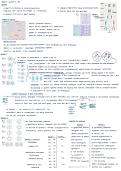
1. What are the differences and similarities between Meiosis and Mitosis? 2. Describe the steps in Meiosis I and Meiosis II. 3. What are the differences between Meiosis I and Meiosis II? 4. What happens during crossing over? 5. What types of mutations could arise during Meiosis and how do they occur? Describe the processes. Meiosis versus Mitosis, Meiosis I, Meiosis II, Chromosome, Chromatid, Homologous Chromosomes, Crossing Over, Unequal crossing over, Chiasmata, Nondisjunction, Aneupl...
- Notas de lectura
- • 2 páginas's •
-
University Of Wisconsin - Madison•BIOL 151
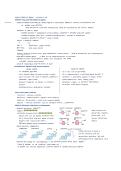
1. Understand how the endocrine system (ES) works in tandem with the nervous system (NS) to better respond to an animal’s environment. 2. Understand the difference between hydrophilic and hydrophobic hormones based on where their receptors are on/in the cell and the type of response invoked. 3. Know the difference between tropic and direct hormones released by the anterior pituitary. 4. Describe examples of how our ES utilizes negative and positive feedback. 5. Describe how your body maint...
- Notas de lectura
- • 5 páginas's •
-
University Of Wisconsin - Madison•BIOL 151
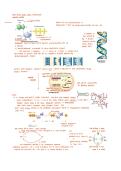
1. Explain the role of hydrogen bonding between complementary nitrogenous bases in the formation of the DNA double helix (reviewed from last lecture) and a folded RNA ribozyme. 2. Outline the central dogma of replication, transcription, and translation. 3. Describe roles for triphosphate nucleotides in energy transfer and storage in a cell. 4. Explain the structural/chemical difference between a fatty acid, triglyceride, phospholipid, and steroid. 5. Draw a diagram of a micelle and of a lipo...
- Notas de lectura
- • 2 páginas's •
-
University Of Wisconsin - Madison•BIOL 151
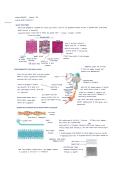
1. Describe the hierarchical organization of skeletal muscle from sarcomere to whole muscle. 2. Understand how actin and myosin interact via the cross-bridge cycle to generate force and produce movement. 3. Know how smooth and striated (cardiac & skeletal) muscle types differ and are controlled by different branches of the nervous system. 4. Demonstrate how muscle contraction begins with motor neurons depolarizing muscle cells, triggering the release of calcium that initiates sarcomere contra...
- Notas de lectura
- • 5 páginas's •
-
University Of Wisconsin - Madison•BIOL 151
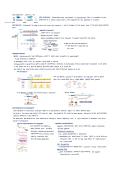
1. What is an Operon, and what is its structure? 2. Discuss how gene regulation occurs in Prokaryotes using the Lac Operon as an example. 3. What are Epigenetic Modifications? Give Examples and discuss how they regulate gene expression. 4. How might Transcription be regulated in Eukaryotes? 5. How might RNA Processing lead to different protein products? 6. How might RNA Editing lead to different protein products? 7. How might Translation be regulated in Eukaryotes? Gene Regulation, Gene...
- Notas de lectura
- • 2 páginas's •
-
University Of Wisconsin - Madison•BIOL 151
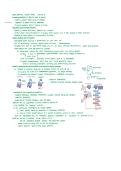
1. Predict how changes in temperature and pH might affect the shape and function of proteins. 2. Define what competitive inhibition and allosteric regulation of an enzyme means. 3. Draw a simple diagram of a metabolic pathway undergoing feedback regulation using an allosteric inhibitor. 4. Identify the phosphate, monosaccharide and nitrogenous base portions of a nucleotide, and the phosphodiester bond in a nucleic acid polymer. 5. Explain the role of hydrogen bonding between complementary ni...
- Notas de lectura
- • 1 páginas's •
-
University Of Wisconsin - Madison•BIOL 151