

State University Of New York Oswego
Las últimas cargas en State University Of New York Oswego. ¿Buscando notas en State University Of New York Oswego? Tenemos muchas notas, guias de estudio y notas de estudio disponsible para tu escuela.
-
10
- 0
- 0
All courses for State University Of New York Oswego
-
Exams 2
Último contenido State University Of New York Oswego
Biology 101 Notes
- Notas de lectura
- • 1 páginas's •
-
State University Of New York Oswego•BIO 120
Vista previa 1 fuera de 1 páginas
Preparando tu documento...
Biology 101 Notes
Biology 101 Notes
- Notas de lectura
- • 1 páginas's •
-
State University Of New York Oswego•BIO 120
Vista previa 1 fuera de 1 páginas
Preparando tu documento...
Biology 101 Notes
Biology 101 Notes
- Notas de lectura
- • 1 páginas's •
-
State University Of New York Oswego•BIO 120
Vista previa 1 fuera de 1 páginas
Preparando tu documento...
Biology 101 Notes
Biology 101 Notes
- Notas de lectura
- • 1 páginas's •
-
State University Of New York Oswego•BIO 120
Vista previa 1 fuera de 1 páginas
Preparando tu documento...
Biology 101 Notes
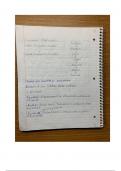
Bio 101 notes,
- Notas de lectura
- • 1 páginas's •
-
State University Of New York Oswego•BIO 120
Vista previa 1 fuera de 1 páginas
Preparando tu documento...
Bio 101 notes,
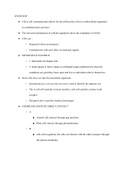
Concepts/Topics 1. Why is cell communication important? 2. Know the different ways cells communicate with each other. 3. Understand cell signaling beginning with the types of receptors, receptor-ligand interaction (reception), and ending with the different ways cells can respond. 4. Understand how gene expression relates to genotype and phenotype. 5. General differences between bacterial and eukaryotic transcription and translation. 6. Messenger RNA synthesis and processing. 7. Mechanism...
- Notas de lectura
- • 32 páginas's •
-
State University Of New York Oswego•BIO 120
Vista previa 4 fuera de 32 páginas
Preparando tu documento...
Concepts/Topics 1. Why is cell communication important? 2. Know the different ways cells communicate with each other. 3. Understand cell signaling beginning with the types of receptors, receptor-ligand interaction (reception), and ending with the different ways cells can respond. 4. Understand how gene expression relates to genotype and phenotype. 5. General differences between bacterial and eukaryotic transcription and translation. 6. Messenger RNA synthesis and processing. 7. Mechanism...
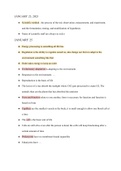
Concepts/Topics 1. Scientific method and hypothesis formation. 2. Seven different properties of life. 3. Themes that unite life. a. How organisms interact with their environment and role of energy. b. How form relates to function. c. The cell as the basic unit of life. d. DNA, inheritance and gene expression. e. Classifying molecular biology via “-omics”. f. Mechanisms of regulating systems. g. Classification of life. h. Evolution as the central theme to life. 4. Characteristics ...
- Notas de lectura
- • 27 páginas's •
-
State University Of New York Oswego•BIO 120
Vista previa 3 fuera de 27 páginas
Preparando tu documento...
Concepts/Topics 1. Scientific method and hypothesis formation. 2. Seven different properties of life. 3. Themes that unite life. a. How organisms interact with their environment and role of energy. b. How form relates to function. c. The cell as the basic unit of life. d. DNA, inheritance and gene expression. e. Classifying molecular biology via “-omics”. f. Mechanisms of regulating systems. g. Classification of life. h. Evolution as the central theme to life. 4. Characteristics ...
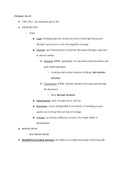
Concepts/Topics 1. Know the characteristics of microscopy and cell fractionation and how they can be used to study cells. 2. Characteristics of prokaryotic and eukaryotic cells and what makes animal and plant cells different. 3. Characteristics of the nucleus. 4. Ribosome characteristics. 5. Endomembrane system – know the characteristics and functions of each component and how the system is specifically organized for shuttling molecules within the cell. 6. Mitochondria and chloroplasts ...
- Notas de lectura
- • 25 páginas's •
-
State University Of New York Oswego•BIO 120
Vista previa 3 fuera de 25 páginas
Preparando tu documento...
Concepts/Topics 1. Know the characteristics of microscopy and cell fractionation and how they can be used to study cells. 2. Characteristics of prokaryotic and eukaryotic cells and what makes animal and plant cells different. 3. Characteristics of the nucleus. 4. Ribosome characteristics. 5. Endomembrane system – know the characteristics and functions of each component and how the system is specifically organized for shuttling molecules within the cell. 6. Mitochondria and chloroplasts ...
Art and Science of Advanced Practice NursingArt and Science of Advanced Practice NursingArt and Science of Advanced Practice NursingArt and Science of Advanced Practice Nursing
- Examen
- • 531 páginas's •
-
State University Of New York Oswego•exams
Vista previa 4 fuera de 531 páginas
Preparando tu documento...
Art and Science of Advanced Practice NursingArt and Science of Advanced Practice NursingArt and Science of Advanced Practice NursingArt and Science of Advanced Practice Nursing
Test bank for Psychology Modules for Active Learning, 12th EditionTest bank for Psychology Modules for Active Learning, 12th EditionTest bank for Psychology Modules for Active Learning, 12th EditionTest bank for Psychology Modules for Active Learning, 12th EditionTest bank for Psychology Modules for Active Learning, 12th Edition
- Examen
- • 160 páginas's •
-
State University Of New York Oswego•exams
Vista previa 4 fuera de 160 páginas
Preparando tu documento...
Test bank for Psychology Modules for Active Learning, 12th EditionTest bank for Psychology Modules for Active Learning, 12th EditionTest bank for Psychology Modules for Active Learning, 12th EditionTest bank for Psychology Modules for Active Learning, 12th EditionTest bank for Psychology Modules for Active Learning, 12th Edition