State University Of New York - Binghamton
Las últimas cargas en State University Of New York - Binghamton. ¿Buscando notas en State University Of New York - Binghamton? Tenemos muchas notas, guias de estudio y notas de estudio disponsible para tu escuela.
-
411
- 0
-
19
All courses for State University Of New York - Binghamton
-
BIO113 BIO113 2
-
Calculus I - MATH 224 MATH224 2
-
Chem 231 Chem 231 1
-
NUR 2092NUR 2092 Health Assessment Exam 1 Study Guide NUR 2092NUR 2092 Health Assessment Exam 1 Study Guide 1
-
Organic Chemistry 2 CHEM 332 1
-
Organic Chemistry I CHEM 231 1
-
Pre-Health Biochemistry BIOL 304 1
-
PSYC 111 PSYC 111 2
-
PSYC 228 PSYC 228 1
-
TEST BANKS 25
-
VSim for Nursing | Marvin Hayes 1
Libros populares State University Of New York - Binghamton

Roy F. Baumeister, Brad Bushman • ISBN 9781305673540
Francis A. Carey, Robert M. Giuliano, Neil Thomas Allison, Susan L. Bane Tuttle • ISBN 9781260148923
Último contenido State University Of New York - Binghamton
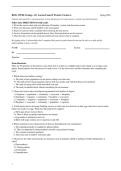
Midterm Review N320 (Binghamton University - Decker College of Nursing and Health Sciences course Nurs 320) Questions With Complete Solutions
- Examen
- • 27 páginas's •
-
State University Of New York - Binghamton•N320
Vista previa 3 fuera de 27 páginas
Preparando tu documento...
Midterm Review N320 (Binghamton University - Decker College of Nursing and Health Sciences course Nurs 320) Questions With Complete Solutions
1. The last common ancestor of all animals was probably a ________. 
A) unicellular chytrid 
B) unicellular yeast 
C) multicellular algae 
D) multicellular fungus 
E) flagellated protist - Answer E) flagellated protist 
 
1. What synapomorphy distinguishes animals as a monophyletic group, distinct from choanoflagellates? 
A) Sexual reproduction 
B) Heterotrophy 
C) Multicellularity 
D) No cell walls - Answer C) Multicellularity 
 
1. The evolution of animal species has been prolific. Much ...
- Examen
- • 20 páginas's •
-
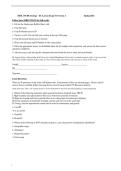
State University Of New York - Binghamton•Bio 114
Vista previa 3 fuera de 20 páginas
Preparando tu documento...
1. The last common ancestor of all animals was probably a ________. 
A) unicellular chytrid 
B) unicellular yeast 
C) multicellular algae 
D) multicellular fungus 
E) flagellated protist - Answer E) flagellated protist 
 
1. What synapomorphy distinguishes animals as a monophyletic group, distinct from choanoflagellates? 
A) Sexual reproduction 
B) Heterotrophy 
C) Multicellularity 
D) No cell walls - Answer C) Multicellularity 
 
1. The evolution of animal species has been prolific. Much ...
What are the key traits that define eukaryotes? - Answer - very diverse lineage 
- diverse morphology (uni- and multicellular, range in size) 
- diverse reproduction (asexually by mitosis, sexually by meiosis) 
- membrane-bound organelles & DNA (nucleus) 
- linear chromosomes 
 
How did the nuclear envelope evolve? - Answer Increased infoldings of prokaryotic plasma membranes led to the evolution of the nucleus and evolution by natural selection. 
 
What are the advantages of infoldings? -...
- Package deal
- Examen
- • 4 páginas's •
-
State University Of New York - Binghamton•Bio 114
-
Bio 114 EXAM PACKAGE DEAL WITH A GUARANTEED PASS!!• Por TestSolver9
Vista previa 1 fuera de 4 páginas
Preparando tu documento...
What are the key traits that define eukaryotes? - Answer - very diverse lineage 
- diverse morphology (uni- and multicellular, range in size) 
- diverse reproduction (asexually by mitosis, sexually by meiosis) 
- membrane-bound organelles & DNA (nucleus) 
- linear chromosomes 
 
How did the nuclear envelope evolve? - Answer Increased infoldings of prokaryotic plasma membranes led to the evolution of the nucleus and evolution by natural selection. 
 
What are the advantages of infoldings? -...
Cell Theory - Answer All organisms are made of cells, and all cells come from pre-existing cells. 
 
Conclusion: If you trace a cell's lineage back far enough, you will discover that all cells are descended from a common ancestral cell 
 
Evolution - Answer The heritable change in a population over time or a change in gene frequency in a population over a number of 
generations 
 
Proximate process - Answer what happens in short term, measured in fractions of lifetimes 
 
Ultimate pr...
- Package deal
- Examen
- • 43 páginas's •
-
State University Of New York - Binghamton•Bio 114
-
Bio 114 EXAM PACKAGE DEAL WITH A GUARANTEED PASS!!• Por TestSolver9
Vista previa 4 fuera de 43 páginas
Preparando tu documento...
Cell Theory - Answer All organisms are made of cells, and all cells come from pre-existing cells. 
 
Conclusion: If you trace a cell's lineage back far enough, you will discover that all cells are descended from a common ancestral cell 
 
Evolution - Answer The heritable change in a population over time or a change in gene frequency in a population over a number of 
generations 
 
Proximate process - Answer what happens in short term, measured in fractions of lifetimes 
 
Ultimate pr...
Contrivance - Answer an adaptation that is a result of the modification of a previous ancestor 
 
Adaptation - Answer A trait that helps an organism survive and reproduce 
 
Exaptation - Answer evolutionary adaptation of an existing structure for a completely new purpose 
 
Vestigial Trait - Answer A trait inherited from a common ancestor but is no longer used 
 
dipliod cell - Answer cell that has 2 copies of each chromosome, one from egg, one from sperm (46) 
 
Hapliod - Answer ...
- Package deal
- Examen
- • 8 páginas's •
-
State University Of New York - Binghamton•Bio 114
-
Bio 114 EXAM PACKAGE DEAL WITH A GUARANTEED PASS!!• Por TestSolver9
Vista previa 2 fuera de 8 páginas
Preparando tu documento...
Contrivance - Answer an adaptation that is a result of the modification of a previous ancestor 
 
Adaptation - Answer A trait that helps an organism survive and reproduce 
 
Exaptation - Answer evolutionary adaptation of an existing structure for a completely new purpose 
 
Vestigial Trait - Answer A trait inherited from a common ancestor but is no longer used 
 
dipliod cell - Answer cell that has 2 copies of each chromosome, one from egg, one from sperm (46) 
 
Hapliod - Answer ...
What is the branch of biology dealing 
with the processes, 
activities, and 
phenomena characteristic of life? - Answer physiology 
 
What are the common activities that must be carried out to sustain life? - Answer 1. Obtain materials with which to construct the body. 
2. Obtain energy for construction, maintenance, and reproduction. 
3. Exchange gases, principally carbon dioxide and oxygen, with the environment. 
4. Regulate body composition by eliminating excess or undesirable mat...
- Package deal
- Examen
- • 4 páginas's •
-
State University Of New York - Binghamton•Bio 114
-
Bio 114 EXAM PACKAGE DEAL WITH A GUARANTEED PASS!!• Por TestSolver9
Vista previa 1 fuera de 4 páginas
Preparando tu documento...
What is the branch of biology dealing 
with the processes, 
activities, and 
phenomena characteristic of life? - Answer physiology 
 
What are the common activities that must be carried out to sustain life? - Answer 1. Obtain materials with which to construct the body. 
2. Obtain energy for construction, maintenance, and reproduction. 
3. Exchange gases, principally carbon dioxide and oxygen, with the environment. 
4. Regulate body composition by eliminating excess or undesirable mat...
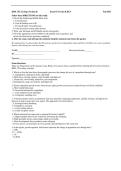
Milstein's group in 1972 used a cell free mRNA synthesis that showed when RER is added to the in vitro the protein is 20+ amino acids shorter than the mixture without RER. This was critical to the discovery of: 
hondrial targeting sequences 
b. signal peptidases/signal sequences 
c.SRP/SRP receptor 
d. Role of GTP/GDP in the RER protein synthesis 
e. Importance of trans-membrane potential across RER membrane and the role in protein synthesis - Answer Signal peptidases/ signal sequences 
 ...
- Examen
- • 22 páginas's •
-
State University Of New York - Binghamton•BIOL 311
Vista previa 3 fuera de 22 páginas
Preparando tu documento...
Milstein's group in 1972 used a cell free mRNA synthesis that showed when RER is added to the in vitro the protein is 20+ amino acids shorter than the mixture without RER. This was critical to the discovery of: 
hondrial targeting sequences 
b. signal peptidases/signal sequences 
c.SRP/SRP receptor 
d. Role of GTP/GDP in the RER protein synthesis 
e. Importance of trans-membrane potential across RER membrane and the role in protein synthesis - Answer Signal peptidases/ signal sequences 
 ...
Microtubules - Answer Involved in mitosis and in non-dividing cell often radiate out from a MTOC (microtubule organizing center) 
 
How much of proteins do actin filaments make up - Answer 10% in muscle cells, 1-5% in normal cells, most abundant protein in muscle cells 
 
Molecular weight of actin filaments - Answer 42000 - G-actin (globular) 
 
How many actin genes are there - Answer 6 in humans that each encode an isoform 
 
Alpha actin - Answer Associated with contractile struc...
- Package deal
- Examen
- • 23 páginas's •
-
State University Of New York - Binghamton•BIOL 311
-
BIOL 311 Exam( Binghamton)Questions And Correct Answers Bundle Graded A+.• Por TestSolver9
Vista previa 3 fuera de 23 páginas
Preparando tu documento...
Microtubules - Answer Involved in mitosis and in non-dividing cell often radiate out from a MTOC (microtubule organizing center) 
 
How much of proteins do actin filaments make up - Answer 10% in muscle cells, 1-5% in normal cells, most abundant protein in muscle cells 
 
Molecular weight of actin filaments - Answer 42000 - G-actin (globular) 
 
How many actin genes are there - Answer 6 in humans that each encode an isoform 
 
Alpha actin - Answer Associated with contractile struc...
Lysosomes and proteasomes - Answer -Both degrade molecules, especially proteins 
 
Christian de Duve - Answer -Won Nobel Prize for discovering lysosomes 
-1955 
-First to use a centrifuge to purify organelles 
-Created pellets (intact vs injured) 
-Intact showed respiratory activity due to mitochondria, injured showed hydrolytic activity due to lysosomes 
 
Lysosomes - Answer -Contain hydrolytic enzymes 
-Cleave to degrade most normal molecules/proteins 
-Enzymes not typical. Optimum p...
- Package deal
- Examen
- • 12 páginas's •
-
State University Of New York - Binghamton•BIOL 311
-
BIOL 311 Exam( Binghamton)Questions And Correct Answers Bundle Graded A+.• Por TestSolver9
Vista previa 2 fuera de 12 páginas
Preparando tu documento...
Lysosomes and proteasomes - Answer -Both degrade molecules, especially proteins 
 
Christian de Duve - Answer -Won Nobel Prize for discovering lysosomes 
-1955 
-First to use a centrifuge to purify organelles 
-Created pellets (intact vs injured) 
-Intact showed respiratory activity due to mitochondria, injured showed hydrolytic activity due to lysosomes 
 
Lysosomes - Answer -Contain hydrolytic enzymes 
-Cleave to degrade most normal molecules/proteins 
-Enzymes not typical. Optimum p...
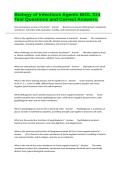
Dark Specimen, bright viewing field requires staining 
Pathologist, histologist, cytochemistry 
Iden - Answer 1. Bright field microscopy/compound light microscopy 
 
isolate the tissue or organ, choose a fixative that cross-links protein (formaldehyde), remove water and the fixative, replacing it with ethanol, replace ethanol with xylene, replace with molten paraffin and let solidify, cut 10–15-micron sections, remove the wax by doing the above steps in reverse, and stain with dye - Answer...
- Package deal
- Examen
- • 13 páginas's •
-
State University Of New York - Binghamton•BIOL 311
-
BIOL 311 Exam( Binghamton)Questions And Correct Answers Bundle Graded A+.• Por TestSolver9
Vista previa 2 fuera de 13 páginas
Preparando tu documento...
Dark Specimen, bright viewing field requires staining 
Pathologist, histologist, cytochemistry 
Iden - Answer 1. Bright field microscopy/compound light microscopy 
 
isolate the tissue or organ, choose a fixative that cross-links protein (formaldehyde), remove water and the fixative, replacing it with ethanol, replace ethanol with xylene, replace with molten paraffin and let solidify, cut 10–15-micron sections, remove the wax by doing the above steps in reverse, and stain with dye - Answer...