
Stem Early College
Las últimas cargas en Stem Early College. ¿Buscando notas en Stem Early College? Tenemos muchas notas, guias de estudio y notas de estudio disponsible para tu escuela.
-
16
- 0
- 0
All courses for Stem Early College
Último contenido Stem Early College

Muscular system - Muscle cells are found in every organ in the body and participate in every activity that requires movement. Together, they constitute nearly half of our body mass. The most obvious are the skeletal muscles that attach to the skeleton and give us strength and mobility. There are 3 types of muscles in our body: 1. Skeletal muscles: sculpt the body and contribute to our sense of attractiveness and well-being. Some of the smallest skeletal muscles control the focus of our ...
- Otro
- • 30 páginas's •
-
Stem Early College•BIOLOGY MISC
Endocrine system - An animal hormone is a chemical signal that is secreted into the extracellular fluid, circulates in the blood or hemolymph, and communicates regulatory messages within the body. ○ A hormone may reach all parts of the body, but only specific target cells have the receptors that enable a response. ○ A given hormone traveling in the bloodstream elicits specific responses— such as a change in metabolism—only from its target cells while other cells are unaffected. ...
- Examen
- • 34 páginas's •
-
Stem Early College•BIOLOGY MISC

The skeletal system comprises three types of connective tissue—bones, ligaments, and cartilage. • Bones are the hard elements of the skeleton with which we are most familiar. • Ligaments consist of dense fibrous connective tissue—they bind the bones to each other. • Cartilage is a specialized connective tissue consisting primarily of fibers of collagen and elastic in a gel-like fluid called ground substance. Cartilage has several functions, including reducing friction in joint...
- Examen
- • 33 páginas's •
-
Stem Early College•BIOLOGY MISC
Mammalian Circulation Let’s first examine the overall organization of the mammalian cardiovascular system, beginning with the pulmonary circuit. 1. Contraction of the right ventricle pumps blood to the lungs via the 2. pulmonary arteries. As the blood flows through 3. capillary beds in the left and right lungs, it loads O2 and unloads CO2. Oxygen-rich blood returns from the lungs via the pulmonary veins to the 4. left atrium of the heart. Next, the oxygen-rich blood flows into ...
- Examen
- • 31 páginas's •
-
Stem Early College•BIOLOGY MISC

Concept and importance of excretion: All biological processes that occur in the bodies of all living organisms are carried out through chemical reactions that leave some waste products. The living organism must get rid of these waste products as soon as they are formed, otherwise it will cause many problems and infections. - Excretion: the process by which the living organisms get rid of these waste products. Excretion in Animals Excretion refers to the materials that leave the body throu...
- Examen
- • 25 páginas's •
-
Stem Early College•BIOLOGY MISC

The parts of the immune system are scattered, means its parts are not linked to each other in anatomical succession as that in digestive system, respiratory system or circulatory system, it consists of different parts throughout the body, but they interact and cooperate with each other in a coordinated manner. The Lymphoid organs These organs contain large numbers of lymphocytes where maturation and differentiation of lymphocytes take place, from these organs: 1. Bone marrow It is a tiss...
- Examen
- • 40 páginas's •
-
Stem Early College•BIOLOGY MISC

In mammals, a system of branching ducts conveys air to the lungs, which are located in the thoracic cavity. • Air enters through the nostrils and is then filtered by hairs, warmed, humidified, and sampled for odors as it flows through a maze of spaces in the nasal cavity. • The nasal cavity leads to the pharynx, an intersection where the paths for air and food cross. When food is swallowed, the larynx (the upper part of the respiratory tract) moves upward and tips the epiglottis over ...
- Examen
- • 12 páginas's •
-
Stem Early College•BIOLOGY MISC
- Muscle cells are found in every organ in the body and participate in every activity that requires movement. Together, they constitute nearly half of our body mass. The most obvious are the skeletal muscles that attach to the skeleton and give us strength and mobility. There are 3 types of muscles in our body: 1. Skeletal muscles: sculpt the body and contribute to our sense of attractiveness and well-being. Some of the smallest skeletal muscles control the focus of our eyes; some of the...
- Otro
- • 30 páginas's •
-
Stem Early College•BIOLOGY MISC

The skeletal system consists of connective tissue - The skeletal system comprises three types of connective tissue—bones, ligaments, and cartilage. • Bones are the hard elements of the skeleton with which we are most familiar. • Ligaments consist of dense fibrous connective tissue—they bind the bones to each other. • Cartilage is a specialized connective tissue consisting primarily of fibers of collagen and elastic in a gel-like fluid called ground substance. Cartilage has sev...
- Caso
- • 33 páginas's •
-
Stem Early College•BIOLOGY MISC

Endocrine system - An animal hormone is a chemical signal that is secreted into the extracellular fluid, circulates in the blood or hemolymph, and communicates regulatory messages within the body. ○ A hormone may reach all parts of the body, but only specific target cells have the receptors that enable a response. ○ A given hormone traveling in the bloodstream elicits specific responses— such as a change in metabolism—only from its target cells while other cells are unaffected. ...
- Examen
- • 34 páginas's •
-
Stem Early College•BIOLOGY MISC
- Concept and importance of excretion: All biological processes that occur in the bodies of all living organisms are carried out through chemical reactions that leave some waste products. The living organism must get rid of these waste products as soon as they are formed, otherwise it will cause many problems and infections. - Excretion: the process by which the living organisms get rid of these waste products. Excretion in Animals Excretion refers to the materials that leave the body thr...
- Otro
- • 25 páginas's •
-
Stem Early College•BIOLOGY MISC

Mammalian Circulation Let’s first examine the overall organization of the mammalian cardiovascular system, beginning with the pulmonary circuit. 1. Contraction of the right ventricle pumps blood to the lungs via the 2. pulmonary arteries. As the blood flows through 3. capillary beds in the left and right lungs, it loads O2 and unloads CO2. Oxygen-rich blood returns from the lungs via the pulmonary veins to the 4. left atrium of the heart. Next, the oxygen-rich blood flows into ...
- Otro
- • 31 páginas's •
-
Stem Early College•BIOLOGY MISC

In mammals, a system of branching ducts conveys air to the lungs, which are located in the thoracic cavity. • Air enters through the nostrils and is then filtered by hairs, warmed, humidified, and sampled for odors as it flows through a maze of spaces in the nasal cavity. • The nasal cavity leads to the pharynx, an intersection where the paths for air and food cross. When food is swallowed, the larynx (the upper part of the respiratory tract) moves upward and tips the epiglottis over ...
- Otro
- • 12 páginas's •
-
Stem Early College•BIOLOGY MISC

5. The lymph nodes - The lymph nodes present along network of the lymphatic vessels that located in all the body parts under the armpits, at the two sides of the neck ,in upper thigh, and near the internal body’s organs. Their size ranging from a pinhead, to the seed of small beans. The node is divided internally into pockets filled with B- lymphocytes, T- lymphocytes, and macrophages and some other types of white blood cells that get rid of germs and the debris cells. • They purify ...
- Examen
- • 40 páginas's •
-
Stem Early College•BIOLOGY MISC

y Today’s Inquiry Questions How and why did the Ottoman Empire develop and expand from 1450 to 1750? ● What methods did Ottoman Sultans (rulers) use to legitimize and consolidate power in the Ottoman Empire? Part I: Ottoman Development and Expansion Document Based on this document, how and/or why did the Ottoman Empire develop and expand from 1450 to 1750? 1 Map of Ottoman Expansion The Ottoman Empire is a land-based empire which followed parts of the Silk Road and the Trans-Sahar...
- Examen
- • 3 páginas's •
-
Stem Early College•HISTORY MIS
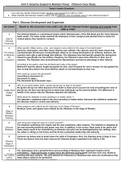
Part I: Ottoman Development and Expansion Document Based on this document, how and/or why did the Ottoman Empire develop and expand from 1450 to 1750? 1 Map of Ottoman Expansion The Ottoman Empire is a land-based empire which followed parts of the Silk Road and the Trans-Saharan trade routes. The trade routes assisted the Ottomans in their conquest and allowed them to reach the various places they wanted to conquer. 2 The History of Mehmed the Conqueror What specific military tact...
- Examen
- • 3 páginas's •
-
Stem Early College•HISTORY MISC