NSG 210

West Kentucky Community And Technical College

Aquí están los mejores recursos para pasar NSG 210. Encuentra NSG 210 guías de estudio, notas, tareas, y mucho más.

All 39 resultados

Ordenador por:
Chapter 21, Caring for Clients With Lower Respiratory Disorders
  • Examen

    Chapter 21, Caring for Clients With Lower Respiratory Disorders

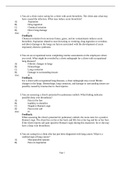
  • 1.You are a clinic nurse caring for a client with acute bronchitis. The client asks what may have caused the infection. What may induce acute bronchitis? A) Aspiration B) Drug ingestion C) Chemical irritation D) Direct lung damage Ans: C Feedback: Chemical irritation from noxious fumes, gases, and air contaminants induces acute bronchitis. Aspiration related to near drowning or vomiting, drug ingestion or overdose, and direct damage to the lungs are factors associated with the developm...
  • greatsolutions
    $9.99 Más información
Chapter 26, Caring for Clients With Cardiac Dysrhythmias.
  • Examen

    Chapter 26, Caring for Clients With Cardiac Dysrhythmias.

  • 1.You are caring for a client who has premature ventricular contractions. What sign or symptom is observed in this client? A) Fluttering B) Nausea C) Hypotension D) Fever Ans: A Feedback: Premature ventricular contractions usually cause a flip-flop sensation in the chest, sometimes described as “fluttering.” Associated signs and symptoms include pallor, nervousness, sweating, and faintness. Symptoms of premature ventricular contractions are not nausea, hypotension, and fever. 2.A...
  • greatsolutions
    $9.99 Más información
Chapter 18, Caring for Clients With Cancer
  • Examen

    Chapter 18, Caring for Clients With Cancer

  • 1.Which of the following advice does the nurse offer clients who are undergoing unsealed radiation therapy to reduce exposure? A) Avoid drinking plenty of fluids. B) Avoid eating for 3 hours after therapy. C) Avoid applying skin moisturizers. D) Avoid kissing and sexual contact. Ans: D Feedback: Clients who are undergoing unsealed radiation therapy are advised to avoid kissing and sexual contact due to the spread of radioactivity. Clients are encouraged to drink plenty of fluids to hel...
  • greatsolutions
    $8.99 Más información
Chapter 25, Caring for Clients With Disorders of Coronary
  • Examen

    Chapter 25, Caring for Clients With Disorders of Coronary

  • 1.You are caring for a client with coronary artery disease (CAD). What is an appropriate nursing action when evaluating a client with CAD? A) Assess the client's mental and emotional status. B) Assess the skin of the client. C) Assess the characteristics of chest pain. D) Assess for any kind of drug abuse. Ans: C Feedback: The nurse should assess the characteristics of chest pain for a client with CAD. Assessing the client's mental and emotional status, skin, or for drug abuse will no...
  • greatsolutions
    $8.99 Más información
Chapter 30, Introduction to the Hematopoietic and Lymphatic Systems.
  • Examen

    Chapter 30, Introduction to the Hematopoietic and Lymphatic Systems.

  • 1.You are caring for three clients who have the following blood count values: Client A has 24,500/mm3 white blood cells (WBCs), client B has 13.4 g/dL hemoglobin, and client C has a 250,000/mm3 platelet count. Which statement correctly describes the condition of each client? A) Client A has a normal WBC count, client B has a higher hemoglobin count than normal, and client C has a normal platelet count. B) Client A has a higher WBC count than normal, client B has a normal hemoglobin co...
  • greatsolutions
    $8.99 Más información
Chapter 20, Caring for Clients With Upper Respiratory Disorders
  • Examen

    Chapter 20, Caring for Clients With Upper Respiratory Disorders

  • 1.You are caring for a client who is post–sinus surgery. When you assess this client, you ask him how many fingers you are holding up. Why do you assess postoperative visual acuity? A) To assess possible hemorrhage B) To assess damage to the optic nerve C) To assess postoperative infection D) To assess impaired drainage Ans: B Feedback: A client who has undergone a sinus surgery faces a serious risk of damage to the optic nerve. Therefore, the nurse assesses postoperative visual acui...
  • greatsolutions
    $8.99 Más información
Chapter 32, Caring for Clients With Disorders of the Lymphatic System
  • Examen

    Chapter 32, Caring for Clients With Disorders of the Lymphatic System

  • 1.The family nurse practitioner is performing a physical assessment on a client with a suspected lymphatic disorder. What would be the nurse practitioner's primary assessment for all clients with lymphatic disorders? A) Fever and sore throat B) Painful joints C) Signs of leukopenia and thrombocytopenia D) Enlargement of the lymph glands Ans: D Feedback: Most of the disorders related to the lymph glands cause an inflammation of the lymph nodes. As a result, the nurse should assess the ...
  • greatsolutions
    $8.99 Más información
Chapter 27, Caring for Clients With Hypertension
  • Examen

    Chapter 27, Caring for Clients With Hypertension

  • 1.A client has just been diagnosed with prehypertension. What would the nurse instruct this client to do to restore his blood pressure below hypertensive levels? A) Increase iodine intake. B) Decrease sodium intake. C) Increase fluid intake. D) Avoid over-the-counter decongestants. Ans: B Feedback: The nurse should instruct clients with prehypertension to avoid or decrease sodium and iodine intake. Increasing fluid intake raises circulating blood volume and systemic vascular resistance...
  • greatsolutions
    $9.99 Más información
Chapter 42, Caring for Clients With Eye Disorders.
  • Examen

    Chapter 42, Caring for Clients With Eye Disorders.

  • 1.A client is diagnosed with blepharitis. What symptoms should a nurse monitor in this client? A) Patchy flakes clinging to the eyelashes B) A red pustule in the internal tissue of the eyelid C) Redness surrounding the conjunctival sac D) A halo around the pupil Ans: A Feedback: Blepharitis is an inflammation of the lid margins. The nurse monitors visible patchy flakes clinging to the eyelashes and about the lids. The condition does not cause redness or a halo around the pupil. In case...
  • greatsolutions
    $9.99 Más información
Chapter 36, Introduction to the Nervous System
  • Examen

    Chapter 36, Introduction to the Nervous System

  • 1.The family nurse practitioner is performing the physical examination of a client with a suspected neurologic disorder. In addition to assessing other parts of the body, the nurse should assess for neck rigidity. Which method should help the nurse assess for neck rigidity correctly? A) Moving the head toward both sides B) Lightly tapping the lower portion of the neck to detect sensation C) Moving the head and chin toward the chest D) Gently pressing the bones on the neck Ans: C Feedbac...
  • greatsolutions
    $8.99 Más información
Y así es como ganas dinero extra
¿Sabías que, de media, un vendedor en Stuvia gana 76 euros al mes con la venta de recursos de estudio? Hmm, pista, pista.