
NURSING MED SURG 3
Chamberlain College Nursing
Aquí están los mejores recursos para pasar NURSING MED SURG 3. Encuentra NURSING MED SURG 3 guías de estudio, notas, tareas, y mucho más.

Examen
RN Pharmacology Online Practice 2016 B Flashcards _ Quizlet
A nurse is planning to care for a client who has hypertension and is to start taking metoprolol. Which of the following interventions should the nurse include in the plan of care? A.) Weigh the client weekly B.) Determine apical pulse prior to administering B.) Determine apical pulse prior to administering 8/15/2017 RN Pharmacology Online Practice 2016 B Flashcards | Quizlet C.) Administer the medication 30 min prior to breakfast D.) Monitor the client for jaundice A nurse ...
 Havilah
Examen
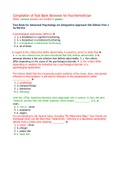
Test Bank for Abnormal Psychology An Integrative Approach 6th Edition Part 1 by Barlow
PopularA psychological dysfunction refers to 1. a. a breakdown in cognitive functioning. 2. b. a breakdown in emotional functioning. 3. c. a breakdown in behavioral functioning. 4. d. all of these In regard to the criteria that define abnormality, it would be correct to state that 1. a. no one criterion has yet been developed that fully defines abnormality. 2. b. personal distress is the one criterion that defines abnormality. 3. c. the criteria differ depending on the cause of the psychologi...
Havilah
Examen
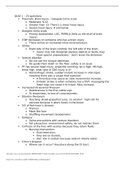
NURSING MED SURG 3 Quizzes Medsurg
Traumatic Brain Injury – Glasgow Coma scale o Moderate: 9-12 o Greater than 13: There’s a minor head injury o Severe head injury: 8 and below Glasgow coma scale o Priority assessment: LOC, PERRLA (tells us the level of brain injury) If BP decreases on someone who has a brain injury o There will be an increased intracranial pressure. Stroke o Right side of the brain controls: the left side of the brain. Injury: may not recognize obvious objects or faces, may have s...
Havilah
Examen
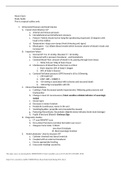
Neuro Exam Study Guide Spring A GRADED
Intracranial Pressure and Head Injuries A. Factors that influence ICP a. Arterial and Venous pressure b. Intraabdominal and intrathoracic pressure c. Posture- Patient should not be lying flat (positioning important) 30 degrees with head in the midline d. Temperature- Keep room temp (Avoid shivering and rigors) e. Blood gases – Co2 dilates blood vessels which increase volume of blood in brain and increase ICP B. Important Values a. Normal ICP 5 to 15 mmHg- Elevated if > 20 mmHg b....
Havilah