

University of St Andrews
Las últimas cargas en University of St Andrews. ¿Buscando notas en University of St Andrews? Tenemos muchas notas, guias de estudio y notas de estudio disponsible para tu escuela.
-
136
- 0
-
6
Estudios @ University of St Andrews
Notas disponibles para los estudios siguiente en University of St Andrews
-
Biochemistry 1
-
French Literature 1
-
Medicine 52
-
University of St Andrews 2
Último contenido University of St Andrews

Homeostasis Element Learning Outcomes: -Describe the structural hierarchy of the human body -Explain the importance of physiological control systems -Explain the importance of controlling the extracellular fluid -Explain the meaning of homeostasis -Describe, using physiological examples, the process of homeostatic control -List the major features of homeostatic control systems
- Notas de lectura
- • 2 páginas's •
-
University of St Andrews•MD2001

Homeostatic Control of Body Temperature Element Learning Outcomes: -Identify and explain the involvement of the main physiological components of the homeostatic control of body temperature temperature control. -Define what a pyrogen is, explain how pyrogens arise explain their basic mechanism of inducing a fever -Explain the causes of, and differences between, a fever and other forms of hyperthermia -Use control of body temperature as an example to describe homeostatic negative feedback con...
- Notas de lectura
- • 1 páginas's •
-
University of St Andrews•MD2001

Ion Channels and Disease Element Learning Outcomes: -Identify the importance of studying ion channels -Describe the key experimental techniques used to measure current flow through ion channels -Interpret the types of information we can obtain from single channel measurements -Describe examples of channel mutations that result in alterations in single channel function and cause pathologies
- Notas de lectura
- • 1 páginas's •
-
University of St Andrews•MD2001
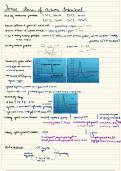
Ionic Basis of Action Potential Element Learning Outcomes: -Define Na+ and K+ equilibrium potential, depolarisation, repolarisation and hyperpolarisation -Compare the response of electrically excitable and inexcitable cells to depolarisation -Describe the main characteristics of an action potential -Describe the relationship between the changes in membrane permeability and membrane voltage -Explain the role of voltage-gated and time-dependent Na and K channels in the action potential
- Notas de lectura
- • 1 páginas's •
-
University of St Andrews•MD2001
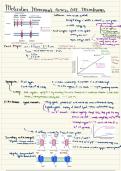
Molecular Movement Across Cell Membranes Element Learning Outcomes: -Explain the key role that the lipid bilayer plays in determining trans-membrane diffusion and maintaining a concentration gradient. -Compare and contrast passive, carrier mediated of facilitated transport and active transport and explain, using examples of molecules which are transported using these mechanisms and be able to explain how these movements may be interrelated -Describe the role played by the permeability consta...
- Notas de lectura
- • 2 páginas's •
-
University of St Andrews•MD2001

Neurotransmitters Element Learning Outcomes: -Define the characteristics of a neurotransmitter, including the main methods of inactivation and explain how the variety of receptors gives scope to the neurotransmitter function. -Recall the normal major functions of the key neurotransmitters within the major classes. -Illustrate that abnormalities of specific neurotransmitter systems can cause specific diseases by the use of named examples. -Provide examples of how synthetic drugs can exert a ...
- Notas de lectura
- • 2 páginas's •
-
University of St Andrews•MD2001

Spread of the Nerve Impulse Element Learning Outcomes: -Define the cells of the nervous system and explain their function. -Describe the key structural features of a typical neuron. -Explain the role of (i) nerve diameter and (ii) capacitance of the plasma membrane in the transmission of signal along a neuron. -Describe the ionic events which underpin the action potential. -Define how the action potential is propagated in terms of: i. Direction (refractory periods), ii. Frequency (multiple...
- Notas de lectura
- • 1 páginas's •
-
University of St Andrews•MD2001
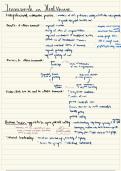
Teamwork in Healthcare Element Learning Outcomes: -Define interprofessional collaborative practice -Identify the drivers for effective teamwork in healthcare -Review the evidence-based benefits of and barriers to effective teamwork -Discuss the concept of shared leadership -Explain the concept of human factors and the important part that teamwork plays in patient safety
- Notas de lectura
- • 1 páginas's •
-
University of St Andrews•MD2001

Intro to Global Health Element Learning Outcomes: -Describe the scope of global health -Describe the impact of globalisation on health -Describe the nature and drivers of global health inequalities -Identify the key drivers in the global health agenda
- Notas de lectura
- • 1 páginas's •
-
University of St Andrews•MD2001

Intro to Health Promotion Element Learning Outcomes: -Define health promotion -Distinguish between the risk behaviour and risk context approaches to health promotion -Distinguish between top-down and bottom-up approaches to health promotion -Describe the 5 approaches to health promotion -Describe the role of empowerment in bottom-up health promotion
- Notas de lectura
- • 2 páginas's •
-
University of St Andrews•MD2001
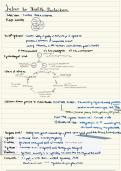
Introduction to Health Protection Element Learning Outcomes: -Understand principles of disease transmission -Know the definition of sporadic, endemic, epidemic, pandemic -Understand the concept of chain of infection -Be able to describe the principles of control of communicable disease including definition of an outbreak -Know your responsibility as medical practitioners to notify certain infectious diseases and disease states
- Notas de lectura
- • 2 páginas's •
-
University of St Andrews•MD2001
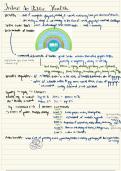
Introduction to Public Health Element Learning Outcomes: Discuss what is meant by the concept of health. Describe the scope of Public Health and the five waves of Public Health practice in the UK. Define the concept of health inequality, and interpret data concerning inequalities in health. Describe the influences on health. Identify approaches to address health inequalities through the social determinants of health.
- Notas de lectura
- • 2 páginas's •
-
University of St Andrews•MD2001

In depth revision notes for 3rd year quantum chemistry
- Notas de lectura
- • 34 páginas's •
-
University of St Andrews•Quantum Theory of Atoms, Molecules and Solids
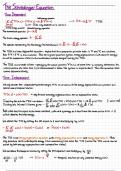
In depth revision notes for 3rd year Quantum mechanics
- Notas de lectura
- • 20 páginas's •
-
University of St Andrews•Quantum Mechanics 1

In depth revision notes for 2nd year physical chemistry
- Notas de lectura
- • 49 páginas's •
-
University of St Andrews•Physical Chemistry 2

In depth revision notes for the thermal part of thermal and statistical mechanics 3rd year
- Notas de lectura
- • 13 páginas's •
-
University of St Andrews•Thermal and Statistical Mechanics

In depth revision notes of third year statistical mechanics
- Notas de lectura
- • 12 páginas's •
-
University of St Andrews•Thermal and Statistical Mechanics

In depth revision notes for 3rd year quantum mechanics
- Notas de lectura
- • 23 páginas's •
-
University of St Andrews•Quantum Mechanics 2

In depth revision notes for waves, electricity and magnetism second year level physics - black background, white writing
- Notas de lectura
- • 53 páginas's •
-
University of St Andrews•Physics 2B
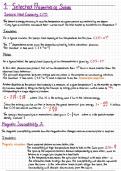
In depth revision notes for introduction to condensed matter physics
- Notas de lectura
- • 32 páginas's •
-
University of St Andrews•Introduction to Condensed Matter Physics