

AQA • A Level Chemistry
Las últimas cargas en A Level Chemistry @ AQA. ¿Buscas apuntes de A Level Chemistry en AQA? Tenemos un montón de apuntes, guías de estudio y notas de estudio disponibles para A Level Chemistry en AQA.
-
1319
-
16
-
179
Cursos A Level Chemistry @ AQA
Notas disponibles para los cursos siguiente de A Level Chemistry en AQA
-
Unit 3.1.3 - Bonding
Último contenido AQA • A Level Chemistry
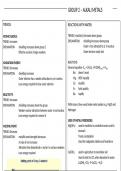
two page summary on the group 2 and group 7, targetted for AQA a level chemistry students, made by A* Chemistry student
- Resumen
- • 2 páginas's •
-
AQA•Unit 3.2.3 - Group 7, the halogens
Vista previa 1 fuera de 2 páginas
Preparando tu documento...
two page summary on the group 2 and group 7, targetted for AQA a level chemistry students, made by A* Chemistry student
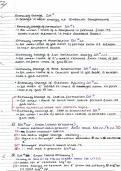
This resource comprehensively covers all the essential information and topics outlined in the AQA specification, providing everything needed to effectively prepare and succeed in your studies.
- Resumen
- • 22 páginas's •
-
AQA•Unit 3.1.8 - Thermodynamics
Vista previa 3 fuera de 22 páginas
Preparando tu documento...
This resource comprehensively covers all the essential information and topics outlined in the AQA specification, providing everything needed to effectively prepare and succeed in your studies.

These notes cover the fundamental concepts of atomic structure, including Atomic Models, Electron Configuration, Periodic Trends and mass spectroscopy. These notes feature clear explanations and diagrams to aid understanding and retention
- Resumen
- • 0 páginas's •
-
AQA•Unit 3.1.1 - Atomic structure
Vista previa 0 fuera de 0 páginas
Preparando tu documento...
These notes cover the fundamental concepts of atomic structure, including Atomic Models, Electron Configuration, Periodic Trends and mass spectroscopy. These notes feature clear explanations and diagrams to aid understanding and retention
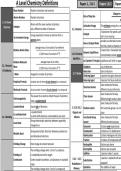
this is a document containing common questions that come up on each chemistry exam paper and has the definitions of every possible vocabulary you can be asked to define. also this helped me so much as i memorised the content on this document using a whiteboard and by that i had memorised most of them and there were some i hadn't known and on my actual exams i got asked a definition i had never known but due to this document i got the full 2 marks or else i had lost them
- Resumen
- • 8 páginas's •
-
AQA•common knowledge
Vista previa 1 fuera de 8 páginas
Preparando tu documento...
this is a document containing common questions that come up on each chemistry exam paper and has the definitions of every possible vocabulary you can be asked to define. also this helped me so much as i memorised the content on this document using a whiteboard and by that i had memorised most of them and there were some i hadn't known and on my actual exams i got asked a definition i had never known but due to this document i got the full 2 marks or else i had lost them

these are the notes you need t0 be able to kick start your journey from gcse to alevel chemistry it has all the basics and helps you ease down from feeling the difference between difficulty gap. it is very detailed and this knowledge is key to ace your whole alevel journey
- Package deal
- Notas de lectura
- • 7 páginas's •
-
AQA•bridging alevel chemistry
-
aqa alevel chemistry all of physical chemistry topics hnadwriiten notes detailed• Poraabubaker1312
Vista previa 1 fuera de 7 páginas
Preparando tu documento...
these are the notes you need t0 be able to kick start your journey from gcse to alevel chemistry it has all the basics and helps you ease down from feeling the difference between difficulty gap. it is very detailed and this knowledge is key to ace your whole alevel journey
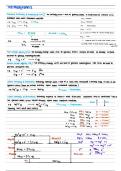
Thermodynamics in A-Level Chemistry involves the study of energy changes, particularly in chemical reactions. Here's a brief summary of the key concepts: 1. Enthalpy (H) Enthalpy Change (ΔH): The heat energy change measured under constant pressure. Exothermic Reactions: Release heat to the surroundings, ΔH is negative (e.g., combustion). Endothermic Reactions: Absorb heat from the surroundings, ΔH is positive (e.g., photosynthesis). 2. Standard Enthalpy Changes Standard Conditions: 2...
- Resumen
- • 6 páginas's •
-
AQA•Unit 3.1.8 - Thermodynamics
Vista previa 2 fuera de 6 páginas
Preparando tu documento...
Thermodynamics in A-Level Chemistry involves the study of energy changes, particularly in chemical reactions. Here's a brief summary of the key concepts: 1. Enthalpy (H) Enthalpy Change (ΔH): The heat energy change measured under constant pressure. Exothermic Reactions: Release heat to the surroundings, ΔH is negative (e.g., combustion). Endothermic Reactions: Absorb heat from the surroundings, ΔH is positive (e.g., photosynthesis). 2. Standard Enthalpy Changes Standard Conditions: 2...
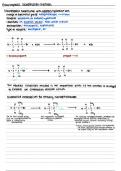
Summary - Organic pathway as (Chem)
- Resumen
- • 12 páginas's •
-
AQA•Organic pathway as
Vista previa 2 fuera de 12 páginas
Preparando tu documento...
Summary - Organic pathway as (Chem)
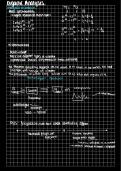
Organic analysis in A-Level Chemistry under the AQA specification involves the identification and characterization of organic compounds using a variety of techniques. Here’s a brief summary of the key aspects: 1. Functional Group Analysis Test for Alkenes: Bromine water test. Alkenes decolorize bromine water (from orange to colorless). Test for Alcohols: Primary and Secondary Alcohols: Oxidation with acidified potassium dichromate (orange to green). Tertiary Alcohols: No reaction with a...
- Resumen
- • 2 páginas's •
-
AQA•Unit 3.3.6 - Organic analysis
Vista previa 1 fuera de 2 páginas
Preparando tu documento...
Organic analysis in A-Level Chemistry under the AQA specification involves the identification and characterization of organic compounds using a variety of techniques. Here’s a brief summary of the key aspects: 1. Functional Group Analysis Test for Alkenes: Bromine water test. Alkenes decolorize bromine water (from orange to colorless). Test for Alcohols: Primary and Secondary Alcohols: Oxidation with acidified potassium dichromate (orange to green). Tertiary Alcohols: No reaction with a...
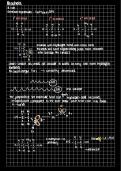
Alcohols are a class of organic compounds characterized by the presence of one or more hydroxyl (-OH) groups attached to a carbon atom. Here are the key points about alcohols relevant to A-level chemistry: Structure and Classification General Formula: The general formula for alcohols is C n H 2 n + 1 O H C n H 2n+1 OH. Functional Group: The defining feature of alcohols is the hydroxyl (-OH) group. Classification: Alcohols are classified based on the number of...
- Resumen
- • 8 páginas's •
-
AQA•Unit 3.3.5 - Alcohols
Vista previa 2 fuera de 8 páginas
Preparando tu documento...
Alcohols are a class of organic compounds characterized by the presence of one or more hydroxyl (-OH) groups attached to a carbon atom. Here are the key points about alcohols relevant to A-level chemistry: Structure and Classification General Formula: The general formula for alcohols is C n H 2 n + 1 O H C n H 2n+1 OH. Functional Group: The defining feature of alcohols is the hydroxyl (-OH) group. Classification: Alcohols are classified based on the number of...
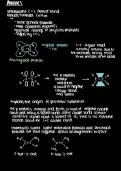
Alkenes are a class of hydrocarbons that contain at least one carbon-carbon double bond (C=C). Here are the key points about alkenes: Structure General Formula: The general formula for alkenes is C n H 2 n C n H 2n , where n n is the number of carbon atoms. Double Bond: The presence of a carbon-carbon double bond defines alkenes. This double bond consists of one sigma (σ) bond and one pi (π) bond. Nomenclature Naming: Alkenes are named by identifying the lo...
- Notas de lectura
- • 8 páginas's •
-
AQA•1.4 alkenes
Vista previa 2 fuera de 8 páginas
Preparando tu documento...
Alkenes are a class of hydrocarbons that contain at least one carbon-carbon double bond (C=C). Here are the key points about alkenes: Structure General Formula: The general formula for alkenes is C n H 2 n C n H 2n , where n n is the number of carbon atoms. Double Bond: The presence of a carbon-carbon double bond defines alkenes. This double bond consists of one sigma (σ) bond and one pi (π) bond. Nomenclature Naming: Alkenes are named by identifying the lo...