

University of Santo Tomas
Las últimas cargas en University of Santo Tomas. ¿Buscando notas en University of Santo Tomas? Tenemos muchas notas, guias de estudio y notas de estudio disponsible para tu escuela.
-
144
-
3
-
2
All courses for University of Santo Tomas
-
Accountancy 0044 1
-
Acct 101 FIN003 23
-
Analysis Of Urine and Body Fluids 1
-
Anatomy 2
-
Anatomy and Physiology 32
-
Biochemistry 1
-
BT4 1
-
Building Technology BT5 1
-
CE226 1
-
Clinical Chemistry 1
-
D10 D10 1
-
Educ104 Edtect2 1
-
ENG 201 - Chemistry and its Applications 1
-
ENG 2010 1
-
ENG 2014 - Differential Equations 1
-
ENG 203-Calculus 1 1
-
ENG 206 - Integral Calculus 1
-
Ethics 1
-
Histopathology 1
-
HOA 2
-
Human Anatomy and Physiology 5
-
ICS2602 ICS2602 1
-
ME 2023 - Thermodynamics 2 3
-
ME 264 - Thermodynamics 1 1
-
ME 268 - Advanced Engineering Mathematics 1
-
Media and Information Literacy 1
-
Medical Biology Biology 10
-
Medicine 2
-
Micro Perspective of Tourism and Hospitality 2
-
MSHRM 4
-
Nursing 5
-
Nutrition 1
-
Parasitology 4
-
Pathology 1
-
Personal Development 1
-
PHA 614 1
-
Pharmaceutical Botany with Taxonomy PHA611 10
-
PHARMACEUTICAL MICROBIOLOGY AND PARASITOLOGY 3
-
PHARMACY INFORMATICS 1
-
Phlebotomy 1
-
PURPCOM 1
-
READ_PH 1
-
Risk Management 1
-
Social Science 1
-
Special Needs SNED7285 1
-
SPN1 1
-
Theories of Personality PSY434 1
-
Thermodynamics Sample Problems 2
-
THM520Macro Perspective of Tourism and Hospitality THM5202 1
-
THY1 1
Último contenido University of Santo Tomas
The text discusses how nerve impulses travel along nerve pathways. There are four main steps involved: 1) Resting potential. At rest, the interior of the neuron cell is negatively charged due to sodium-potassium pumps that actively transport sodium ions out and potassium ions in. 2) Depolarization. When a threshold stimulus is received, sodium ion channels open and sodium ions diffuse into the cell, making the interior more positively charged and depolarizing the membrane. 3) Repolariz...
- Book
- Resumen
- • 20 páginas's •
-
University Of Santo Tomas•Anatomy and Physiology
-
Chemical Transmission of Nerve Impulses • Z. M. Bacq• ISBN 9781483154510
This text discusses the 12 cranial nerves, their function, assessment tests and common abnormalities. The key points are: The olfactory nerve is responsible for smell. It can be assessed by asking the patient to identify different odor samples. The optic nerve provides vision. Visual acuity and internal eye structure can be examined using a Snellen chart and opthalmoscope respectively. The oculomotor, trochlear and abducens nerves control eye movements. Tests involve checking pupil re...
- Otro
- • 10 páginas's •
-
University Of Santo Tomas•Anatomy and Physiology
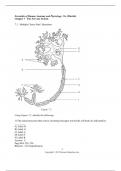
This text discusses the nervous system, including structure and function of neurons and neuroglia, properties of the central and peripheral nervous systems, and anatomy and physiology of the brain and spinal cord. Some key points: • The nervous system has three main functions: sensory, integrative, and motor. Neurons conduct nerve impulses while neuroglia support and protect neurons. • Neurons are polarized at rest but become depolarized when an action potential occurs. This involves ...
- Book
- Examen
- • 35 páginas's •
-
University Of Santo Tomas•Anatomy and Physiology
-
Development of the Nervous System • Dan Sanes, Thomas A. Reh• ISBN 9780128039960
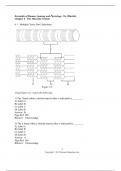
The text discusses the muscular system, including the different types of muscle tissue, structure and function of skeletal muscles, and movement. Some key points: There are three main types of muscle tissue: skeletal, smooth, and cardiac. They differ in structure, properties, and location. Skeletal and cardiac muscles are striated while smooth muscle is not. Skeletal muscles contain myofibrils made of thick myosin and thin actin filaments. A sarcomere is the basic contractile unit between...
- Book
- Examen
- • 27 páginas's •
-
University Of Santo Tomas•Anatomy and Physiology
-
The Muscular System Manual - E-Book • Joseph E. Muscolino• ISBN 9780323327718

The text discusses various topics related to cells and tissues. The key points are: • Ribosomes are responsible for protein synthesis while the Golgi apparatus is responsible for packaging. Smooth muscle tissue is made up of nonstriated involuntary muscle cells. • Microvilli are tiny extensions of the plasma membrane that increase the area for absorption. Cilia and flagella actually move the cell. • Mitochondria are responsible for cellular respiration and ATP formation. The pla...
- Book
- Examen
- • 35 páginas's •
-
University Of Santo Tomas•Anatomy and Physiology
-
Cells and Tissues • Rogers• ISBN 9780080984100
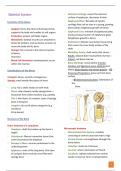
The text discusses the skeletal and muscular systems in detail. Some key points: The skeletal system includes bones and cartilage that provide structure, support, movement, and protection. Bones have different classifications based on shape: long, short, flat, and irregular. Bones are composed of compact and spongy bone tissue. The skeleton includes the axial skeleton (skull, vertebral column) and appendicular skeleton (shoulder girdle, upper limbs, pelvic girdle, lower limbs). The muscul...
- Book
- Resumen
- • 30 páginas's •
-
University Of Santo Tomas•Anatomy and Physiology
-
The Skeletal and Muscular Systems • Gregory Stewart, Denton A. Cooley• ISBN 9781438107738

This text contains multiple choice questions about the skeletal system. The questions cover a variety of topics including: • The number of thoracic vertebrae • The definition of anatomical structures like sinuses and foramina • Bone types like sesamoid bones • Locations of hematopoietic tissue and structures like the atlas and axis • Types of fractures • Names of proximal ends of bones like the humerus and femur • What ligaments connect • Names of bones like the tibi...
- Book
- Examen
- • 35 páginas's •
-
University Of Santo Tomas•Anatomy and Physiology
-
Your Skeletal System • Caroline Arnold• ISBN 9781541505759
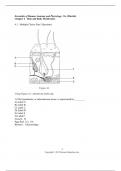
The text discusses the anatomy and physiology of skin and body membranes. It covers the structure and functions of the skin, membranes, and glands. Here are the key points: The skin is composed of two main layers: the epidermis and the dermis. The epidermis is made of stratified squamous epithelium and provides a protective barrier. The dermis is made of connective tissue and contains blood vessels, nerves, hair follicles, and glands. There are four types of membranes - cutaneous, mucous,...
- Book
- Examen
- • 24 páginas's •
-
University Of Santo Tomas•Anatomy and Physiology
-
Anatomy & Physiology Made Easy • Nedu• ISBN 9781952914164
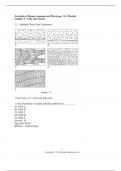
This chapter covers cells and tissues. The basic unit of life is the cell, which consists of a nucleus containing DNA, a plasma membrane that encloses the cell, and cytoplasm including organelles that perform specific functions. The plasma membrane is a phospholipid bilayer with hydrophilic heads and hydrophobic tails. It regulates what enters and exits the cell using passive and active transport. Passive transport moves substances down a concentration gradient and requires no energy. Active tra...
- Book
- Examen
- • 31 páginas's •
-
University Of Santo Tomas•Anatomy and Physiology
-
Essentials of Human Anatomy and Physiology • David Shier• ISBN 9780072440461
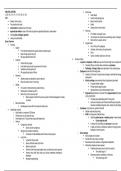
The skeletal system, consisting of the axial and appendicular skeleton, joints, cartilages, and ligaments, serves to support, protect, and enable movement, with bone fractures being manageable through bone remodeling.
- Book
- Resumen
- • 11 páginas's •
-
University Of Santo Tomas•Anatomy and Physiology
-
Your Skeletal System • Caroline Arnold• ISBN 9781541505759