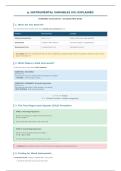
INSTRUMENTAL VARIABLES (IV) EXPLAINED
ECON2061 Econometrics | Complete Mini-Guide
1. When Do You Need IV?
You need Instrumental Variables when OLS is biased and inconsistent due to:
Problem Why OLS Fails Example
Omitted Variable Bias Corr(X, u) ≠ 0 Ability omitted from wage regression
Simultaneity X affects Y AND Y affects X Price and quantity in supply/demand
Measurement Error X measured with error Self-reported income
Key Insight: When X is correlated with the error term (endogeneity), OLS gives wrong answers. IV provides a solution by using a "clean"
source of variation in X.
2. What Makes a Valid Instrument?
A valid instrument Z must satisfy TWO conditions:
CONDITION 1: RELEVANCE
Corr(Z, X) ≠ 0
The instrument must be correlated with the endogenous variable X
✅ TESTABLE - Use first-stage F-statistic
CONDITION 2: EXOGENEITY (Exclusion Restriction)
Corr(Z, u) = 0
The instrument must affect Y ONLY through X, not directly
❌ NOT TESTABLE - Must argue theoretically
Z → X → Y (Valid)
Z → Y directly (Invalid - violates exogeneity)
3. The Two-Stage Least Squares (2SLS) Procedure
STAGE 1: First-Stage Regression
Regress the endogenous variable X on the instrument Z:
X = π₀ + π₁Z + v
Get the predicted values: X (the "clean" part of X)
STAGE 2: Second-Stage Regression
Regress Y on the predicted values from Stage 1:
Y = β₀ + β₁X + error
̂
β₁ is the IV estimate (consistent if instrument is valid)
⚠ Important: Use statistical software for 2SLS! Manual two-stage gives wrong standard errors.
4. Testing for Weak Instruments
A weak instrument is barely correlated with X. This causes:
Biased IV estimates (can be worse than OLS!)
ECON2061 Econometrics | Complete Mini-Guide
1. When Do You Need IV?
You need Instrumental Variables when OLS is biased and inconsistent due to:
Problem Why OLS Fails Example
Omitted Variable Bias Corr(X, u) ≠ 0 Ability omitted from wage regression
Simultaneity X affects Y AND Y affects X Price and quantity in supply/demand
Measurement Error X measured with error Self-reported income
Key Insight: When X is correlated with the error term (endogeneity), OLS gives wrong answers. IV provides a solution by using a "clean"
source of variation in X.
2. What Makes a Valid Instrument?
A valid instrument Z must satisfy TWO conditions:
CONDITION 1: RELEVANCE
Corr(Z, X) ≠ 0
The instrument must be correlated with the endogenous variable X
✅ TESTABLE - Use first-stage F-statistic
CONDITION 2: EXOGENEITY (Exclusion Restriction)
Corr(Z, u) = 0
The instrument must affect Y ONLY through X, not directly
❌ NOT TESTABLE - Must argue theoretically
Z → X → Y (Valid)
Z → Y directly (Invalid - violates exogeneity)
3. The Two-Stage Least Squares (2SLS) Procedure
STAGE 1: First-Stage Regression
Regress the endogenous variable X on the instrument Z:
X = π₀ + π₁Z + v
Get the predicted values: X (the "clean" part of X)
STAGE 2: Second-Stage Regression
Regress Y on the predicted values from Stage 1:
Y = β₀ + β₁X + error
̂
β₁ is the IV estimate (consistent if instrument is valid)
⚠ Important: Use statistical software for 2SLS! Manual two-stage gives wrong standard errors.
4. Testing for Weak Instruments
A weak instrument is barely correlated with X. This causes:
Biased IV estimates (can be worse than OLS!)