
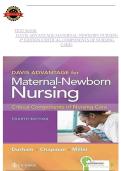
TEST BANK
DAVIS ADVANTAGE MATERNAL-NEWBORN NURSING
4th EDITION [CRITICAL COMPONENTS OF NURSING
CARE]
,TABLE OF CONTENT
Maternity Nursing Overview
1. Trends and Issues
2. Ethics and Standards of Practice Issues
The Antepartum Period
3. Genetics, Conception, Fetal Development, and Reproductive Technology
4. Physiological Aspects of Antepartum Care
5. The Psycho-Social-Cultural Aspects of the Antepartum Period
6. Antepartum Tests
7. High-Risk Antepartum Nursing Care
Intrapartum Period
8. Intrapartum Assessment and Interventions
9. Fetal Heart Rate Assessment
10. High-Risk Labor and Birth
11. Intrapartum and Postpartum Care of the Cesarean Birth Families
Postpartum Period
12. Postpartum Physiological Assessments and Nursing Care
13. Transition to Parenthood
14. High-Risk Postpartum Nursing Care
Neonatal Period
15. Physiological and Behavioral Responses of the Neonate
16. Discharge Planning and Teaching
17. High-Risk Neonatal Nursing Care
Women’s Health
18. Well Women’s Health
19. Alterations in Women’s Health
,Chapter 1: Trends and Issues
MULTIPLE CHOICE
1. The nurse is caring for a patient who is in labor with her first child. The patient’s mother is
present for support and notes that things have changed in the delivery room since she last
gave birth in the early 1980s. Which current trend or intervention may the patient’s mother
find most different?
1. Fetal monitoring throughout labor
2. Postpartum stay of 10 days
3. Expectant partner and family in operating room for cesarean birth
4. Hospital support for breastfeeding
ANS: 4
Chapter: Chapter 1 Trends and Issues
Chapter Learning Objective: 1. Discuss current trends in the management of labor and birth
Page: 4
Heading: Table 1-1: Past and Present Trends
Integrated Processes: Nursing Process
Client Need: Health Promotion and Maintenance
Cognitive Level: Application [Applying]
Concept: Evidence-Based Practice
Difficulty: Moderate
Feedback
1 This is incorrect. Fetal monitoring during labor began in the late 1970s. As such,
this likely would have occurred during the mother’s labor and delivery during
the 1980s.
2 This is incorrect. In the past, the average hospital postpartum stay was 10 days.
Presently, the average postpartum stay is 48 hours or less.
3 This is incorrect. In the past, expectant partners and families were excluded from
the labor and birth experience. Present trends involve the expectant partner and
family in the labor and birth experience, including presence in the operating
Room for cesarean births.
4 This is correct. Hospital support for breastfeeding, including a lactation
consultant and employment of the Baby-Friendly Hospital Initiative, were both
Enacted during the early 1990s.
PTS: 1 CON: Evidence-Based Practice
2. A patient with a history of hypertension is giving birth. During delivery, the staff was not
able to stabilize the patient’s blood pressure. As a result, the patient died shortly after
delivery. This is an example of what type of death?
1. Early maternal death
2. Late maternal death
3. Direct obstetric death
4. Indirect obstetric death
ANS: 4
, Chapter: Chapter 1 Trends and Issues
Chapter Learning Objective: 2. Discuss current trends in maternal and infant health
outcomes.
Page: 7
Heading: Trends > Maternal Death and Mortality Rates
Integrated Processes: Nursing Process
Client Need: Physiological Integrity: Reduction of Risk Potential
Cognitive Level: Application [Applying]
Concept: Ante/Intra/Post-partum
Difficulty: Hard
Feedback
1 This is incorrect. Early maternal death is not an example of maternal death.
Examples of maternal death include late maternal death, indirect obstetric death,
direct obstetric death, and pregnancy-related death.
2 This is incorrect. Late maternal death occurs 42 days after termination of
pregnancy from a direct or indirect obstetric cause.
3 This is incorrect. Direct obstetric death results from complications during
pregnancy, labor, birth, and/or postpartum period.
4 This is correct. Indirect obstetric death is caused by a preexisting disease, or a
disease that develops during pregnancy.
PTS: 1 CON: Ante/Intra/Post-partum
3. The nurse is providing education to a patient who has given birth to her first child and is
being discharged home. The patient expressed concern regarding infant mortality and
sudden infant death syndrome (SIDS). The patient had an uncomplicated pregnancy, labor,
and vaginal delivery. She has a body mass index of 25 and has no other health conditions.
The infant is healthy and was delivered full-term. What will be most helpful thing to explain
to the patient?
1. Uses of extracorporeal membrane oxygenation therapy (ECMO)
2. Uses of exogenous pulmonary surfactant
3. The Baby-Friendly Hospital Initiative
4. The Safe to Sleep campaign
ANS: 4
Chapter: Chapter 1 Trends and Issues
Chapter Learning Objective: 3. Identify leading causes of infant death.
Page: 7
Heading: Trends > Infant Mortality Rates
Integrated Processes: Nursing process
Client Need: Safe and Effective Care Environment: Safety and Infection Control
Cognitive Level: Application [Applying]
Concept: Health Promotion
Difficulty: Moderate
Feedback
1 This is incorrect. EMCO has been cited as one of the factors that has reduced
infant mortality among preterm infants.
DAVIS ADVANTAGE MATERNAL-NEWBORN NURSING
4th EDITION [CRITICAL COMPONENTS OF NURSING
CARE]
,TABLE OF CONTENT
Maternity Nursing Overview
1. Trends and Issues
2. Ethics and Standards of Practice Issues
The Antepartum Period
3. Genetics, Conception, Fetal Development, and Reproductive Technology
4. Physiological Aspects of Antepartum Care
5. The Psycho-Social-Cultural Aspects of the Antepartum Period
6. Antepartum Tests
7. High-Risk Antepartum Nursing Care
Intrapartum Period
8. Intrapartum Assessment and Interventions
9. Fetal Heart Rate Assessment
10. High-Risk Labor and Birth
11. Intrapartum and Postpartum Care of the Cesarean Birth Families
Postpartum Period
12. Postpartum Physiological Assessments and Nursing Care
13. Transition to Parenthood
14. High-Risk Postpartum Nursing Care
Neonatal Period
15. Physiological and Behavioral Responses of the Neonate
16. Discharge Planning and Teaching
17. High-Risk Neonatal Nursing Care
Women’s Health
18. Well Women’s Health
19. Alterations in Women’s Health
,Chapter 1: Trends and Issues
MULTIPLE CHOICE
1. The nurse is caring for a patient who is in labor with her first child. The patient’s mother is
present for support and notes that things have changed in the delivery room since she last
gave birth in the early 1980s. Which current trend or intervention may the patient’s mother
find most different?
1. Fetal monitoring throughout labor
2. Postpartum stay of 10 days
3. Expectant partner and family in operating room for cesarean birth
4. Hospital support for breastfeeding
ANS: 4
Chapter: Chapter 1 Trends and Issues
Chapter Learning Objective: 1. Discuss current trends in the management of labor and birth
Page: 4
Heading: Table 1-1: Past and Present Trends
Integrated Processes: Nursing Process
Client Need: Health Promotion and Maintenance
Cognitive Level: Application [Applying]
Concept: Evidence-Based Practice
Difficulty: Moderate
Feedback
1 This is incorrect. Fetal monitoring during labor began in the late 1970s. As such,
this likely would have occurred during the mother’s labor and delivery during
the 1980s.
2 This is incorrect. In the past, the average hospital postpartum stay was 10 days.
Presently, the average postpartum stay is 48 hours or less.
3 This is incorrect. In the past, expectant partners and families were excluded from
the labor and birth experience. Present trends involve the expectant partner and
family in the labor and birth experience, including presence in the operating
Room for cesarean births.
4 This is correct. Hospital support for breastfeeding, including a lactation
consultant and employment of the Baby-Friendly Hospital Initiative, were both
Enacted during the early 1990s.
PTS: 1 CON: Evidence-Based Practice
2. A patient with a history of hypertension is giving birth. During delivery, the staff was not
able to stabilize the patient’s blood pressure. As a result, the patient died shortly after
delivery. This is an example of what type of death?
1. Early maternal death
2. Late maternal death
3. Direct obstetric death
4. Indirect obstetric death
ANS: 4
, Chapter: Chapter 1 Trends and Issues
Chapter Learning Objective: 2. Discuss current trends in maternal and infant health
outcomes.
Page: 7
Heading: Trends > Maternal Death and Mortality Rates
Integrated Processes: Nursing Process
Client Need: Physiological Integrity: Reduction of Risk Potential
Cognitive Level: Application [Applying]
Concept: Ante/Intra/Post-partum
Difficulty: Hard
Feedback
1 This is incorrect. Early maternal death is not an example of maternal death.
Examples of maternal death include late maternal death, indirect obstetric death,
direct obstetric death, and pregnancy-related death.
2 This is incorrect. Late maternal death occurs 42 days after termination of
pregnancy from a direct or indirect obstetric cause.
3 This is incorrect. Direct obstetric death results from complications during
pregnancy, labor, birth, and/or postpartum period.
4 This is correct. Indirect obstetric death is caused by a preexisting disease, or a
disease that develops during pregnancy.
PTS: 1 CON: Ante/Intra/Post-partum
3. The nurse is providing education to a patient who has given birth to her first child and is
being discharged home. The patient expressed concern regarding infant mortality and
sudden infant death syndrome (SIDS). The patient had an uncomplicated pregnancy, labor,
and vaginal delivery. She has a body mass index of 25 and has no other health conditions.
The infant is healthy and was delivered full-term. What will be most helpful thing to explain
to the patient?
1. Uses of extracorporeal membrane oxygenation therapy (ECMO)
2. Uses of exogenous pulmonary surfactant
3. The Baby-Friendly Hospital Initiative
4. The Safe to Sleep campaign
ANS: 4
Chapter: Chapter 1 Trends and Issues
Chapter Learning Objective: 3. Identify leading causes of infant death.
Page: 7
Heading: Trends > Infant Mortality Rates
Integrated Processes: Nursing process
Client Need: Safe and Effective Care Environment: Safety and Infection Control
Cognitive Level: Application [Applying]
Concept: Health Promotion
Difficulty: Moderate
Feedback
1 This is incorrect. EMCO has been cited as one of the factors that has reduced
infant mortality among preterm infants.

