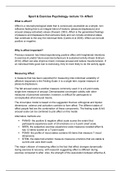
Sport & Exercise Psychology- lecture 13- Affect
What is affect?
Affect is a neurophysiological state that is consciously accessible as a simple, non-
reflective feeling that is an integral blend of hedonic (pleasure-displeasure) and
arousal (sleepy-activated) values (Russell, 2003). Affect is the generalised feelings
of pleasure and displeasure that someone feels and can include emotional states
that contribute to the way the individual feels (Carels et al 2006). Affect can be both
positive or negative.
Why is affect important?
Previous research has linked experiencing positive affect with heightened intentions
to exercise & predict future exercise behaviours & sustained activity (Kwan & Bryan
2010). Affect can also improve mood, increase arousal and reduce muscle tension. If
an individual feels good due to exercising, they’re more likely to do the activity again.
Measuring Affect
A measure that has been supported for measuring inter-individual variability of
affective responses is the Feeling Scale. It is a single item, bipolar measure of
pleasure-displeasure.
The felt arousal scale is another measure commonly used. It is a 6-point scale,
single item measure of arousal. Demonstrated convergent validity with other
measures of perceived activation, however, is difficult for participants to
conceptualise what arousal means.
The circumplex model is based on the suggestion that two orthogonal and bipolar
dimensions- valence and activation combine to form affect. The different states of
affect people feel are the combination of these components. The feeling scale & felt
arousal scale can be combined to plot affect on this model.
Alternative methods are:
PANAS- the positive & negative affect scale scores the extent that
participants experience each of 20 emotions on a 5 point Likert scale.
SEES- the subjective exercise experience scale measures recalled affect &
has 12-items scored on a 7-point scale.
POMS- the profile of mood states contains 65 items that measure 7 mood
dimensions.
STEM- the state trait emotion measure measures emotions that are stable &
current and uses likert scale.
The major criticism of measuring affect is the fact that affect changes dynamically
during exercise & recovery, with research suggesting affect is different during
exercise compared to after. Also, the strength of the association between affective &
What is affect?
Affect is a neurophysiological state that is consciously accessible as a simple, non-
reflective feeling that is an integral blend of hedonic (pleasure-displeasure) and
arousal (sleepy-activated) values (Russell, 2003). Affect is the generalised feelings
of pleasure and displeasure that someone feels and can include emotional states
that contribute to the way the individual feels (Carels et al 2006). Affect can be both
positive or negative.
Why is affect important?
Previous research has linked experiencing positive affect with heightened intentions
to exercise & predict future exercise behaviours & sustained activity (Kwan & Bryan
2010). Affect can also improve mood, increase arousal and reduce muscle tension. If
an individual feels good due to exercising, they’re more likely to do the activity again.
Measuring Affect
A measure that has been supported for measuring inter-individual variability of
affective responses is the Feeling Scale. It is a single item, bipolar measure of
pleasure-displeasure.
The felt arousal scale is another measure commonly used. It is a 6-point scale,
single item measure of arousal. Demonstrated convergent validity with other
measures of perceived activation, however, is difficult for participants to
conceptualise what arousal means.
The circumplex model is based on the suggestion that two orthogonal and bipolar
dimensions- valence and activation combine to form affect. The different states of
affect people feel are the combination of these components. The feeling scale & felt
arousal scale can be combined to plot affect on this model.
Alternative methods are:
PANAS- the positive & negative affect scale scores the extent that
participants experience each of 20 emotions on a 5 point Likert scale.
SEES- the subjective exercise experience scale measures recalled affect &
has 12-items scored on a 7-point scale.
POMS- the profile of mood states contains 65 items that measure 7 mood
dimensions.
STEM- the state trait emotion measure measures emotions that are stable &
current and uses likert scale.
The major criticism of measuring affect is the fact that affect changes dynamically
during exercise & recovery, with research suggesting affect is different during
exercise compared to after. Also, the strength of the association between affective &