BIOLOGY
YEAR 1
QUARTER 2
2018/2019
Cellular biochemistry
SUMMARY OF THE COURSE CELLULAR BIOCHEMISTRY
NWI-BB007C
ELISE REUVEKAMP
,Content
Lecture 1: Interactions in aqueous solutions and amino acids ........................................................... 2
Lecture 2: Protein structure, folding and processing of proteins ....................................................... 6
Lecture 3: Enzymes working mechanisms, kinetics and inhibitors ..................................................... 9
Lecture 4: Working with proteins purification and characterization ................................................ 13
Lecture 5: Catabolism of amino acids and fatty acids and lipids ...................................................... 15
Lecture 6: Principles of Bioenergetics ............................................................................................... 20
Lecture 7: Cytoskeleton, Cell adhesion and Extracellular matrix ...................................................... 23
Lecture 8: carbohydrates and glycoconjugates ................................................................................. 27
Lecture 9 and 10: signal transduction and cellular decisions............................................................ 30
Guest lectures: .................................................................................................................................. 35
,Cellular Biochemistry
Lecture 1: Interactions in aqueous solutions and amino acids
Key points: Thermodynamics, equilibrium constants, hydrogen bonds, ionic and
hydrophobic interactions, Van der Waals interactions, Keq, Kw, pH, pKa, titration
curves, buffers and Henderson-Hassel Bach equation. Nomenclature of amino
acids, stereoisomerism, classification and PI.
Thermodynamics and equilibrium constant
Thermodynamics is a concept in the biochemistry, which deals with the transference of energy.
∆𝐺 = ∆𝐻 − 𝑇∆𝑆
∆𝐺 = changes in free energy content
∆𝐻 = change in enthalpy
𝑇 = absolute temperature
∆𝑆 = change in entropy/randomness
∆G>0 → endergonic reaction (unfavourable)
∆G<0 → exergonic reaction (spontaneous)
A process tends to occur spontaneously only if the change in free energy is negative, meaning that
there is a release of energy and it shifts to a thermodynamically lower state. A positive change in free
energy means that the reaction gained energy to occur and therefore shift to a thermodynamically
higher state, so it does not occur spontaneously.
Change in enthalpy is negative for a reaction that releases heat and the change in entropy is positive
when a system increases in randomness, so a more organized state (solid) has a low randomness.
𝐶 𝑒𝑞 𝐷𝑒𝑞
𝐾𝑒𝑞=
𝐴𝑒𝑞 𝐵 𝑒𝑞
Besides change in free energy, the equilibrium constant is also a measure of a reaction’s tendency to
proceed spontaneously. The larger the K (equilibrium constant) the sooner it will proceed as a
spontaneously reaction.
Weak interactions
Hydrogen bond: The very different electronegativities of H and O make water highly polar, capable
of forming hydrogen bonds and can form hydrogen bonds with other water molecules and solutes.
- The tendency of water to evaporate or melt is spontaneous and entropy driven, meaning
that the increase in disorder outweighs its desire to form
hydrogen bonds
- Relatively weak
- Strongest when donor-hydrogen-acceptor are in a straight line
, Water as a solvent
Hydrophilic: easily dissolved in water (polar)
Hydrophobic: difficult to dissolve in water (nonpolar)
Amphipathic: compounds with both hydrophobic and hydrophilic groups, when added to water they
cluster together and form micelles (like lipids)
→ hydrophobic interactions: dissolving hydrophobic compounds in water decreases entropy,
because water is forces in cage like shells) and therefore unfavourable for a G.
→ ionic interactions: dissolving ionic compounds in water increases entropy and are therefore
favourable for G.
Van der Waals interactions: when two uncharged atoms are brought very close together and their
surrounding electron clouds influence each other
Ionization of water, weak acids, weak bases
Water itself is slightly ionized: H2O↔ H++OH
The Kw is a constant that is the basis for the pH and therefore if H+ is high that OH- is low and the
other way around. (Kw= [reactants]x[Keq]=[product]x[product])
Weak acids can donate H+ and Weak bases can accept H+
𝑝𝐻 = − log[𝐻 +]
- pH is a denotation of the H+ concentration, it is a logarithmic scale, this means that a
difference in a single pH unit indicates a 10 fold difference in H+ concentration.
- The pH measurements are important, because 1) it can affect the structure and function of
proteins and 2) it is a diagnostic marker of blood and urine.
(𝐻𝐴) ↔ (𝐻 +) + (𝐴 −)
[𝐻 +][𝐴−]
𝐾𝑒𝑞 = = 𝐾𝑎
[𝐻𝐴]
𝑝𝐾𝑎 = −log [𝐾𝑎]
• Ka is the acid dissociation constant, when it is very high it tells you that the acid is strong and
has a high tendency to dissociate a proton and therefore have a low pH.
• pKa is a method to indicate the strength of an acid. The lower the pKa value, the stronger the
acid is.
• The higher Ka the lower the pKa, meaning a strong acid.
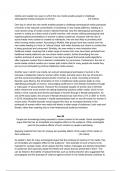
Titration curve:
• Titration curve: a plot of pH against the amount of base added until
acid is neutralized
• the midpoint of the titration curve shows when 50% of the weak
acid is dissociated
• the blue region is the buffer region, where the change of OH-
concentration doesn’t affect the state of acid. Buffers maintain the pH
stability in the cell
• pKa = pH when 50% of the acid is dissociated, so at the midpoint.
• All titration curves of weak acids have the same shape, but start at
different pH levels, and therefore the strength of these acids differ.
YEAR 1
QUARTER 2
2018/2019
Cellular biochemistry
SUMMARY OF THE COURSE CELLULAR BIOCHEMISTRY
NWI-BB007C
ELISE REUVEKAMP
,Content
Lecture 1: Interactions in aqueous solutions and amino acids ........................................................... 2
Lecture 2: Protein structure, folding and processing of proteins ....................................................... 6
Lecture 3: Enzymes working mechanisms, kinetics and inhibitors ..................................................... 9
Lecture 4: Working with proteins purification and characterization ................................................ 13
Lecture 5: Catabolism of amino acids and fatty acids and lipids ...................................................... 15
Lecture 6: Principles of Bioenergetics ............................................................................................... 20
Lecture 7: Cytoskeleton, Cell adhesion and Extracellular matrix ...................................................... 23
Lecture 8: carbohydrates and glycoconjugates ................................................................................. 27
Lecture 9 and 10: signal transduction and cellular decisions............................................................ 30
Guest lectures: .................................................................................................................................. 35
,Cellular Biochemistry
Lecture 1: Interactions in aqueous solutions and amino acids
Key points: Thermodynamics, equilibrium constants, hydrogen bonds, ionic and
hydrophobic interactions, Van der Waals interactions, Keq, Kw, pH, pKa, titration
curves, buffers and Henderson-Hassel Bach equation. Nomenclature of amino
acids, stereoisomerism, classification and PI.
Thermodynamics and equilibrium constant
Thermodynamics is a concept in the biochemistry, which deals with the transference of energy.
∆𝐺 = ∆𝐻 − 𝑇∆𝑆
∆𝐺 = changes in free energy content
∆𝐻 = change in enthalpy
𝑇 = absolute temperature
∆𝑆 = change in entropy/randomness
∆G>0 → endergonic reaction (unfavourable)
∆G<0 → exergonic reaction (spontaneous)
A process tends to occur spontaneously only if the change in free energy is negative, meaning that
there is a release of energy and it shifts to a thermodynamically lower state. A positive change in free
energy means that the reaction gained energy to occur and therefore shift to a thermodynamically
higher state, so it does not occur spontaneously.
Change in enthalpy is negative for a reaction that releases heat and the change in entropy is positive
when a system increases in randomness, so a more organized state (solid) has a low randomness.
𝐶 𝑒𝑞 𝐷𝑒𝑞
𝐾𝑒𝑞=
𝐴𝑒𝑞 𝐵 𝑒𝑞
Besides change in free energy, the equilibrium constant is also a measure of a reaction’s tendency to
proceed spontaneously. The larger the K (equilibrium constant) the sooner it will proceed as a
spontaneously reaction.
Weak interactions
Hydrogen bond: The very different electronegativities of H and O make water highly polar, capable
of forming hydrogen bonds and can form hydrogen bonds with other water molecules and solutes.
- The tendency of water to evaporate or melt is spontaneous and entropy driven, meaning
that the increase in disorder outweighs its desire to form
hydrogen bonds
- Relatively weak
- Strongest when donor-hydrogen-acceptor are in a straight line
, Water as a solvent
Hydrophilic: easily dissolved in water (polar)
Hydrophobic: difficult to dissolve in water (nonpolar)
Amphipathic: compounds with both hydrophobic and hydrophilic groups, when added to water they
cluster together and form micelles (like lipids)
→ hydrophobic interactions: dissolving hydrophobic compounds in water decreases entropy,
because water is forces in cage like shells) and therefore unfavourable for a G.
→ ionic interactions: dissolving ionic compounds in water increases entropy and are therefore
favourable for G.
Van der Waals interactions: when two uncharged atoms are brought very close together and their
surrounding electron clouds influence each other
Ionization of water, weak acids, weak bases
Water itself is slightly ionized: H2O↔ H++OH
The Kw is a constant that is the basis for the pH and therefore if H+ is high that OH- is low and the
other way around. (Kw= [reactants]x[Keq]=[product]x[product])
Weak acids can donate H+ and Weak bases can accept H+
𝑝𝐻 = − log[𝐻 +]
- pH is a denotation of the H+ concentration, it is a logarithmic scale, this means that a
difference in a single pH unit indicates a 10 fold difference in H+ concentration.
- The pH measurements are important, because 1) it can affect the structure and function of
proteins and 2) it is a diagnostic marker of blood and urine.
(𝐻𝐴) ↔ (𝐻 +) + (𝐴 −)
[𝐻 +][𝐴−]
𝐾𝑒𝑞 = = 𝐾𝑎
[𝐻𝐴]
𝑝𝐾𝑎 = −log [𝐾𝑎]
• Ka is the acid dissociation constant, when it is very high it tells you that the acid is strong and
has a high tendency to dissociate a proton and therefore have a low pH.
• pKa is a method to indicate the strength of an acid. The lower the pKa value, the stronger the
acid is.
• The higher Ka the lower the pKa, meaning a strong acid.
Titration curve:
• Titration curve: a plot of pH against the amount of base added until
acid is neutralized
• the midpoint of the titration curve shows when 50% of the weak
acid is dissociated
• the blue region is the buffer region, where the change of OH-
concentration doesn’t affect the state of acid. Buffers maintain the pH
stability in the cell
• pKa = pH when 50% of the acid is dissociated, so at the midpoint.
• All titration curves of weak acids have the same shape, but start at
different pH levels, and therefore the strength of these acids differ.