BIOLOGY
YEAR 2
QUARTER 1
2019/2020
Brain and behaviour
SUMMARY OF THE COURSE BRAIN AND BEHAVIOUR
NWI-BB085C
ELISE REUVEKAMP
,Inhoud
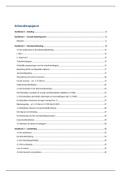
Lecture 1&2: Introduction to neuroscience ............................................................................................ 2
Lecture 3: Membrane potentials ............................................................................................................. 6
Lecture 4: Cellular neurophysiology ........................................................................................................ 9
lecture 5: Brain development pre-natal ................................................................................................ 12
Lecture 6: Brain development in childhood and adolescence .............................................................. 15
Lecture 7: Mapping ............................................................................................................................... 17
Lecture 8: Principles of sensation.......................................................................................................... 19
Lecture 9: Muscle physiology ................................................................................................................ 21
Lecture 10: Brain plasticity and behaviour ............................................................................................ 26
Lecture 11: Structural plasticity of the brain......................................................................................... 28
Lecture 12: Brain injury and disorders .................................................................................................. 29
Lecture 13: Dangers for the brain ......................................................................................................... 31
,Lecture 1&2: Introduction to neuroscience
The nervous system is an information processing organ. The information is generated, processed,
transferred and recovered. The nervous system is organized into central and peripheral nervous
systems, which have a common operational principle.
- Peripheral nervous system: sensory input + motor output
- Central nervous system: integration of sensory input
Organisation of the nervous system across spatial scales
Nervous System (macro scale) → the network is organized into PNS and CNS
➢ The peripheral nervous system consists of the sensors that bring sensory input and motor
output (receptors) embedded throughout the body and the wiring that connects them to the
CNS.
➢ The central nervous system, also the brain and the spinal cord. It is organized into distinct
regions with specialized functions. It is fast, adaptive and context specific but also error
prone.
Functional systems → the inspiration for deep neural networks
To create function the brain performs parallel computations. Distributed nodes first deconstruct the
input in a process called decoding before encoding it to create perception and action.
Map → organization of the body and space allow self- and world-centric information processing
Maps are the topographical representations of the sensory and skeletal muscles. Sensory maps
enable remapping of your neurons to new sensor inputs. Motor maps enable rapid coordinated
action of muscles
Network → made of modular computational units that are diverse and display distinct circuit
connectivity
Networks of neurons come together to build the maps in the brain. In the cerebral cortex they are
organized in cortical columns. Layers have distinct distribution of neurons and different input/output
relationship with local and distant networks
Neurons → complex non-linear computations first arise at the single neuron level
Neurons are compartmentalized: dendrites are the principal input layer, axon is the output layer
that provides the circuit its wiring and the soma is the main electrical integration node and the
center of biochemical production.
Synapses → communication is mediated across specialized nodes
Axons make synapses to enable communication across neurons. The synapses mediate
communication using molecules and direct ionic exchange.
Molecules → the structural and functional primers of brain organization
Classification of brain regions can be either by:
➢ Structure: neighbouring cortical tissue that shows similar anatomical organization
, ➢ Function: a population of neurons activated by the same kind of stimulus and/or involved in
similar tasks (you know when a region is active in the brain when there is more oxygen
supply/blood flow for the action potentials
Structure: The central nervous system van be divided into seven main parts and four lobes:
Seven main parts: four lobes
1. Spinal cord 1. Frontal lobe
2. Medulla oblongata 2. Parietal lobe
3. Pons brainstem 3. Occipital lobe
4. Midbrain 4. Temporal lobe
5. Cerebellum
6. Diencephalon
7. Cerebrum
Neurons differ in shape, size, location, biochemical, anatomical and functional organization
1) Neurons that have local connections have smaller soma and compact projections
2) Neurons with large soma have long distance connections, talking to variety of structures
throughout the brain
3) The fourth layer is the main input layer for most cortical regions
4) All other layers have distinct connectivity patterns to integrate information locally as well as
throughout the brain
The anatomy of the neuron:
Soma: metabolic center of neurons
Dendrites: most synapses are made on dendritic
spines which are small protrusions coming out of
the dendrites
Axon: action potentials are generated close to
where the axon originates from the soma; action
potentials are also regenerated along the axon to
ultimately cause neurotransmitter release from
the axonal boutons/synaptic terminals.
Synapses are where neurons exchange
information. The organization differs across
chemical and electrical synapses.
YEAR 2
QUARTER 1
2019/2020
Brain and behaviour
SUMMARY OF THE COURSE BRAIN AND BEHAVIOUR
NWI-BB085C
ELISE REUVEKAMP
,Inhoud
Lecture 1&2: Introduction to neuroscience ............................................................................................ 2
Lecture 3: Membrane potentials ............................................................................................................. 6
Lecture 4: Cellular neurophysiology ........................................................................................................ 9
lecture 5: Brain development pre-natal ................................................................................................ 12
Lecture 6: Brain development in childhood and adolescence .............................................................. 15
Lecture 7: Mapping ............................................................................................................................... 17
Lecture 8: Principles of sensation.......................................................................................................... 19
Lecture 9: Muscle physiology ................................................................................................................ 21
Lecture 10: Brain plasticity and behaviour ............................................................................................ 26
Lecture 11: Structural plasticity of the brain......................................................................................... 28
Lecture 12: Brain injury and disorders .................................................................................................. 29
Lecture 13: Dangers for the brain ......................................................................................................... 31
,Lecture 1&2: Introduction to neuroscience
The nervous system is an information processing organ. The information is generated, processed,
transferred and recovered. The nervous system is organized into central and peripheral nervous
systems, which have a common operational principle.
- Peripheral nervous system: sensory input + motor output
- Central nervous system: integration of sensory input
Organisation of the nervous system across spatial scales
Nervous System (macro scale) → the network is organized into PNS and CNS
➢ The peripheral nervous system consists of the sensors that bring sensory input and motor
output (receptors) embedded throughout the body and the wiring that connects them to the
CNS.
➢ The central nervous system, also the brain and the spinal cord. It is organized into distinct
regions with specialized functions. It is fast, adaptive and context specific but also error
prone.
Functional systems → the inspiration for deep neural networks
To create function the brain performs parallel computations. Distributed nodes first deconstruct the
input in a process called decoding before encoding it to create perception and action.
Map → organization of the body and space allow self- and world-centric information processing
Maps are the topographical representations of the sensory and skeletal muscles. Sensory maps
enable remapping of your neurons to new sensor inputs. Motor maps enable rapid coordinated
action of muscles
Network → made of modular computational units that are diverse and display distinct circuit
connectivity
Networks of neurons come together to build the maps in the brain. In the cerebral cortex they are
organized in cortical columns. Layers have distinct distribution of neurons and different input/output
relationship with local and distant networks
Neurons → complex non-linear computations first arise at the single neuron level
Neurons are compartmentalized: dendrites are the principal input layer, axon is the output layer
that provides the circuit its wiring and the soma is the main electrical integration node and the
center of biochemical production.
Synapses → communication is mediated across specialized nodes
Axons make synapses to enable communication across neurons. The synapses mediate
communication using molecules and direct ionic exchange.
Molecules → the structural and functional primers of brain organization
Classification of brain regions can be either by:
➢ Structure: neighbouring cortical tissue that shows similar anatomical organization
, ➢ Function: a population of neurons activated by the same kind of stimulus and/or involved in
similar tasks (you know when a region is active in the brain when there is more oxygen
supply/blood flow for the action potentials
Structure: The central nervous system van be divided into seven main parts and four lobes:
Seven main parts: four lobes
1. Spinal cord 1. Frontal lobe
2. Medulla oblongata 2. Parietal lobe
3. Pons brainstem 3. Occipital lobe
4. Midbrain 4. Temporal lobe
5. Cerebellum
6. Diencephalon
7. Cerebrum
Neurons differ in shape, size, location, biochemical, anatomical and functional organization
1) Neurons that have local connections have smaller soma and compact projections
2) Neurons with large soma have long distance connections, talking to variety of structures
throughout the brain
3) The fourth layer is the main input layer for most cortical regions
4) All other layers have distinct connectivity patterns to integrate information locally as well as
throughout the brain
The anatomy of the neuron:
Soma: metabolic center of neurons
Dendrites: most synapses are made on dendritic
spines which are small protrusions coming out of
the dendrites
Axon: action potentials are generated close to
where the axon originates from the soma; action
potentials are also regenerated along the axon to
ultimately cause neurotransmitter release from
the axonal boutons/synaptic terminals.
Synapses are where neurons exchange
information. The organization differs across
chemical and electrical synapses.