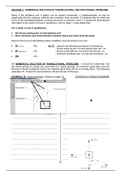
SECTION 4 - NUMERICAL SOLUTION OF TRANSLATIONAL AND ROTATIONAL PROBLEMS
Many of the problems met in statics can be solved numerically, or mathematically, as well as
graphically and the solutions obtained are invariably more accurate. To illustrate this we shall use
some of the examples/problems covered previously in sections 2 and 3. It should be remembered
that statics is the study of forces in equilibrium, and on page 1 it was stated that:
For a body a to be in equilibrium;
the forces acting upon it must balance and
their clockwise and anticlockwise moments about any point must be equal.
Now for this to be so the following three conditions must be shown to be true:
FVERTICAL =0 NOTE - assume the following convention for directions:
- forces acting up are +ve and acting down are –ve.
FHORIZONTAL =0 - forces to the right are +ve and to the left are –ve.
- moments clockwise are +ve and anti-clockwise –ve.
M =0
4.1 NUMERICAL SOLUTION OF TRANSLATIONAL PROBLEMS - it should be noted that if all
the forces acting on a body are concurrent (i.e. acting through one common point) then only the
first two of these conditions need to be checked since there will be no turning effect. The following
examples 18, 19 and 20) and problems ( 28 and 29) are of this type.
EXAMPLE 18 - repeat example 7 shown on page 18. SYSTEM OF FORCES DIAGRAM
.......................................................................... ...........................................................................
.......................................................................... ...........................................................................
.......................................................................... ...........................................................................
.......................................................................... ...........................................................................
.......................................................................... ...........................................................................
.......................................................................... ...........................................................................
.......................................................................... ...........................................................................
.......................................................................... ...........................................................................
.......................................................................... ...........................................................................
.......................................................................... ...........................................................................
36
, EXAMPLE 19 – repeat example 8 shown on page 20.
……………………………………………………………….
……………………………………………………………….
……………………………………………………………….
……………………………………………………………….
……………………………………………………………….
……………………………………………………………….
SYSTEM OF FORCES DIAGRAM
………………………………………………………………
…………………………………………………………….....
……………………………………………………………….
……………………………………………………………….
……………………………………………………………….
……………………………………………………………….
PROBLEM 28 – repeat problem 10 shown on page 21.
……………………………………………………………..
……………………………………………………………..
……………………………………………………………..
……………………………………………………………..
……………………………………………………………..
……………………………………………………………..
……………………………………………………………..
……………………………………………………………..
……………………………………………………………..
……………………………………………………………..
……………………………………………………………….
……………………………………………………………….
……………………………………………………………….
37
Many of the problems met in statics can be solved numerically, or mathematically, as well as
graphically and the solutions obtained are invariably more accurate. To illustrate this we shall use
some of the examples/problems covered previously in sections 2 and 3. It should be remembered
that statics is the study of forces in equilibrium, and on page 1 it was stated that:
For a body a to be in equilibrium;
the forces acting upon it must balance and
their clockwise and anticlockwise moments about any point must be equal.
Now for this to be so the following three conditions must be shown to be true:
FVERTICAL =0 NOTE - assume the following convention for directions:
- forces acting up are +ve and acting down are –ve.
FHORIZONTAL =0 - forces to the right are +ve and to the left are –ve.
- moments clockwise are +ve and anti-clockwise –ve.
M =0
4.1 NUMERICAL SOLUTION OF TRANSLATIONAL PROBLEMS - it should be noted that if all
the forces acting on a body are concurrent (i.e. acting through one common point) then only the
first two of these conditions need to be checked since there will be no turning effect. The following
examples 18, 19 and 20) and problems ( 28 and 29) are of this type.
EXAMPLE 18 - repeat example 7 shown on page 18. SYSTEM OF FORCES DIAGRAM
.......................................................................... ...........................................................................
.......................................................................... ...........................................................................
.......................................................................... ...........................................................................
.......................................................................... ...........................................................................
.......................................................................... ...........................................................................
.......................................................................... ...........................................................................
.......................................................................... ...........................................................................
.......................................................................... ...........................................................................
.......................................................................... ...........................................................................
.......................................................................... ...........................................................................
36
, EXAMPLE 19 – repeat example 8 shown on page 20.
……………………………………………………………….
……………………………………………………………….
……………………………………………………………….
……………………………………………………………….
……………………………………………………………….
……………………………………………………………….
SYSTEM OF FORCES DIAGRAM
………………………………………………………………
…………………………………………………………….....
……………………………………………………………….
……………………………………………………………….
……………………………………………………………….
……………………………………………………………….
PROBLEM 28 – repeat problem 10 shown on page 21.
……………………………………………………………..
……………………………………………………………..
……………………………………………………………..
……………………………………………………………..
……………………………………………………………..
……………………………………………………………..
……………………………………………………………..
……………………………………………………………..
……………………………………………………………..
……………………………………………………………..
……………………………………………………………….
……………………………………………………………….
……………………………………………………………….
37