FUN 1022 : Fundamentals of Nursing (FUN1022)
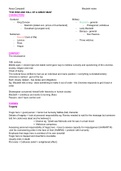
FUNDAMENTAL Reasoning Jared Johnson, 10 years old Primary Concept Gas Exchange Interrelated Concepts (In order of emphasis) 1. Inflammation 2. Clinical Judgment 3. Patient Education FUNDAMENTAL Reasoning: STUDENT History of Present Problem: Pediatric Asthma Jared Johnson is a 10 year-old African-American boy with a history of moderate persistent asthma. He is being admitted to the pediatric unit of the hospital from the walk-in clinic with an acute asthma exacerbation. Jared started complaining of increased chest tightness and shortness of breath one day prior to admission. He has been at 50 percent of his personal best measurement for his peak expiratory flow (PEF) meter reading which did not improve with the use of albuterol metered dose inhaler (MDI) (per his written asthma management plan). In the walk-in clinic Jared is alert, speaking in short sentences due to breathlessness at rest. He has coarse expiratory wheezes throughout both lung fields with decreased breath sounds at the right base. His oxygen saturation on room air is 90%. His color is ashen and he has dark circles under his eyes. He is sitting upright and using his accessory chest muscles to breath and has moderate intercostal and substernal retractions. He is complaining of tightness in his chest. Jared was diagnosed with asthma at age 6 years and has three prior hospitalizations for asthma with one admission to the pediatric intensive care unit. He has never had to be intubated with these episodes. Personal/Social History: He is accompanied by his mother and 16-year-old sister. Jared lives with his mother, maternal grandmother, and sister in an older housing development in the inner city. He is in the 5th grade and a good student despite two to three absences per school year for his asthma. He likes to ride his bike and is the goalie on the soccer team. He says that he has lots of friends at school and likes his teacher, Mr. Bates, who is also his soccer coach. Both Jared and his mother deny tobacco smoke at home. What data from the histories are important and RELEVANT; therefore it has clinical significance to the nurse? RELEVANT Data from Present Problem: Clinical Significance: History of moderate persistent asthma. Increased chest tightness and shortness of breath 50 percent of his personal best measurement for his peak expiratory flow (PEF) meter Coarse expiratory wheezes throughout both lung fields with decreased breath sounds at the right base. His oxygen saturation on room air is 90%. His color is ashen and he has dark circles under his eyes. Using his accessory chest muscles to breath and has moderate intercostal and substernal retractions. Has been treated before. Subjective data. Oxygen is running low. Breath sounds are not normal. Oxygen Saturation is low. Skin color is not normal. Sign of a breathing problem. RELEVANT Data from Social History: Clinical Significance: Lives with his mother, maternal grandmother, and sister in an older housing development in the inner city. Both patient and his mother deny tobacco smoke at home. Two to three absences per school year for his asthma. Sister did not deny tobacco use. Chronic problem. Patient Care Begins: Current VS: P-Q-R-S-T Pain Assessment (5th VS): T: 99.9 F/37.7 C (oral) Provoking/Palliative: Worsens when tries to take a deep breath. Feels better when allowed to sit upright on gurney P: 120 (regular) Quality: Tightness R: 30 (regular) Region/Radiation: Across anterior chest BP: 114/78 Severity: 8/10 O2 sat: 90% on room air Timing: Constant End Tidal CO2: 30 What VS data are RELEVANT and must be recognized as clinically significant to the nurse? RELEVANT VS Data: Clinical Significance: Temperature 02 Sat Worsens when tries to take a breath Region- anterior chest 8/10 on pain scale A low grade fever, may be a sign of infection if it gets higher. Running a little low. Would like to be higher. Is not comfortable while laying down. Location of pain is important for interventions. Pain is high, needs to be controlled. Current Assessment: GENERAL APPEARANCE: Ashen, anxious appearing, moderate respiratory distress. Sitting upright on gurney. Only able to talk in short sentences due to breathlessness. Has intercostal and sub- sternal retractions with increased respiratory rate, using accessory muscles to breathe (sternocleidomastoid muscles). RESP: Breath sounds with inspiratory and expiratory wheezing and prolonged expiration. Has tight-sounding non-productive cough, decreased breath sounds in right base CARDIAC: Pale, warm & moist at forehead, no edema, heart sounds regular with no abnormal beats, pulses strong, equal with palpation at radial/pedal/post-tibial landmarks NEURO: Alert & oriented to person, place, time, and situation (x4) GI: Abdomen soft/non-tender, bowel sounds audible per auscultation in all four quadrants GU: Voiding without difficulty, urine clear/yellow SKIN: Skin integrity intact, moist on forehead What assessment data are RELEVANT and must be recognized as clinically significant to the nurse? RELEVANT Assessment Data: Clinical Significance: General Appearance Respirations Skin Color of Ashen, anxious, respiratory distress, breathlessness, intercoastal and substernal retractions, with increased respiratory rate, using accessory muscles to breathe. Breath sounds with inspiratory and expiratory wheezing and prolonged expiration.Has tight-sounding non-productive cough, decreased breath sounds in right base. Pale, warm & moist at forehead Pharmacology: Home Med: Classification: Mechanism of Action: Nursing Considerations: Fluticasone/Sal meterol DPI 100 mcg/50 mcg 1 inhalation bid Albuterol HFA (hydrofluoroalk ane) inhaler 2 puffs every 4-6 hours as needed for symptoms Montelukast 5 mg every evening at bedtime Pathophysiology: 1. What is the primary problem your patient is most likely presenting? Closed air way, trouble breathing, shortness of breath, cough, chest tightness. 2. What is the underlying cause/pathophysiology of this primary problem? (Relate initial manifestations to the pathophysiology of the primary problem) Pathophysiology of Primary Problem: Lining of airways become inflamed and swollen. Muscles around airway tighten. Chronic inflammation Shortness of breath. Tightness in chest. Appearance of inflammation. Developing Nurse Thinking by Identifying Clinical RELATIONSHIPS 1. What is the RELATIONSHIP of the past medical history and current medications? (Which medication treats which condition? Draw lines to connect) Past Medical History(PMH): Home Meds: Moderate persistent asthma THESE ALL TREAT ASTHMA. • Fluticasone/Salmeterol DPI 100 mcg/50 mcg 1 inhalation bid • Albuterol HFA (hydrofluoroalkane) inhaler 2 puffs every 4-6 hours as needed for symptoms • Montelukast 5 mg every evening at bedtime
Escuela, estudio y materia
- Institución
- Keiser University
- Grado
- Nursing123
Información del documento
- Subido en
- 23 de febrero de 2021
- Número de páginas
- 8
- Escrito en
- 2020/2021
- Tipo
- Caso
- Profesor(es)
- Prof:
- Grado
- A+
Temas
-
pediatric asthma fundamental reasoning