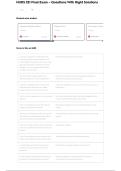
NURS 321 Final Exam – Questions With Right Solutions
Save
Students also studied
Sherpath: Diabetes Mellitus Chapter 21 Test Case Study 4 (Short
30 terms 24 terms 22 terms
jesssbee Preview kenanderson2017 Preview Brittany182
Terms in this set (681)
A nurse is caring for an older adult who Dementia (Neurocognitive Disorder)
frequently forgets recent events but can
recall childhood memories. The nurse notes
gradual progression of symptoms and no
change in level of consciousness. Which
condition is most likely?
The nurse differentiates delirium from Delirium has an acute onset and fluctuating symptoms;
dementia based on which characteristic? dementia is gradual and progressive.
A patient is admitted with confusion that Assess for underlying causes such as infection, hypoxia, or
developed over the last 12 hours after medications
surgery. What is the nurse's first action?
which client is at greatest risk for developing an 82-year old postop patient on opioid analgesics with a
delirium history of dementia and sleep deprivation
The nurse identifies which as the hallmark Beta-amyloid plaques and neurofibrillary tangles of tau
findings of Alzheimer's disease? protein.
The nurse is providing education to a family "His dementia is related to reduced blood flow from small
of a patient with vascular dementia. Which strokes."
statement indicates understanding?
The nurse should question which medication Haloperidol (Haldol)
order for a patient with dementia with Lewy
bodies?
The nurse recognizes which symptom as a Visual hallucinations and fluctuating alertness
classic sign of Dementia with Lewy Bodies?
A client diagnosed with frontotemporal Disinhibition and inappropriate social behavior
dementia is most likely to exhibit which
behavior?
Which finding should alert the nurse to the Rapidly progressive cognitive decline with lack of
possibility of Creutzfeldt-Jakob disease? coordination and visual disturbances.
,A patient with normal pressure Surgical shunt placement to drain excess cerebrospinal fluid.
hydrocephalus exhibits unsteady gait,
urinary incontinence, and confusion. What
treatment should the nurse anticipate?
Which factor places a hospitalized client at Multiple medications and sleep deprivation in the intensive
greatest risk for delirium? care unit.
The nurse is planning care for a patient with Provide frequent orientation cues and ensure use of glasses
delirium. Which intervention is most or hearing aids.
appropriate?
A nurse suspects delirium in a patient who is Urinalysis and electrolyte levels (to rule out infection or
disoriented and agitated. Which diagnostic metabolic imbalance).
test should the nurse review first?
When caring for a patient with acute Low-dose antipsychotic (chemical restraint with caution).
delirium, which medication should be used
only if the patient's safety is at risk?
Which outcome best indicates successful The patient's cognition returns to baseline and they are
treatment of delirium? discharged to their pre-hospital setting.
Which statement by a nurse demonstrates "I will encourage mobility, ensure adequate hydration, and
understanding of delirium prevention? promote sleep."
Which intervention is most important for a Identify and treat the underlying cause.
patient experiencing delirium in the
hospital?
An older adult becomes withdrawn, reports Depression.
loss of interest in hobbies, and sleeps
excessively. Which condition should the
nurse suspect?
Why can depression in older adults be Both may present with forgetfulness and decreased
mistaken for dementia? concentration.
A nurse is assessing an older adult who has Assess for reversible causes such as medication effects,
difficulty remembering new information but dehydration, or infection.
can recall long-term events. What should
the nurse do first?
Which nursing action best supports a patient Encourage independence in daily activities for as long as
newly diagnosed with Alzheimer's disease? possible.
Which of the following is the most common Difficulty remembering newly learned information.
early symptom of Alzheimer's disease?
Which finding best differentiates Alzheimer's Inability to retrace steps to find lost objects.
disease from normal aging?
The nurse recognizes which medications are Donepezil (Aricept), Galantamine (Razadyne), Rivastigmine
used to slow cognitive decline in (Exelon), and Memantine (Namenda).
Alzheimer's disease?
,A nurse is educating caregivers of a patient Maintain a safe environment and prevent wandering or injury.
with moderate Alzheimer's. Which
instruction is most important?
The nurse notes that an older adult has Major neurocognitive disorder (dementia).
become increasingly forgetful, disoriented,
and unable to perform ADLs. Which
diagnostic term best describes this
condition?
Which goal is appropriate for the patient Maintain functional ability and personal dignity for as long as
with Alzheimer's disease? possible
A patient with Alzheimer's is becoming Provide a calm environment and maintain consistent routines.
increasingly agitated during evening hours.
Which nursing intervention is best?
The nurse observes a caregiver yelling at a Ensure the patient's safety and report suspected abuse
confused Alzheimer's patient. What is the following policy
nurse's priority action?
When providing discharge teaching to a "We'll restrain her if she tries to wander at night."
family of a patient with moderate
Alzheimer's, which statement indicates the
need for further teaching?
The nurse knows that the early stages of Mild memory problems and confusion.
Alzheimer's disease are most commonly
characterized by which finding?
Which factor increases risk for developing Advancing age and family history.
Alzheimer's disease?
The nurse recognizes that delirium can lead Permanent cognitive decline.
to which long-term consequence?
Which laboratory test should be monitored Liver function tests (due to possible hepatotoxicity).
for a patient taking Donepezil (Aricept)?
The nurse should suspect delirium rather Rapid onset of confusion following surgery or infection.
than dementia when which occurs?
When educating a patient's family about "Medications cannot cure the disease but may slow its
Alzheimer's, which statement is correct? progression."
The nurse recognizes which symptom as Dementia develops at least one year after the onset of motor
most characteristic of Parkinson's disease symptoms.
dementia?
A nurse is assessing a patient with suspected Memory impairment is the most prominent feature.
neurocognitive disorder. Which finding
suggests possible Alzheimer's rather than
Lewy Body dementia?
When developing a care plan for an Use clear, simple explanations and maintain a consistent daily
Alzheimer's patient, which intervention is routine.
most effective to reduce anxiety?
, The nurse explains that infection occurs Microorganisms enter a host, multiply, and cause tissue
when which condition is met? damage.
Which link in the chain of infection does Mode of transmission.
hand hygiene primarily break?
A nurse identifies a contaminated wound Portal of exit.
dressing as which link in the chain of
infection?
The nurse identifies the patient as the Poor nutritional status and chronic illness.
"susceptible host" in the chain of infection
when the patient has which condition?
What differentiates microbes from All pathogens are microbes, but not all microbes cause
pathogens? disease.
The nurse recognizes that health care- Direct contact with contaminated hands of health care
associated infections (HAIs) are most workers.
commonly transmitted by which route?
Which infection site is most common for a Urinary tract.
health care-associated infection?
Which practice is the most effective way to Performing proper hand hygiene before and after all patient
prevent the spread of infection? contact.
Which precaution should the nurse Wear an N95 respirator and ensure negative pressure airflow
implement when entering the room of a in the room.
patient with tuberculosis?
A patient with influenza requires which type Droplet precautions.
of isolation precaution?
Which infection requires contact Methicillin-resistant Staphylococcus aureus (MRSA) or
precautions? Clostridium difficile.
What type of transmission occurs when an Droplet transmission.
infection spreads via coughing or sneezing
droplets within 3-6 feet?
Which type of transmission involves Airborne transmission.
pathogens carried on air currents smaller
than 5 microns?
The nurse dons gown and gloves before Wash hands with soap and water after care (alcohol-based
entering a room with a patient with C. sanitizer is not effective).
difficile. What additional precaution is
essential?
Which type of patient requires protective Immunocompromised or neutropenic patient.
(reverse) isolation?
The nurse identifies which infection as A patient undergoing stem cell transplant.
requiring protective environment
precautions?
Save
Students also studied
Sherpath: Diabetes Mellitus Chapter 21 Test Case Study 4 (Short
30 terms 24 terms 22 terms
jesssbee Preview kenanderson2017 Preview Brittany182
Terms in this set (681)
A nurse is caring for an older adult who Dementia (Neurocognitive Disorder)
frequently forgets recent events but can
recall childhood memories. The nurse notes
gradual progression of symptoms and no
change in level of consciousness. Which
condition is most likely?
The nurse differentiates delirium from Delirium has an acute onset and fluctuating symptoms;
dementia based on which characteristic? dementia is gradual and progressive.
A patient is admitted with confusion that Assess for underlying causes such as infection, hypoxia, or
developed over the last 12 hours after medications
surgery. What is the nurse's first action?
which client is at greatest risk for developing an 82-year old postop patient on opioid analgesics with a
delirium history of dementia and sleep deprivation
The nurse identifies which as the hallmark Beta-amyloid plaques and neurofibrillary tangles of tau
findings of Alzheimer's disease? protein.
The nurse is providing education to a family "His dementia is related to reduced blood flow from small
of a patient with vascular dementia. Which strokes."
statement indicates understanding?
The nurse should question which medication Haloperidol (Haldol)
order for a patient with dementia with Lewy
bodies?
The nurse recognizes which symptom as a Visual hallucinations and fluctuating alertness
classic sign of Dementia with Lewy Bodies?
A client diagnosed with frontotemporal Disinhibition and inappropriate social behavior
dementia is most likely to exhibit which
behavior?
Which finding should alert the nurse to the Rapidly progressive cognitive decline with lack of
possibility of Creutzfeldt-Jakob disease? coordination and visual disturbances.
,A patient with normal pressure Surgical shunt placement to drain excess cerebrospinal fluid.
hydrocephalus exhibits unsteady gait,
urinary incontinence, and confusion. What
treatment should the nurse anticipate?
Which factor places a hospitalized client at Multiple medications and sleep deprivation in the intensive
greatest risk for delirium? care unit.
The nurse is planning care for a patient with Provide frequent orientation cues and ensure use of glasses
delirium. Which intervention is most or hearing aids.
appropriate?
A nurse suspects delirium in a patient who is Urinalysis and electrolyte levels (to rule out infection or
disoriented and agitated. Which diagnostic metabolic imbalance).
test should the nurse review first?
When caring for a patient with acute Low-dose antipsychotic (chemical restraint with caution).
delirium, which medication should be used
only if the patient's safety is at risk?
Which outcome best indicates successful The patient's cognition returns to baseline and they are
treatment of delirium? discharged to their pre-hospital setting.
Which statement by a nurse demonstrates "I will encourage mobility, ensure adequate hydration, and
understanding of delirium prevention? promote sleep."
Which intervention is most important for a Identify and treat the underlying cause.
patient experiencing delirium in the
hospital?
An older adult becomes withdrawn, reports Depression.
loss of interest in hobbies, and sleeps
excessively. Which condition should the
nurse suspect?
Why can depression in older adults be Both may present with forgetfulness and decreased
mistaken for dementia? concentration.
A nurse is assessing an older adult who has Assess for reversible causes such as medication effects,
difficulty remembering new information but dehydration, or infection.
can recall long-term events. What should
the nurse do first?
Which nursing action best supports a patient Encourage independence in daily activities for as long as
newly diagnosed with Alzheimer's disease? possible.
Which of the following is the most common Difficulty remembering newly learned information.
early symptom of Alzheimer's disease?
Which finding best differentiates Alzheimer's Inability to retrace steps to find lost objects.
disease from normal aging?
The nurse recognizes which medications are Donepezil (Aricept), Galantamine (Razadyne), Rivastigmine
used to slow cognitive decline in (Exelon), and Memantine (Namenda).
Alzheimer's disease?
,A nurse is educating caregivers of a patient Maintain a safe environment and prevent wandering or injury.
with moderate Alzheimer's. Which
instruction is most important?
The nurse notes that an older adult has Major neurocognitive disorder (dementia).
become increasingly forgetful, disoriented,
and unable to perform ADLs. Which
diagnostic term best describes this
condition?
Which goal is appropriate for the patient Maintain functional ability and personal dignity for as long as
with Alzheimer's disease? possible
A patient with Alzheimer's is becoming Provide a calm environment and maintain consistent routines.
increasingly agitated during evening hours.
Which nursing intervention is best?
The nurse observes a caregiver yelling at a Ensure the patient's safety and report suspected abuse
confused Alzheimer's patient. What is the following policy
nurse's priority action?
When providing discharge teaching to a "We'll restrain her if she tries to wander at night."
family of a patient with moderate
Alzheimer's, which statement indicates the
need for further teaching?
The nurse knows that the early stages of Mild memory problems and confusion.
Alzheimer's disease are most commonly
characterized by which finding?
Which factor increases risk for developing Advancing age and family history.
Alzheimer's disease?
The nurse recognizes that delirium can lead Permanent cognitive decline.
to which long-term consequence?
Which laboratory test should be monitored Liver function tests (due to possible hepatotoxicity).
for a patient taking Donepezil (Aricept)?
The nurse should suspect delirium rather Rapid onset of confusion following surgery or infection.
than dementia when which occurs?
When educating a patient's family about "Medications cannot cure the disease but may slow its
Alzheimer's, which statement is correct? progression."
The nurse recognizes which symptom as Dementia develops at least one year after the onset of motor
most characteristic of Parkinson's disease symptoms.
dementia?
A nurse is assessing a patient with suspected Memory impairment is the most prominent feature.
neurocognitive disorder. Which finding
suggests possible Alzheimer's rather than
Lewy Body dementia?
When developing a care plan for an Use clear, simple explanations and maintain a consistent daily
Alzheimer's patient, which intervention is routine.
most effective to reduce anxiety?
, The nurse explains that infection occurs Microorganisms enter a host, multiply, and cause tissue
when which condition is met? damage.
Which link in the chain of infection does Mode of transmission.
hand hygiene primarily break?
A nurse identifies a contaminated wound Portal of exit.
dressing as which link in the chain of
infection?
The nurse identifies the patient as the Poor nutritional status and chronic illness.
"susceptible host" in the chain of infection
when the patient has which condition?
What differentiates microbes from All pathogens are microbes, but not all microbes cause
pathogens? disease.
The nurse recognizes that health care- Direct contact with contaminated hands of health care
associated infections (HAIs) are most workers.
commonly transmitted by which route?
Which infection site is most common for a Urinary tract.
health care-associated infection?
Which practice is the most effective way to Performing proper hand hygiene before and after all patient
prevent the spread of infection? contact.
Which precaution should the nurse Wear an N95 respirator and ensure negative pressure airflow
implement when entering the room of a in the room.
patient with tuberculosis?
A patient with influenza requires which type Droplet precautions.
of isolation precaution?
Which infection requires contact Methicillin-resistant Staphylococcus aureus (MRSA) or
precautions? Clostridium difficile.
What type of transmission occurs when an Droplet transmission.
infection spreads via coughing or sneezing
droplets within 3-6 feet?
Which type of transmission involves Airborne transmission.
pathogens carried on air currents smaller
than 5 microns?
The nurse dons gown and gloves before Wash hands with soap and water after care (alcohol-based
entering a room with a patient with C. sanitizer is not effective).
difficile. What additional precaution is
essential?
Which type of patient requires protective Immunocompromised or neutropenic patient.
(reverse) isolation?
The nurse identifies which infection as A patient undergoing stem cell transplant.
requiring protective environment
precautions?