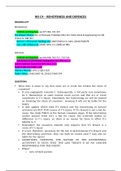
W5 C4 – REMOTENESS AND DEFENCES
READING LIST
Remoteness:
* McBride and Bagshaw, pp 297-302, 311-321
The Wagon Mound (No 1) (Overseas Tankship (UK) Ltd v Morts Dock & Engineering Co Ltd)
[1961] AC 388 (PC)
* Spencer v Wincanton Holdings Ltd [2009] EWCA Civ 1404, [2010] PIQR P8
* Corr v IBC Vehicles Ltd [2008] UKHL 13, [2008] AC 884
Defences:
* McBride and Bagshaw, pp 696-698, 705-717, 737-744
* Law Reform (Contributory Negligence) Act 1945 ss 1, 4
Unfair Contract Terms Act 1977, ss 1, 2, 11
Road Traffic Act 1988, s 149
Morris v Murray [1991] 2 QB 6 (CA)
Patel v Mirza [2016] UKSC 42, [2016] 3 WLR 399
QUESTIONS:
What does it mean to say that some act or event has broken the chain of
causation?
D acts negligently towards C. Subsequently, a 3rd party (can sometimes
be C themselves) or some natural event occurs and this act or event
contributes to C's Injury. Sometimes, the Intervening act will be treated
as 'breaking the chain of causation', meaning D will not be liable for the
Injury.
It only applies where both D's breach and the Intervening or natural
act/event are BUT FOR causes of C's Injury. If D's breach Is not a but for
cause, the claim FAILS at the factual causation stage. If the intervening
act/the natural event isn’t a but for cause, the act/event makes no
difference to C’s injury, so there is no reason for them to affect D’s
liability to C
Remember: the causation element only requires that D’s breach is a
cause of C’s injury
It is not, therefore, necessary for the law to pick between D’s breach and
the intervening act/event—they can both be causes (and T may also be
liable for the injury)
SOMETIMES, HOWEVER, THE NATURE OF THE INTERVENING
ACT/EVENT IS SUCH THAT THE LAW TREATS D AS NO LONGER
RESPONSIBLE FOR THE INJURY
When?
o Acts of third parties:
, Act will break the chain of causation if the third party’s act
was voluntary and unreasonable (Knightley v Johns)
Exception: where it was D’s responsibility to protect C from
being harmed by such third parties (Stansbie v Troman)
o Acts of C:
More commonly dealt with by defence of contributory
negligence [see this afternoon]
Particularly unreasonable acts will nonetheless be treated as
breaking chain of causation (McKew v Holland & Hannen &
Cubitts, Spencer v Wincanton)
Again: exception where D’s duty was to prevent C from
acting in this way (Reeves v Commissioner of Police)
Natural events/Acts of God:
Did D’s breach affect the likelihood of C being harmed by
some such event? (Carslogie Steamship v Royal Norwegian
Government)
Anna’s negligence puts Ben in hospital. The injuries Ben suffers can be
treated and, if they are treated, he will recover fully. Will Anna be liable for
Ben’s death if:
a. A doctor negligently administers a fatal dose of the drug Ben
requires?
Anna and the doctor are both but for causes. But for Anna's
negligence Ben would not be In the hospital (causation
fulfilled). had the doctor not been negligent, Ben would not
have died (causation fulfilled). Both are but for causes, and
there Is a multiple causation scenario here, and are both liable
for factual and legal causation for the death of Ben.
b. A doctor intentionally administers a fatal dose of the drug Ben
requires?
Similar to a.
c. Another patient murders Ben?
Knightley v Johns '3rd party's act unreasonable and voluntary'
so Anna Is not liable; novus actus Interveniens Is present.
d. There is a fire in the hospital which kills Ben?
NATURAL DISASTER/ACT OF GOD
e. Ben refuses all treatment and dies?
Potential synergy with the criminal law and the think skull rule;
It would not be fair to blame the defendant for the death of Ben,
since the hospital took the patient as they found them; I.e. Ben
said I do not want treatment and accepted death.
Why do we have remoteness rules? What is the basic remoteness rule used
in the tort of negligence?
Even in the absence of any intervening act/event, D won’t be liable for
losses resulting from the breach which are treated as too remote
READING LIST
Remoteness:
* McBride and Bagshaw, pp 297-302, 311-321
The Wagon Mound (No 1) (Overseas Tankship (UK) Ltd v Morts Dock & Engineering Co Ltd)
[1961] AC 388 (PC)
* Spencer v Wincanton Holdings Ltd [2009] EWCA Civ 1404, [2010] PIQR P8
* Corr v IBC Vehicles Ltd [2008] UKHL 13, [2008] AC 884
Defences:
* McBride and Bagshaw, pp 696-698, 705-717, 737-744
* Law Reform (Contributory Negligence) Act 1945 ss 1, 4
Unfair Contract Terms Act 1977, ss 1, 2, 11
Road Traffic Act 1988, s 149
Morris v Murray [1991] 2 QB 6 (CA)
Patel v Mirza [2016] UKSC 42, [2016] 3 WLR 399
QUESTIONS:
What does it mean to say that some act or event has broken the chain of
causation?
D acts negligently towards C. Subsequently, a 3rd party (can sometimes
be C themselves) or some natural event occurs and this act or event
contributes to C's Injury. Sometimes, the Intervening act will be treated
as 'breaking the chain of causation', meaning D will not be liable for the
Injury.
It only applies where both D's breach and the Intervening or natural
act/event are BUT FOR causes of C's Injury. If D's breach Is not a but for
cause, the claim FAILS at the factual causation stage. If the intervening
act/the natural event isn’t a but for cause, the act/event makes no
difference to C’s injury, so there is no reason for them to affect D’s
liability to C
Remember: the causation element only requires that D’s breach is a
cause of C’s injury
It is not, therefore, necessary for the law to pick between D’s breach and
the intervening act/event—they can both be causes (and T may also be
liable for the injury)
SOMETIMES, HOWEVER, THE NATURE OF THE INTERVENING
ACT/EVENT IS SUCH THAT THE LAW TREATS D AS NO LONGER
RESPONSIBLE FOR THE INJURY
When?
o Acts of third parties:
, Act will break the chain of causation if the third party’s act
was voluntary and unreasonable (Knightley v Johns)
Exception: where it was D’s responsibility to protect C from
being harmed by such third parties (Stansbie v Troman)
o Acts of C:
More commonly dealt with by defence of contributory
negligence [see this afternoon]
Particularly unreasonable acts will nonetheless be treated as
breaking chain of causation (McKew v Holland & Hannen &
Cubitts, Spencer v Wincanton)
Again: exception where D’s duty was to prevent C from
acting in this way (Reeves v Commissioner of Police)
Natural events/Acts of God:
Did D’s breach affect the likelihood of C being harmed by
some such event? (Carslogie Steamship v Royal Norwegian
Government)
Anna’s negligence puts Ben in hospital. The injuries Ben suffers can be
treated and, if they are treated, he will recover fully. Will Anna be liable for
Ben’s death if:
a. A doctor negligently administers a fatal dose of the drug Ben
requires?
Anna and the doctor are both but for causes. But for Anna's
negligence Ben would not be In the hospital (causation
fulfilled). had the doctor not been negligent, Ben would not
have died (causation fulfilled). Both are but for causes, and
there Is a multiple causation scenario here, and are both liable
for factual and legal causation for the death of Ben.
b. A doctor intentionally administers a fatal dose of the drug Ben
requires?
Similar to a.
c. Another patient murders Ben?
Knightley v Johns '3rd party's act unreasonable and voluntary'
so Anna Is not liable; novus actus Interveniens Is present.
d. There is a fire in the hospital which kills Ben?
NATURAL DISASTER/ACT OF GOD
e. Ben refuses all treatment and dies?
Potential synergy with the criminal law and the think skull rule;
It would not be fair to blame the defendant for the death of Ben,
since the hospital took the patient as they found them; I.e. Ben
said I do not want treatment and accepted death.
Why do we have remoteness rules? What is the basic remoteness rule used
in the tort of negligence?
Even in the absence of any intervening act/event, D won’t be liable for
losses resulting from the breach which are treated as too remote