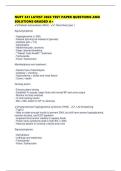
Asthma teaching
Give this one a try later!
Goal is to teach self-management
Understand disease
- Basic facts
- Controlled vs. uncontrolled
- Medications/devices
- S/s of worsening symptoms and what to do
- When to seek care
- Environmental triggers
URI- kids commonly get multiple per year... teaching
Give this one a try later!
, parent reports "my kid is always sick" - kids can get 6-10 colds a year, most
commonly in winter, kids may be sick once a month, concerned if never
seem to get better, be sure to have handwashing, distance, face masks
nursing interventions for epiglottitis
Give this one a try later!
do not put tongue blade in mouth
could trigger respiratory arrest
set up for a tracheostomy
Chiari Malformation type 2
Give this one a try later!
the most common and is usually associated with hydrocephalus and
myelomeningocele
The deformity results from the cerebellum, the medulla oblongata, and the
fourth ventricle displacing into the cervical canal, resulting in an
obstruction of the CSF and causing hydrocephalus.
Parts of the neurologic exam
Give this one a try later!
, Orientation, CN 2-12 ( basic understanding of them controlling senses and
movement of face, swallow, and neck) motor, strength, sensation,
balance/gait i.e. cerebellar function) , GCS
spina bifida occulta
Give this one a try later!
a term that is often used to refer to all NTD that affect the spinal cord.
a defect of the vertebral bodies without protrusion of the spinal cord or
meninges (not visible)
status epilepticus
Give this one a try later!
Common neurologic emergency in children. Can occur with any seizure
activity.
Can be life-threatening
Prolonged or clustered seizures where consciousness does not return
between seizures
The age of the child, cause of the seizures, and duration of status
epilepticus influence prognosis.
Prompt medical intervention is essential to reduce morbidity and mortality.
, Types of partial seizures
Give this one a try later!
simple and complex
late signs of ICP
Give this one a try later!
decreased LOC, memory, HR, irregular respirations, Cheyne-Stokes
respirations
decerebrate posture, fixed and dilated pupils
Pain in newborns
Give this one a try later!
they can feel pain
most common type of cognitive impairment
Give this one a try later!
Give this one a try later!
Goal is to teach self-management
Understand disease
- Basic facts
- Controlled vs. uncontrolled
- Medications/devices
- S/s of worsening symptoms and what to do
- When to seek care
- Environmental triggers
URI- kids commonly get multiple per year... teaching
Give this one a try later!
, parent reports "my kid is always sick" - kids can get 6-10 colds a year, most
commonly in winter, kids may be sick once a month, concerned if never
seem to get better, be sure to have handwashing, distance, face masks
nursing interventions for epiglottitis
Give this one a try later!
do not put tongue blade in mouth
could trigger respiratory arrest
set up for a tracheostomy
Chiari Malformation type 2
Give this one a try later!
the most common and is usually associated with hydrocephalus and
myelomeningocele
The deformity results from the cerebellum, the medulla oblongata, and the
fourth ventricle displacing into the cervical canal, resulting in an
obstruction of the CSF and causing hydrocephalus.
Parts of the neurologic exam
Give this one a try later!
, Orientation, CN 2-12 ( basic understanding of them controlling senses and
movement of face, swallow, and neck) motor, strength, sensation,
balance/gait i.e. cerebellar function) , GCS
spina bifida occulta
Give this one a try later!
a term that is often used to refer to all NTD that affect the spinal cord.
a defect of the vertebral bodies without protrusion of the spinal cord or
meninges (not visible)
status epilepticus
Give this one a try later!
Common neurologic emergency in children. Can occur with any seizure
activity.
Can be life-threatening
Prolonged or clustered seizures where consciousness does not return
between seizures
The age of the child, cause of the seizures, and duration of status
epilepticus influence prognosis.
Prompt medical intervention is essential to reduce morbidity and mortality.
, Types of partial seizures
Give this one a try later!
simple and complex
late signs of ICP
Give this one a try later!
decreased LOC, memory, HR, irregular respirations, Cheyne-Stokes
respirations
decerebrate posture, fixed and dilated pupils
Pain in newborns
Give this one a try later!
they can feel pain
most common type of cognitive impairment
Give this one a try later!