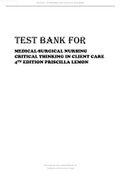
NURSE PRACTITIONER CERTIFICATION
EXAM PREP
7TH EDITION
• AUTHOR(S)MARGARET FITZGERALD
TEST BANK
Q1
Reference: Ch. 1 — Prepping for Nurse Practitioner Boards —
Study Planning & Goal Setting
Stem: A 28-year-old FNP student has 12 weeks before an NP
board exam. She studies inconsistently, does passive review,
and scores low on practice items. She asks you to design a plan
that maximizes learning retention and test readiness in 12
weeks. Which initial strategy is most evidence-aligned for
immediate implementation?
A. Continue passive reading but increase hours per day to
compensate.
B. Implement an interleaved schedule of practice questions
,with spaced review and weekly simulated exams.
C. Focus exclusively on high-yield facts lists for two weeks, then
begin questions.
D. Study only clinical guidelines and ignore practice question
performance.
Correct answer: B
Rationale — Correct: Interleaving practice questions with
spaced repetition and weekly simulations targets retrieval
practice and exam conditions, which enhance long-term
retention and exam performance. This approach shifts study
from passive review to active retrieval and self-assessment,
aligning with best practices in board prep. It also produces
formative data to adjust weak areas.
Rationale — Incorrect:
A. Increasing passive reading time lacks retrieval practice and
yields low discrimination for exam-style thinking.
C. Front-loading fact lists delays the high-yield activity of
applying knowledge to questions and fails to create regular
testing feedback.
D. Focusing only on guidelines without practicing item
interpretation neglects test-taking skills and reasoning under
time constraints.
Teaching point: Prioritize retrieval practice (questions), spaced
review, and weekly simulations.
Citation: Fitzgerald, M. (2025). Nurse Practitioner Certification
Exam Prep (7th ed.). Ch. 1.
,Q2
Reference: Ch. 1 — Test-Taking Strategy — Time Management
& Triage
Stem: During a 150-question NP board simulation, a candidate
spends 8 minutes on a single complex integrated case and then
rushes remaining items. Which time-management change will
most improve overall exam performance?
A. Skip any integrative cases and answer only single-concept
questions.
B. Use a time budget per question and mark difficult items for
review, returning if time permits.
C. Answer every question sequentially no matter how long it
takes.
D. Randomly skip questions to avoid getting bored, then return
later.
Correct answer: B
Rationale — Correct: Allocating a per-question time budget and
flagging difficult items preserves time for the full exam and uses
review periods efficiently. This balances depth on high-yield
items with breadth of coverage, reducing the risk of running out
of time. It reflects effective triage and pacing strategies
emphasized in board-prep guidance.
Rationale — Incorrect:
A. Skipping integrated cases removes high-discrimination items
, that often determine pass/fail and lowers preparedness.
C. Spending unlimited time on single items risks incomplete
exam completion.
D. Random skipping without a plan creates chaotic pacing and
likely reduces accuracy on flagged items.
Teaching point: Set a time budget, flag hard items, then return
during review.
Citation: Fitzgerald, M. (2025). Nurse Practitioner Certification
Exam Prep (7th ed.). Ch. 1.
Q3
Reference: Ch. 1 — Question Analysis — Identifying the True
Task
Stem: A practice item asks: “Which is the most appropriate next
step?” The vignette lists multiple tests, treatment options, and a
palliative approach in the choices. The student is unsure which
option the question targets. What systematic first step should
the student use for every item to reveal the true task?
A. Immediately choose the most familiar answer.
B. Re-read the last sentence to identify the exact action word
(e.g., next step, best initial test).
C. Eliminate the two longest answer options first.
D. Choose the option that includes the most diagnostics.
Correct answer: B
EXAM PREP
7TH EDITION
• AUTHOR(S)MARGARET FITZGERALD
TEST BANK
Q1
Reference: Ch. 1 — Prepping for Nurse Practitioner Boards —
Study Planning & Goal Setting
Stem: A 28-year-old FNP student has 12 weeks before an NP
board exam. She studies inconsistently, does passive review,
and scores low on practice items. She asks you to design a plan
that maximizes learning retention and test readiness in 12
weeks. Which initial strategy is most evidence-aligned for
immediate implementation?
A. Continue passive reading but increase hours per day to
compensate.
B. Implement an interleaved schedule of practice questions
,with spaced review and weekly simulated exams.
C. Focus exclusively on high-yield facts lists for two weeks, then
begin questions.
D. Study only clinical guidelines and ignore practice question
performance.
Correct answer: B
Rationale — Correct: Interleaving practice questions with
spaced repetition and weekly simulations targets retrieval
practice and exam conditions, which enhance long-term
retention and exam performance. This approach shifts study
from passive review to active retrieval and self-assessment,
aligning with best practices in board prep. It also produces
formative data to adjust weak areas.
Rationale — Incorrect:
A. Increasing passive reading time lacks retrieval practice and
yields low discrimination for exam-style thinking.
C. Front-loading fact lists delays the high-yield activity of
applying knowledge to questions and fails to create regular
testing feedback.
D. Focusing only on guidelines without practicing item
interpretation neglects test-taking skills and reasoning under
time constraints.
Teaching point: Prioritize retrieval practice (questions), spaced
review, and weekly simulations.
Citation: Fitzgerald, M. (2025). Nurse Practitioner Certification
Exam Prep (7th ed.). Ch. 1.
,Q2
Reference: Ch. 1 — Test-Taking Strategy — Time Management
& Triage
Stem: During a 150-question NP board simulation, a candidate
spends 8 minutes on a single complex integrated case and then
rushes remaining items. Which time-management change will
most improve overall exam performance?
A. Skip any integrative cases and answer only single-concept
questions.
B. Use a time budget per question and mark difficult items for
review, returning if time permits.
C. Answer every question sequentially no matter how long it
takes.
D. Randomly skip questions to avoid getting bored, then return
later.
Correct answer: B
Rationale — Correct: Allocating a per-question time budget and
flagging difficult items preserves time for the full exam and uses
review periods efficiently. This balances depth on high-yield
items with breadth of coverage, reducing the risk of running out
of time. It reflects effective triage and pacing strategies
emphasized in board-prep guidance.
Rationale — Incorrect:
A. Skipping integrated cases removes high-discrimination items
, that often determine pass/fail and lowers preparedness.
C. Spending unlimited time on single items risks incomplete
exam completion.
D. Random skipping without a plan creates chaotic pacing and
likely reduces accuracy on flagged items.
Teaching point: Set a time budget, flag hard items, then return
during review.
Citation: Fitzgerald, M. (2025). Nurse Practitioner Certification
Exam Prep (7th ed.). Ch. 1.
Q3
Reference: Ch. 1 — Question Analysis — Identifying the True
Task
Stem: A practice item asks: “Which is the most appropriate next
step?” The vignette lists multiple tests, treatment options, and a
palliative approach in the choices. The student is unsure which
option the question targets. What systematic first step should
the student use for every item to reveal the true task?
A. Immediately choose the most familiar answer.
B. Re-read the last sentence to identify the exact action word
(e.g., next step, best initial test).
C. Eliminate the two longest answer options first.
D. Choose the option that includes the most diagnostics.
Correct answer: B