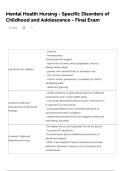
Mental Health Nursing - Specific Disorders of
Childhood and Adolescence - Final Exam
Save
- poverty
- homelessness
child abuse and neglect
- high levels of family stress (separation, divorce,
sibling relationships)
risk factors for children
- parents with mental illness or substance use
- out of home placement
- chronic illness, prematurity or disability of child or
caretaking adult
- death and grieving
- 17,000 members surveyed about adverse childhood
experiences and current health status
- two-thirds reported at least one ACE, more than 1 in
Adverse childhood
5 reported 3 or more ACEs
experiences (ACES) study
- social populations more vulnerable because of
findings
social and economic conditions
- relationship between ACEs and negative health and
well-being outcomes
-The higher the score the greater the risk for psych\
-Consists of 10 questions
-5 questions are about childhood experiences of
Adverse Childhood
abuse and neglect
Experiences survey
-Other 5 are related to family members and include
addiction, domestic violence, loss of a parent, and
mental illness
, early adversity has ________ lasting impacts
_________
- injury (traumatic brain injury, fractures, burns)
- mental health (depression, anxiety, suicide, PTSD)
- maternal health (unintended pregnancy, pregnancy
examples of adverse complications, fetal death)
childhood experiences - infectious disease (HIV, STDs)
- chronic disease (cancer, diabetes)
- risky behaviors (alcohol and drug abuse, unsafe sex)
- opportunities (education, occupation, income)im
central nervous system abnormalities (usually in the
neurodevelopmental brain) that start in childhood and alter thinking and
disorders behavior (as in intellectual limitations or a
psychological disorder)
examples of intellectual development disorder (intellectual
neurodevelopmental disability), autism spectrum disorder, (attention
disorders deficit/hyperactivity disorder (ADHD)
onset during developmental period that includes both
intellectual development
intellectual and adaptive functioning deficits in
disorder DSM-5 definition
conceptual, social, and practical domains
intellectual development 1% of general population
disorder incident rate
intellectual development mild, moderate, severe, profound
disorder levels of
impairment
how is intellectual IQ tests, social adaptability tests
development disorder
determined?
Childhood and Adolescence - Final Exam
Save
- poverty
- homelessness
child abuse and neglect
- high levels of family stress (separation, divorce,
sibling relationships)
risk factors for children
- parents with mental illness or substance use
- out of home placement
- chronic illness, prematurity or disability of child or
caretaking adult
- death and grieving
- 17,000 members surveyed about adverse childhood
experiences and current health status
- two-thirds reported at least one ACE, more than 1 in
Adverse childhood
5 reported 3 or more ACEs
experiences (ACES) study
- social populations more vulnerable because of
findings
social and economic conditions
- relationship between ACEs and negative health and
well-being outcomes
-The higher the score the greater the risk for psych\
-Consists of 10 questions
-5 questions are about childhood experiences of
Adverse Childhood
abuse and neglect
Experiences survey
-Other 5 are related to family members and include
addiction, domestic violence, loss of a parent, and
mental illness
, early adversity has ________ lasting impacts
_________
- injury (traumatic brain injury, fractures, burns)
- mental health (depression, anxiety, suicide, PTSD)
- maternal health (unintended pregnancy, pregnancy
examples of adverse complications, fetal death)
childhood experiences - infectious disease (HIV, STDs)
- chronic disease (cancer, diabetes)
- risky behaviors (alcohol and drug abuse, unsafe sex)
- opportunities (education, occupation, income)im
central nervous system abnormalities (usually in the
neurodevelopmental brain) that start in childhood and alter thinking and
disorders behavior (as in intellectual limitations or a
psychological disorder)
examples of intellectual development disorder (intellectual
neurodevelopmental disability), autism spectrum disorder, (attention
disorders deficit/hyperactivity disorder (ADHD)
onset during developmental period that includes both
intellectual development
intellectual and adaptive functioning deficits in
disorder DSM-5 definition
conceptual, social, and practical domains
intellectual development 1% of general population
disorder incident rate
intellectual development mild, moderate, severe, profound
disorder levels of
impairment
how is intellectual IQ tests, social adaptability tests
development disorder
determined?