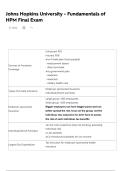
Johns Hopkins University - Fundamentals of
HPM Final Exam
Save
Uninsured: 10%
Insured: 90%
Any Private plan (most people)
- employment based
Sources of Insurance
- direct purchase
Coverage
Any government plan
- medicare
- medicaid
- military health care
Employer sponsored insurance
Types of private insurance
Individual/Direct purchase
Large group: >200 employees
Small group: <200 employees
Employer-sponsored Bigger employers can have bigger pools and can
insurance better spread the risk. focus on the group, not the
individual. less expensive bc don't have to assess
the risk of each individual. tax benefits
can be more expensive (less risk pooling, assessing
individual risk)
Individual/Direct Purchase
no tax benefits
ACA introduced subsidies for low income
Tax exclusion for employer-sponsored health
Largest Tax Expenditure
insurance
, - naturally organizes enrollees into large groups, and
large groups better spread risk
Positive effects of ESI
- large groups have better bargaining power to get
lower rates
- regression (lower income ppl benefit more)
- potential job lock: people become dependent on
their employment for health insurance
Negative effects of ESI - wage insurance trade off: insurance costs passed
onto the employees in the form of lower (or stagnant)
wages
--> employees may value insurance less than wages
Premiums
- worker component
Paying for ESI
- employer component
Cost Sharing
- deductibles, copays, coinsurances
- attempts to reduce moral hazard by requiring
Cost sharing payment at the time of services
- motivate patients to be smart shoppers or to have
"skin in the game"
1. Conventional
2. Health Maintenance organization (HPO)
Types of ESI plans 3. Preferred Provider Organization (HMO)
4. Point of Service (POS)
5. High Deductible Health Plan (HDHP)
More expensive, can usually see a doctor, no
management by PCP
Conventional Health Care
Plan This type of arrangement has few incentives for the
provider or the patient to minimize the cost of
treatment.
HPM Final Exam
Save
Uninsured: 10%
Insured: 90%
Any Private plan (most people)
- employment based
Sources of Insurance
- direct purchase
Coverage
Any government plan
- medicare
- medicaid
- military health care
Employer sponsored insurance
Types of private insurance
Individual/Direct purchase
Large group: >200 employees
Small group: <200 employees
Employer-sponsored Bigger employers can have bigger pools and can
insurance better spread the risk. focus on the group, not the
individual. less expensive bc don't have to assess
the risk of each individual. tax benefits
can be more expensive (less risk pooling, assessing
individual risk)
Individual/Direct Purchase
no tax benefits
ACA introduced subsidies for low income
Tax exclusion for employer-sponsored health
Largest Tax Expenditure
insurance
, - naturally organizes enrollees into large groups, and
large groups better spread risk
Positive effects of ESI
- large groups have better bargaining power to get
lower rates
- regression (lower income ppl benefit more)
- potential job lock: people become dependent on
their employment for health insurance
Negative effects of ESI - wage insurance trade off: insurance costs passed
onto the employees in the form of lower (or stagnant)
wages
--> employees may value insurance less than wages
Premiums
- worker component
Paying for ESI
- employer component
Cost Sharing
- deductibles, copays, coinsurances
- attempts to reduce moral hazard by requiring
Cost sharing payment at the time of services
- motivate patients to be smart shoppers or to have
"skin in the game"
1. Conventional
2. Health Maintenance organization (HPO)
Types of ESI plans 3. Preferred Provider Organization (HMO)
4. Point of Service (POS)
5. High Deductible Health Plan (HDHP)
More expensive, can usually see a doctor, no
management by PCP
Conventional Health Care
Plan This type of arrangement has few incentives for the
provider or the patient to minimize the cost of
treatment.