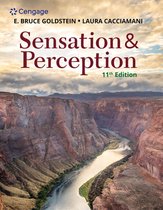
TEST BANK FOR SENSATION AND PERCEPTION 11th
EDITION BY E. BRUCE GOLDSTEIN| REVISED 100%
CORRECT ANSWERS (INCLUDES ESSAY QUESTIONS)
,
,
,
EDITION BY E. BRUCE GOLDSTEIN| REVISED 100%
CORRECT ANSWERS (INCLUDES ESSAY QUESTIONS)
,
,
,


Download Sensation and Perception 11th Edition Test Bank by E. Bruce Goldstein Test Bank Immediately After the Purchase. Just in case you have trouble downloading, kindly message me, and I will send it to you via Google Doc or email. Thank you The Sensation and Perception 11th Edition Test Bank by E. Bruce Goldstein is a comprehensive resource designed to assist students in their study of the fascinating field of sensation and perception. This test bank offers a wide range of carefully crafted questions and assessments that align with the content covered in the Sensation and Perception 11th Edition textbook. With the Sensation and Perception test bank, students can assess their understanding of key concepts, theories, and principles related to sensory processes and perceptual experiences. The test bank includes multiple-choice questions, true or false statements, and short answer questions that allow students to gauge their knowledge and comprehension of the subject matter. By using this test bank, students can enhance their preparation for exams, reinforce their learning, and gain confidence in their grasp of sensation and perception topics. The Sensation and Perception 10th Edition Test Bank by E. Bruce Goldstein serves as an invaluable tool for both instructors and students seeking to excel in this captivating field of study. Complete Test Bank Sensation and Perception 10th Edition Goldstein Questions & Answers with rationales (Chapter 1-15) 1. “Perceiving machines” that can negotiate the environment with humanlike ease a. were developed by computer scientists in the 1960s. b. were developed by computer scientists in the 1970s. c. were developed by computer scientists in the 1990s. d. have yet to be developed. 2. Which of the following is an application of perception research? a. Developing speech recognition systems. c. Devising robots that can “see.” b. Treating hearing problems. d. All of these. 3. Which of the following is a reason for studying perception? a. To become more aware of your own perceptual experiences. b. To provide information that may help with a future career. c. To apply perception to everyday problems, such as highway sign visibility. d. All of these. 4. The study of perception can overlap with a. medicine. c. philosophy. b. computer science. d. all of these. 5. Which of the following is NOT a category of the stages in the perceptual process? a. Stimuli c. Serendipity b. Neural Processing d. Behavioral Responses 6. The process of transforming energy in the environment into electrical energy in the neurons is called a. refraction. c. reduction. b. transduction. d. construction. 7. is the step in the perceptual process that is analogous to an ATM withdrawal (pressure from button press becomes electrical energy then becomes a mechanical response resulting in the dispensing of money). a. Knowledge c. Action b. Transference d. Transduction 8. The specific term for the “stimulus on the receptors” in visual processing is the a. transduced image. c. visual image. b. environmental stimulus. d. perception. 9. The image projected on the retina is best described as a of the actual stimulus. a. representation. c. replication. b. environmental stimulus. d. scale model. 10. Which brain structure is responsible for creating perceptions and producing other “high” level functions such as language, memory, and thinking? a. Brain stem c. Hypothalamus b. Cerebral cortex d. Occipital lobe 11. Visual form agnosia is a problem of the step of the perceptual process. a. action c. transduction b. attention d. recognition 12. Which of the following best describes the steps of the perceptual process? a. The steps are unidirectional, starting at the environmental stimulus and ending at perception. b. The steps are unidirectional, starting at the environmental stimulus and ending at knowledge. c. The steps are unidirectional, starting at transduction and ending at recognition. d. The sequence of steps is dynamic and constantly changing. 13. If a person sees the unambiguous “rat” stimulus, and then views the ambiguous “rat-man” figure, the person will most likely report seeing a. a rat, because of the effect of knowledge. b. a man, because we tend to see things that match our species. c. a rat, because of the effect of action. d. a rat or a man equally. 14. Justin forgot to wear his glasses to class so the writing he sees on the chalk board is blurry. Even so, he is sure it says “Pop Quiz!” because he knows that there are pop quizzes in the class and he can see read the “P” and the “Q”. What allows him to read the board? a. Bottom-up processing c. Top-down processing b. Oblique processing d. Compression 15. processing is based on the stimuli reaching the receptors. a. Bottom-up c. Top-down b. Oblique d. Receptor 16. Trying to read a note written by someone with poor handwriting involves a. only top-down processing. b. only bottom-up processing. c. both top-down and bottom-up processing. d. only data-based processing. 17. The physiological level of analysis involves the relationship between a. stimulus-and-physiology. b. physiology-and-perception. c. stimulus-and-perception. d. both stimulus-and-physiology and physiology-and-perception. 18. Kimmy is casting shadows on the wall and watching whether her cat Tiger jumps at the shadows or not. She uses different hand motions to see if there is a difference in whether Tiger jumps or not. Kimmy is informally studying which relationship? a. the stimulus-physiology relationship c. the stimulus-perception relationship b. the physiology-perception relationship d. all of these 19. Cognitive influences affect the level of analysis. a. physiological c. both physiological and psychophysical b. psychophysical d. neither physiological and psychophysical 20. The psychophysical method in which stimuli of varying intensities are presented in ascending and descending orders in discrete steps is called the method of a. limits. c. searching. b. constant stimuli. d. scaling. 21. When using the method of limits, the absolute threshold is determined by calculating a. the stimulus intensity detected 50% of the time. b. the stimulus intensity detected 75% of the time. c. the stimulus intensity detected 100% of the time. d. the average of the “cross-over” points. 22. The difference between the method of limits and the method of adjustment is that, in the method of adjustment, stimulus intensity is changed in a manner. a. stepwise c. continuous b. bivariate d. discrete 23. Of the three classical psychophysical methods, the method of constant stimuli a. is most accurate, but takes the most amount of time. b. is least accurate, but is the fastest. c. is the fastest and most accurate method. d. is the least accurate and takes the most amount of time. 24. As used in the textbook, the “DL” is the abbreviation for a. detection level. c. descending limit. b. differenze limen. d. determinant logarithm. 25. Using Weber’s Law, if the DL for a 100 gram weight standard is 2 grams, then the DL when using a 200 gram standard would be grams. a. 0.02 c. 4 b. 2 d. 50 26. The Weber’s fraction for electric shock is , and for light intensity. a. 0.01; 0.08 c. 0.02; 0.02 b. 0.08; 0.01 d. 0.08; 0.08 27. The “S” in the Weber fraction stands for: a. sensation c. standard stimulus b. synapse d. somatic

Hi! I’m a dedicated student who creates clear, exam-focused summaries, study guides, and assignment notes. My materials are designed for fast understanding, simple revision, and higher grades. I specialize in breaking down complex topics into easy, structured notes that save you time and boost exam confidence. Every document is organized, original, and created from high-quality course content. If you want reliable, easy-to-use, and exam-ready notes — you’re in the right place.

Calidad en la que puedes confiar: escrito por estudiantes que aprobaron y evaluado por otros que han usado estos resúmenes.
¡No te preocupes! Puedes elegir directamente otro documento que se ajuste mejor a lo que buscas.
Sin suscripción, sin compromisos. Paga como estés acostumbrado con tarjeta de crédito y descarga tu documento PDF inmediatamente.

“Comprado, descargado y aprobado. Así de fácil puede ser.”