

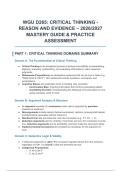
WGU D265: CRITICAL THINKING -
REASON AND EVIDENCE – 2026/2027
MASTERY GUIDE & PRACTICE
ASSESSMENT
PART 1: CRITICAL THINKING DOMAINS SUMMARY
Domain A: The Fundamentals of Critical Thinking
● Critical Thinking is the disciplined process of actively and skillfully conceptualizing,
applying, analyzing, synthesizing, and evaluating information to reach reasoned
judgments.
● Statements (Propositions) are declarative sentences that can be true or false (e.g.,
"Water boils at 100°C"). Non-statements include questions, commands, and
exclamations.
● Cognitive Biases are systematic errors in thinking. Key examples:
○ Confirmation Bias: Favoring information that confirms preexisting beliefs.
○ Availability Heuristic: Overestimating the likelihood of events based on how
easily examples come to mind.
Domain B: Argument Analysis & Structure
● An argument consists of a conclusion (main claim) supported by premises
(reasons or evidence).
● Non-arguments include reports (factual summaries), opinions (unsupported claims),
and illustrations (examples without inference).
● Standard Form lists premises first, then the conclusion (e.g., P1, P2, ∴ C).
● Deductive arguments aim for certainty: if premises are true, the conclusion must be
true. Inductive arguments aim for probability: premises make the conclusion likely.
● Implied premises/conclusions are unstated but necessary for the argument to
work.
Domain C: Deductive Logic & Validity
● A deductive argument is valid if the conclusion logically follows from the premises,
regardless of truth. It is sound if valid and premises are true.
● Categorical Propositions:
○ A: All S are P
○ E: No S are P
, ○ I: Some S are P
○ O: Some S are not P
● Valid Deductive Forms:
○ Modus Ponens: If P, then Q. P. ∴ Q.
○ Modus Tollens: If P, then Q. Not Q. ∴ Not P.
○ Hypothetical Syllogism: If P, then Q. If Q, then R. ∴ If P, then R.
○ Disjunctive Syllogism: P or Q. Not P. ∴ Q.
● Formal Fallacies:
○ Denying the Antecedent: If P, then Q. Not P. ∴ Not Q. (Invalid)
○ Affirming the Consequent: If P, then Q. Q. ∴ P. (Invalid)
Domain D: Inductive Logic & Strength
● An inductive argument is strong if premises make the conclusion probable; cogent if
strong and premises are true.
● Inductive Forms:
○ Generalization: Drawing conclusions about a population from a sample.
○ Analogical Argument: Inferring similarity in one aspect based on similarity in
others.
○ Causal Argument: Claiming one event causes another.
○ Inference to Best Explanation (Abduction): Selecting the hypothesis that
best explains the evidence.
● Inductive Fallacies:
○ Hasty Generalization: Drawing a conclusion from an inadequate sample.
○ Weak Analogy: Comparing things that aren’t sufficiently alike.
○ Post Hoc Ergo Propter Hoc: Assuming causation from mere sequence.
○ Slippery Slope: Claiming a small step will inevitably lead to a chain of events
without evidence.
○ Appeal to Ignorance: Claiming something is true because it hasn’t been
proven false (or vice versa).
Domain E: Fallacies of Relevance & Unwarranted Assumptions
● Ad Hominem: Attacking the person instead of the argument.
● Straw Man: Misrepresenting an opponent’s argument to make it easier to attack.
● Red Herring: Introducing an irrelevant topic to divert attention.
● Appeal to Authority: Citing an authority who is not credible on the topic.
● False Dilemma: Presenting only two options when more exist.
● Begging the Question: Assuming the conclusion in the premises (circular
reasoning).
● Equivocation: Using a word with multiple meanings in different senses within an
argument.
● Appeal to Emotion: Manipulating emotions (fear, pity) instead of using logic.
● Bandwagon: Arguing something is true because it’s popular.
Domain F: Evaluating Evidence & Sources
, ● Credible Evidence must be:
○ Reliable: Consistent and trustworthy.
○ Relevant: Directly related to the claim.
○ Sufficient: Enough to support the conclusion.
● Types of Evidence:
○ Anecdotal: Personal stories (weak for generalization)
○ Statistical: Numerical data (strong if representative)
○ Expert Testimony: From qualified authorities
○ Analogical: Comparisons (strong if relevant similarities outweigh differences)
● Source Evaluation (R.A.V.E.N.):
○ Reputation: Is the source respected in the field?
○ Ability to See: Did the source directly observe the event?
○ Vested Interest: Does the source have a bias or stake in the outcome?
○ Expertise: Does the source have relevant knowledge or credentials?
○ Neutrality: Is the source impartial?
PART 2: COMPREHENSIVE PRACTICE ASSESSMENT
1. **Which of the following is a statement (proposition)?**
A) Please close the door.
B) What time is it?
C) The Earth orbits the Sun.
D) Wow, that’s amazing!
Answer: C
A statement (proposition) is a declarative sentence that can be true or false. Option C is a
factual claim. A is a command, B is a question, and D is an exclamation—none are truth-apt.
2. **Consider the passage: "Since all humans are mortal, and Socrates is a human, it follows
that Socrates is mortal." What is the conclusion?**
A) All humans are mortal.
B) Socrates is a human.
C) Socrates is mortal.
D) All of the above.
REASON AND EVIDENCE – 2026/2027
MASTERY GUIDE & PRACTICE
ASSESSMENT
PART 1: CRITICAL THINKING DOMAINS SUMMARY
Domain A: The Fundamentals of Critical Thinking
● Critical Thinking is the disciplined process of actively and skillfully conceptualizing,
applying, analyzing, synthesizing, and evaluating information to reach reasoned
judgments.
● Statements (Propositions) are declarative sentences that can be true or false (e.g.,
"Water boils at 100°C"). Non-statements include questions, commands, and
exclamations.
● Cognitive Biases are systematic errors in thinking. Key examples:
○ Confirmation Bias: Favoring information that confirms preexisting beliefs.
○ Availability Heuristic: Overestimating the likelihood of events based on how
easily examples come to mind.
Domain B: Argument Analysis & Structure
● An argument consists of a conclusion (main claim) supported by premises
(reasons or evidence).
● Non-arguments include reports (factual summaries), opinions (unsupported claims),
and illustrations (examples without inference).
● Standard Form lists premises first, then the conclusion (e.g., P1, P2, ∴ C).
● Deductive arguments aim for certainty: if premises are true, the conclusion must be
true. Inductive arguments aim for probability: premises make the conclusion likely.
● Implied premises/conclusions are unstated but necessary for the argument to
work.
Domain C: Deductive Logic & Validity
● A deductive argument is valid if the conclusion logically follows from the premises,
regardless of truth. It is sound if valid and premises are true.
● Categorical Propositions:
○ A: All S are P
○ E: No S are P
, ○ I: Some S are P
○ O: Some S are not P
● Valid Deductive Forms:
○ Modus Ponens: If P, then Q. P. ∴ Q.
○ Modus Tollens: If P, then Q. Not Q. ∴ Not P.
○ Hypothetical Syllogism: If P, then Q. If Q, then R. ∴ If P, then R.
○ Disjunctive Syllogism: P or Q. Not P. ∴ Q.
● Formal Fallacies:
○ Denying the Antecedent: If P, then Q. Not P. ∴ Not Q. (Invalid)
○ Affirming the Consequent: If P, then Q. Q. ∴ P. (Invalid)
Domain D: Inductive Logic & Strength
● An inductive argument is strong if premises make the conclusion probable; cogent if
strong and premises are true.
● Inductive Forms:
○ Generalization: Drawing conclusions about a population from a sample.
○ Analogical Argument: Inferring similarity in one aspect based on similarity in
others.
○ Causal Argument: Claiming one event causes another.
○ Inference to Best Explanation (Abduction): Selecting the hypothesis that
best explains the evidence.
● Inductive Fallacies:
○ Hasty Generalization: Drawing a conclusion from an inadequate sample.
○ Weak Analogy: Comparing things that aren’t sufficiently alike.
○ Post Hoc Ergo Propter Hoc: Assuming causation from mere sequence.
○ Slippery Slope: Claiming a small step will inevitably lead to a chain of events
without evidence.
○ Appeal to Ignorance: Claiming something is true because it hasn’t been
proven false (or vice versa).
Domain E: Fallacies of Relevance & Unwarranted Assumptions
● Ad Hominem: Attacking the person instead of the argument.
● Straw Man: Misrepresenting an opponent’s argument to make it easier to attack.
● Red Herring: Introducing an irrelevant topic to divert attention.
● Appeal to Authority: Citing an authority who is not credible on the topic.
● False Dilemma: Presenting only two options when more exist.
● Begging the Question: Assuming the conclusion in the premises (circular
reasoning).
● Equivocation: Using a word with multiple meanings in different senses within an
argument.
● Appeal to Emotion: Manipulating emotions (fear, pity) instead of using logic.
● Bandwagon: Arguing something is true because it’s popular.
Domain F: Evaluating Evidence & Sources
, ● Credible Evidence must be:
○ Reliable: Consistent and trustworthy.
○ Relevant: Directly related to the claim.
○ Sufficient: Enough to support the conclusion.
● Types of Evidence:
○ Anecdotal: Personal stories (weak for generalization)
○ Statistical: Numerical data (strong if representative)
○ Expert Testimony: From qualified authorities
○ Analogical: Comparisons (strong if relevant similarities outweigh differences)
● Source Evaluation (R.A.V.E.N.):
○ Reputation: Is the source respected in the field?
○ Ability to See: Did the source directly observe the event?
○ Vested Interest: Does the source have a bias or stake in the outcome?
○ Expertise: Does the source have relevant knowledge or credentials?
○ Neutrality: Is the source impartial?
PART 2: COMPREHENSIVE PRACTICE ASSESSMENT
1. **Which of the following is a statement (proposition)?**
A) Please close the door.
B) What time is it?
C) The Earth orbits the Sun.
D) Wow, that’s amazing!
Answer: C
A statement (proposition) is a declarative sentence that can be true or false. Option C is a
factual claim. A is a command, B is a question, and D is an exclamation—none are truth-apt.
2. **Consider the passage: "Since all humans are mortal, and Socrates is a human, it follows
that Socrates is mortal." What is the conclusion?**
A) All humans are mortal.
B) Socrates is a human.
C) Socrates is mortal.
D) All of the above.

