hesi peds
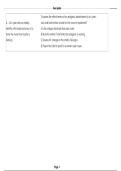
To assess the effectiveness of an analgesic administered to a 4-year-
A - (A 4-year-old can readily old, what intervention is best for the nurse to implement?
identify with simple pictures, A, to A) Use a happy-face/sad-face pain scale.
show the nurse how he/she is B) Ask the mother if she thinks the analgesic is working.
feeling.) C) Assess for changes in the child's vital signs.
D) Teach the child to point to a numeric pain scale.
Page 1
, hesi peds
A,B,D,E - (Correct responses are, A, A 3-week-old newborn is brought to the clinic for follow-up after a
B, D, and E. Neonates who have home birth. The mother reports that her child bottle feeds for 5
VSD may fatigue quickly during minutes only and then falls asleep. The nurse auscultates a loud
feeding and ingest inadequate murmur characteristic of a ventricular septal defect (VSD), and finds
amounts. They should be monitored the newborn is acyanotic with a respiratory rate of 64 breaths per
for weight gain and at least 6 wet minute. What instruction should the nurse provide the mother to
diapers per day, A. A one-month ensure the infant is receiving adequate intake? (Select all that apply.)
old infant should ingest 2 to 4 A) Monitor the the infant's weight and number of wet diapers per day.
ounces of formula per feeding and B) Increase the infant's intake per feeding by 1 to 2 ounces per week.
progress to about 30 ounces per C) Mix the dose of prophylactic antibiotic in a full bottle of formula.
day by 4-months of age, B. Due to D) Allow the infant to rest and re-feed on demand or every 2 hours.
fatigue, the infant should rest, but E) Use a softer nipple or increase the size of the nipple opening.
feed at least every 2 hours to
ensure adequate intake, D. A softer,
preemie, nipple or a larger slit in
the nipple, E, helps to reduce the
sucking effort and energy
expenditure, thus allowing the
infant to ingest more with less
effort.)
Page 2
, hesi peds
Which assessment finding(s) should the nurse expect when caring for a
A, C, D, E - (A, C, D, and E, are all child with cystic fibrosis? (Select all that apply.)
common assessment findings in the A. Steatorrhea
client with cystic fibrosis. Weight B. Obesity
loss, not weight gain, is associated C. Foul-smelling stools
with cystic fibrosis, B.) D. Delayed growth
E. Pulmonary congestion
A, C, F - (The most accurate Which measurements should be used to accurately calculate a
calculations of pediatric dosages pediatric medication dosage? (Select all that apply.)
use the child's height and weight, A. A) Child's height and weight.
The child's BSA is calculated using B) Adult dosage of medication.
the square root of weight in kg C) Body surface area of child.
times height in cm divided by 3600 D) Average adult's body surface area.
or the square root of weight in lb E) Average pediatric dosage of medication.
times height in inches divided by F) Nomogram determined mathematical constant.
3131, C, then the child's BSA is
multiplied by the recommended
published dose per BSA. The
nomogram, F, is used to plot the
child's height and weight, and the
point at which they intersect is the
BSA mathematical constant used to
calculate the child's dose.)
Page 3
, hesi peds
A, C, F - (The most accurate Which measurements should be used to accurately calculate a
calculations of pediatric dosages pediatric medication dosage? (Select all that apply.)
use the child's height and weight, A. A) Child's height and weight.
The child's BSA is calculated using B) Adult dosage of medication.
the square root of weight in kg C) Body surface area of child.
times height in cm divided by 3600 D) Average adult's body surface area.
or the square root of weight in lb E) Average pediatric dosage of medication.
times height in inches divided by F) Nomogram determined mathematical constant.
3131, C, then the child's BSA is
multiplied by the recommended
published dose per BSA. The
nomogram, F, is used to plot the
child's height and weight, and the
point at which they intersect is the
BSA mathematical constant used to
calculate the child's dose.)
A burned child is brought to the emergency room. In estimating the
A - (A child's head and neck are
percentage of the body burned, the nurse uses a modified "Rule of
proportionately larger to their body
Nines." Which part of a child's body is calculated as a larger
than an adult's, A. The standard
percentage of total body surface than an adult's?
"Rule of Nines" is inaccurate for
A) Head and neck.
determining burned body surface
B) Arms and chest.
areas with children, and must be
C) Legs and abdomen.
modified for use with children.)
D) Back and abdomen.
Page 4
To assess the effectiveness of an analgesic administered to a 4-year-
A - (A 4-year-old can readily old, what intervention is best for the nurse to implement?
identify with simple pictures, A, to A) Use a happy-face/sad-face pain scale.
show the nurse how he/she is B) Ask the mother if she thinks the analgesic is working.
feeling.) C) Assess for changes in the child's vital signs.
D) Teach the child to point to a numeric pain scale.
Page 1
, hesi peds
A,B,D,E - (Correct responses are, A, A 3-week-old newborn is brought to the clinic for follow-up after a
B, D, and E. Neonates who have home birth. The mother reports that her child bottle feeds for 5
VSD may fatigue quickly during minutes only and then falls asleep. The nurse auscultates a loud
feeding and ingest inadequate murmur characteristic of a ventricular septal defect (VSD), and finds
amounts. They should be monitored the newborn is acyanotic with a respiratory rate of 64 breaths per
for weight gain and at least 6 wet minute. What instruction should the nurse provide the mother to
diapers per day, A. A one-month ensure the infant is receiving adequate intake? (Select all that apply.)
old infant should ingest 2 to 4 A) Monitor the the infant's weight and number of wet diapers per day.
ounces of formula per feeding and B) Increase the infant's intake per feeding by 1 to 2 ounces per week.
progress to about 30 ounces per C) Mix the dose of prophylactic antibiotic in a full bottle of formula.
day by 4-months of age, B. Due to D) Allow the infant to rest and re-feed on demand or every 2 hours.
fatigue, the infant should rest, but E) Use a softer nipple or increase the size of the nipple opening.
feed at least every 2 hours to
ensure adequate intake, D. A softer,
preemie, nipple or a larger slit in
the nipple, E, helps to reduce the
sucking effort and energy
expenditure, thus allowing the
infant to ingest more with less
effort.)
Page 2
, hesi peds
Which assessment finding(s) should the nurse expect when caring for a
A, C, D, E - (A, C, D, and E, are all child with cystic fibrosis? (Select all that apply.)
common assessment findings in the A. Steatorrhea
client with cystic fibrosis. Weight B. Obesity
loss, not weight gain, is associated C. Foul-smelling stools
with cystic fibrosis, B.) D. Delayed growth
E. Pulmonary congestion
A, C, F - (The most accurate Which measurements should be used to accurately calculate a
calculations of pediatric dosages pediatric medication dosage? (Select all that apply.)
use the child's height and weight, A. A) Child's height and weight.
The child's BSA is calculated using B) Adult dosage of medication.
the square root of weight in kg C) Body surface area of child.
times height in cm divided by 3600 D) Average adult's body surface area.
or the square root of weight in lb E) Average pediatric dosage of medication.
times height in inches divided by F) Nomogram determined mathematical constant.
3131, C, then the child's BSA is
multiplied by the recommended
published dose per BSA. The
nomogram, F, is used to plot the
child's height and weight, and the
point at which they intersect is the
BSA mathematical constant used to
calculate the child's dose.)
Page 3
, hesi peds
A, C, F - (The most accurate Which measurements should be used to accurately calculate a
calculations of pediatric dosages pediatric medication dosage? (Select all that apply.)
use the child's height and weight, A. A) Child's height and weight.
The child's BSA is calculated using B) Adult dosage of medication.
the square root of weight in kg C) Body surface area of child.
times height in cm divided by 3600 D) Average adult's body surface area.
or the square root of weight in lb E) Average pediatric dosage of medication.
times height in inches divided by F) Nomogram determined mathematical constant.
3131, C, then the child's BSA is
multiplied by the recommended
published dose per BSA. The
nomogram, F, is used to plot the
child's height and weight, and the
point at which they intersect is the
BSA mathematical constant used to
calculate the child's dose.)
A burned child is brought to the emergency room. In estimating the
A - (A child's head and neck are
percentage of the body burned, the nurse uses a modified "Rule of
proportionately larger to their body
Nines." Which part of a child's body is calculated as a larger
than an adult's, A. The standard
percentage of total body surface than an adult's?
"Rule of Nines" is inaccurate for
A) Head and neck.
determining burned body surface
B) Arms and chest.
areas with children, and must be
C) Legs and abdomen.
modified for use with children.)
D) Back and abdomen.
Page 4