

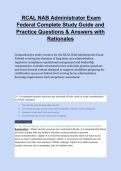
RCAL NAB Administrator Exam
Federal Complete Study Guide and
Practice Questions & Answers with
Rationales
Comprehensive study resource for the RCAL NAB Administrator Exam
Federal covering key domains of long term care administration
regulatory compliance operational management and leadership
competencies. Includes structured review materials practice questions
and exam focused content designed to support candidates preparing for
certification success in federal level nursing home administration
licensing requirements and competency assessment.
Q1. If contracted laundry services are provided off site, what is a key consideration
for RCAL facilities?
1. The laundry must be done daily on site.
2. The off-site laundry service must meet the facility's infection control standards.
3. Residents must wash their own laundry.
4. Laundry services are not required for residents.
Correct Answer:
B. The off-site laundry service must meet the facility's infection control standards.
Explanation - When laundry services are contracted off site, it is essential that these
services comply with the facility's infection control policies to prevent
cross-contamination. Option A is incorrect because laundry does not have to be
done on site if contracted out properly. Option C is incorrect as residents are not
expected to do their own laundry in RCAL settings. Option D is false because
laundry services are a necessary part of resident care.
,Q2. For residents with dementia, optimal food choices are best achieved by:
1. Offering a wide variety of unfamiliar foods.
2. Providing foods that are easy to chew and familiar to the resident.
3. Restricting all snacks between meals.
4. Serving meals in a noisy, busy environment.
Correct Answer:
B. Providing foods that are easy to chew and familiar to the resident.
Explanation - Residents with dementia benefit from familiar, easy-to-chew foods to
reduce confusion and promote adequate nutrition. Option A is incorrect because
unfamiliar foods may cause distress. Option C is incorrect as snacks may be
necessary to maintain nutrition. Option D is incorrect because noisy environments
can increase agitation.
Q3. When should information be added to an Individualized Care Plan (ICP)?
1. Only during the initial assessment.
2. Whenever there is a change in the resident’s condition or needs.
3. Once a year during the annual review.
4. Only when the resident requests it.
Correct Answer:
B. Whenever there is a change in the resident’s condition or needs.
Explanation - An ICP is a dynamic document that should be updated whenever the
resident’s condition or care needs change to ensure appropriate care. Option A is
incorrect because the ICP is not static. Option C is incorrect because waiting a year
may delay necessary care adjustments. Option D is incorrect because staff must
update the ICP proactively, not only on resident request.
,Q4. The correct disposal location for contaminated sharps is:
1. Regular trash bins.
2. Designated sharps containers.
3. Recycling bins.
4. On the floor near workstations.
Correct Answer:
B. Designated sharps containers.
Explanation - Sharps containers prevent injury and contamination. Options A, C,
and D pose safety hazards.
Q5. The acronym R.A.C.E in fire safety stands for:
1. Rescue, Alarm, Confine, Extinguish.
2. Run, Alert, Call, Evacuate.
3. React, Assess, Control, Exit.
4. Reach, Aim, Compress, Evacuate.
Correct Answer:
A. Rescue, Alarm, Confine, Extinguish.
Explanation - R.A.C.E outlines steps to respond to fire emergencies. Other options
are incorrect or unrelated.
, Q6. For residents with dementia, what approach best optimizes food choices to
support their nutritional needs?
1. Offering familiar, easy-to-eat foods in a calm environment
2. Providing a wide variety of unfamiliar foods to stimulate appetite
3. Enforcing strict meal times without flexibility
4. Allowing residents to eat only finger foods regardless of preference
Correct Answer:
:A. Offering familiar, easy-to-eat foods in a calm environment
Explanation - Familiar foods reduce confusion and anxiety in dementia patients, and
easy-to-eat options accommodate their physical and cognitive limitations. A calm
environment supports focus on eating. Offering unfamiliar foods (B) may cause
distress. Strict meal times (C) may not align with residents’ fluctuating appetites.
Finger foods only (D) may limit nutrition and choice unnecessarily.
Q7. Bloodborne Pathogens (BBPs) are best described as:
1. Infectious microorganisms in human blood that can cause disease
2. Non-infectious substances found in the environment
3. Only viruses that affect the respiratory system
4. Chemicals used for cleaning medical equipment
Correct Answer:
:A. Infectious microorganisms in human blood that can cause disease
Explanation - BBPs include viruses like HIV, HBV, and HCV present in blood that
can infect humans. Non-infectious substances (B) and respiratory viruses (C) are
incorrect. Cleaning chemicals (D) are unrelated.
Federal Complete Study Guide and
Practice Questions & Answers with
Rationales
Comprehensive study resource for the RCAL NAB Administrator Exam
Federal covering key domains of long term care administration
regulatory compliance operational management and leadership
competencies. Includes structured review materials practice questions
and exam focused content designed to support candidates preparing for
certification success in federal level nursing home administration
licensing requirements and competency assessment.
Q1. If contracted laundry services are provided off site, what is a key consideration
for RCAL facilities?
1. The laundry must be done daily on site.
2. The off-site laundry service must meet the facility's infection control standards.
3. Residents must wash their own laundry.
4. Laundry services are not required for residents.
Correct Answer:
B. The off-site laundry service must meet the facility's infection control standards.
Explanation - When laundry services are contracted off site, it is essential that these
services comply with the facility's infection control policies to prevent
cross-contamination. Option A is incorrect because laundry does not have to be
done on site if contracted out properly. Option C is incorrect as residents are not
expected to do their own laundry in RCAL settings. Option D is false because
laundry services are a necessary part of resident care.
,Q2. For residents with dementia, optimal food choices are best achieved by:
1. Offering a wide variety of unfamiliar foods.
2. Providing foods that are easy to chew and familiar to the resident.
3. Restricting all snacks between meals.
4. Serving meals in a noisy, busy environment.
Correct Answer:
B. Providing foods that are easy to chew and familiar to the resident.
Explanation - Residents with dementia benefit from familiar, easy-to-chew foods to
reduce confusion and promote adequate nutrition. Option A is incorrect because
unfamiliar foods may cause distress. Option C is incorrect as snacks may be
necessary to maintain nutrition. Option D is incorrect because noisy environments
can increase agitation.
Q3. When should information be added to an Individualized Care Plan (ICP)?
1. Only during the initial assessment.
2. Whenever there is a change in the resident’s condition or needs.
3. Once a year during the annual review.
4. Only when the resident requests it.
Correct Answer:
B. Whenever there is a change in the resident’s condition or needs.
Explanation - An ICP is a dynamic document that should be updated whenever the
resident’s condition or care needs change to ensure appropriate care. Option A is
incorrect because the ICP is not static. Option C is incorrect because waiting a year
may delay necessary care adjustments. Option D is incorrect because staff must
update the ICP proactively, not only on resident request.
,Q4. The correct disposal location for contaminated sharps is:
1. Regular trash bins.
2. Designated sharps containers.
3. Recycling bins.
4. On the floor near workstations.
Correct Answer:
B. Designated sharps containers.
Explanation - Sharps containers prevent injury and contamination. Options A, C,
and D pose safety hazards.
Q5. The acronym R.A.C.E in fire safety stands for:
1. Rescue, Alarm, Confine, Extinguish.
2. Run, Alert, Call, Evacuate.
3. React, Assess, Control, Exit.
4. Reach, Aim, Compress, Evacuate.
Correct Answer:
A. Rescue, Alarm, Confine, Extinguish.
Explanation - R.A.C.E outlines steps to respond to fire emergencies. Other options
are incorrect or unrelated.
, Q6. For residents with dementia, what approach best optimizes food choices to
support their nutritional needs?
1. Offering familiar, easy-to-eat foods in a calm environment
2. Providing a wide variety of unfamiliar foods to stimulate appetite
3. Enforcing strict meal times without flexibility
4. Allowing residents to eat only finger foods regardless of preference
Correct Answer:
:A. Offering familiar, easy-to-eat foods in a calm environment
Explanation - Familiar foods reduce confusion and anxiety in dementia patients, and
easy-to-eat options accommodate their physical and cognitive limitations. A calm
environment supports focus on eating. Offering unfamiliar foods (B) may cause
distress. Strict meal times (C) may not align with residents’ fluctuating appetites.
Finger foods only (D) may limit nutrition and choice unnecessarily.
Q7. Bloodborne Pathogens (BBPs) are best described as:
1. Infectious microorganisms in human blood that can cause disease
2. Non-infectious substances found in the environment
3. Only viruses that affect the respiratory system
4. Chemicals used for cleaning medical equipment
Correct Answer:
:A. Infectious microorganisms in human blood that can cause disease
Explanation - BBPs include viruses like HIV, HBV, and HCV present in blood that
can infect humans. Non-infectious substances (B) and respiratory viruses (C) are
incorrect. Cleaning chemicals (D) are unrelated.




