AO3 Evaluations - The Working Memory Model
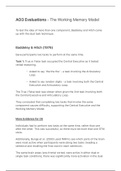
To test the idea of more than one component, Baddeley and Hitch came
up with the dual task technique.
Baddeley & Hitch (1976)
Gave participants two tasks to perform at the same time.
Task 1: True or False task occupied the Central Executive as it tested
verbal reasoning.
– Asked to say ‘the the the’ - a task involving the Articulatory
Loop.
– Asked to say random digits - a task involving both the Central
Executive and Articulatory Loop.
The True / False task was slower when given the 2nd task involving both
the Central Executive and Articulatory Loop.
They concluded that completing two tasks that involve the same
component causes difficulty, supporting the Central Executive and the
Working Memory Model.
More Evidence for CE
Individuals had to perform two tasks at the same time, rather than one
after the other. This was successful, so there must be more than one STM
store.
Additionally, Bunge et al. (2000) used fMRI to see which parts of the brain
were most active when participants were doing two tasks (reading a
sentence and recalling the final word in each sentence).
The same brain areas (pre-frontal cortex) were active in either dual or
single task conditions; there was significantly more activation in the dual
To test the idea of more than one component, Baddeley and Hitch came
up with the dual task technique.
Baddeley & Hitch (1976)
Gave participants two tasks to perform at the same time.
Task 1: True or False task occupied the Central Executive as it tested
verbal reasoning.
– Asked to say ‘the the the’ - a task involving the Articulatory
Loop.
– Asked to say random digits - a task involving both the Central
Executive and Articulatory Loop.
The True / False task was slower when given the 2nd task involving both
the Central Executive and Articulatory Loop.
They concluded that completing two tasks that involve the same
component causes difficulty, supporting the Central Executive and the
Working Memory Model.
More Evidence for CE
Individuals had to perform two tasks at the same time, rather than one
after the other. This was successful, so there must be more than one STM
store.
Additionally, Bunge et al. (2000) used fMRI to see which parts of the brain
were most active when participants were doing two tasks (reading a
sentence and recalling the final word in each sentence).
The same brain areas (pre-frontal cortex) were active in either dual or
single task conditions; there was significantly more activation in the dual