Genetics I Study Guide
By Alex Z
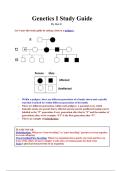
Let’s start this study guide by taking a look at a pedigree.
- Within a pedigree, there are different generations of a family shown and a specific
trait that is looked for within different generations of the family
- There are different generations within each pedigree. A parental cross, which
basically means one parent that is affected and one parent unaffected mating can be
labelled as the “P” generation. Every generation after that is “F” and the number of
generations after, so for example, “F1” is the first generation after “P”.
- This is an example of hybridization
FLASH VOCAB:
Hybridization: When two “true-breeding” or “pure-breeding” parents are bred together
to create offspring.
True-breeding/Pure-breeding: When two organisms have purely one trait and have no
trace of the other. In more complex words, they are homozygous for their trait.
Trait:A physical characteristic of an organism.
, Gene: A portion of DNA that determines a trait.
WHEN MAKING A PEDIGREE, KEEP IN MIND:
- Squares represent biological males
- Circles represent biological females
- If there is a line connecting two individuals and the line is between them, it means
they are together.
- If there is a line ABOVE two individuals, that means that they are siblings!
❖ REMEMBER: When ordering siblings in a pedigree, the OLDEST is always
on the LEFT, and as you go toward the right they get younger until the
YOUNGEST sibling is on the RIGHT.
- Usually, when an individual is shaded, this means they are affected by the trait
shown.
- A dash diagonally through an organism means that they have died most likely due
to the trait.
Now, since there is A LOT of weird language used in this unit, let’s go over some
vocabulary!
Word Definition Example
Alleles Different versions of genes Alleles are usually
for the same trait. represented by numbers or
letters. EX: (1,1) (1,2) (2,2)
Phenotype The variation of a trait that Traits that show such as
PHYSICALLY shows in an blue eyes or brown hair.
organism. (Think of Pheno
= PHYSICAL)
By Alex Z
Let’s start this study guide by taking a look at a pedigree.
- Within a pedigree, there are different generations of a family shown and a specific
trait that is looked for within different generations of the family
- There are different generations within each pedigree. A parental cross, which
basically means one parent that is affected and one parent unaffected mating can be
labelled as the “P” generation. Every generation after that is “F” and the number of
generations after, so for example, “F1” is the first generation after “P”.
- This is an example of hybridization
FLASH VOCAB:
Hybridization: When two “true-breeding” or “pure-breeding” parents are bred together
to create offspring.
True-breeding/Pure-breeding: When two organisms have purely one trait and have no
trace of the other. In more complex words, they are homozygous for their trait.
Trait:A physical characteristic of an organism.
, Gene: A portion of DNA that determines a trait.
WHEN MAKING A PEDIGREE, KEEP IN MIND:
- Squares represent biological males
- Circles represent biological females
- If there is a line connecting two individuals and the line is between them, it means
they are together.
- If there is a line ABOVE two individuals, that means that they are siblings!
❖ REMEMBER: When ordering siblings in a pedigree, the OLDEST is always
on the LEFT, and as you go toward the right they get younger until the
YOUNGEST sibling is on the RIGHT.
- Usually, when an individual is shaded, this means they are affected by the trait
shown.
- A dash diagonally through an organism means that they have died most likely due
to the trait.
Now, since there is A LOT of weird language used in this unit, let’s go over some
vocabulary!
Word Definition Example
Alleles Different versions of genes Alleles are usually
for the same trait. represented by numbers or
letters. EX: (1,1) (1,2) (2,2)
Phenotype The variation of a trait that Traits that show such as
PHYSICALLY shows in an blue eyes or brown hair.
organism. (Think of Pheno
= PHYSICAL)