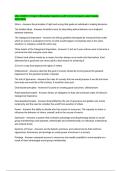
UNL COMM 101 Exam 2 (Bonander) Questions with Correct Answers Latest Update
2025/2026
Ethics - Answers the principles of right and wrong that guide an individual in making decisions
The Golden Mean - Answers Aristotle's term for describing ethical behavior as a midpoint
between extremes
The Categorical Imperative - Answers An ethical guideline developed by Immanuel Kant under
which an action is evaluated in terms of what would happen if everybody else in the same
situation, or category, acted the same way.
Three tenets of the Categorical Imperative - Answers 1) Act as if your actions were to become a
universal law that everyone must obey
2) Never treat others merely as a means, but also always as an ends unto themselves. Kant
believed that a good end can never justify a bad means for achieving it.
3) Act in a way that respects the rights of others
Utilitarianism - Answers idea that the goal of society should be to bring about the greatest
happiness for the greatest number of people
The Veil of Ignorance - Answers the rules for society that we would propose if we did not know
how lucky we would be in life's lottery. It would be more just.
Ends-based-principles - Answers Focused on creating good outcomes. Utilitarianism.
Rules-based-principles - Answers Stress an obligation to duty and universal codes of behavior.
Categorical imperative.
Care-based-principles - Answers Exemplified by the veil of ignorance and golden rule, stress
reciprocity and the need to consider the world from position of others
Power - Answers the ability to decide who has access to resources. The capacity to direct or
influence the behavior of others, oneself, and/or the course of events
Opression - Answers a system that maintains advantage and disadvantage based on social
group memberships and operates, intentionally and unintentionally, on individual, institutional,
and cultural levels
Systems of Power - Answers are the beliefs, practices, and cultural norms that reinforce
oppression, dominance, and privilege to create power structures in a society
Privilege - Answers unearned access to resources only readily available to some people as a
result of their advantaged social group membership
, Class - Answers a system of ordering a society in which people are divided based on perceived
social class or economic status
Hegemony - Answers the dominance of one group over another, often supported by legitimizing
norms and ideas. Ex: hegemonic masculinity
Patriarchy - Answers a social system in which father or male elder has absolute authority over
the family group specifically
Social Change - Answers occurs when systems of power ingrained in society are confronted or
attempt to be altered
Micro Agression - Answers are the everyday verbal, nonverbal, and environmental slights, snubs,
or insults, whether intentional or unintentional, that communicate hostile, derogatory, or
negative messages to target persons based solely upon their marginalized group membership
Elected Leader - Answers although used by groups of all sizes, this process is often necessary
for larger groups when direct communication isn't possible
-The election model makes leaders responsible to group bc if they fail they can be removed
-On the other side the election model can lead to the creation of factions of supporters
Appointed Leader - Answers sometimes leaders are appointed by someone or a body outside of
the group. They usually come with some form of expertise that qualified them to lead
-The challenge is that they may not be respected by the group
Emergent Leader - Answers a group member who emerges as a leader during the group's
deliberations.
-This type of leader is identified by the group, but not officially, rather an emergent leader
demonstrates qualities that everyone else in the group sees as both needed and desirable. Can
exist even if there is an elected leader
Reward Power - Answers the ability to either provide a good thing or take away a negative thing
from someone doing a task.
ex: salary, grades, sales
Referent Power - Answers is power derived from charisma of a leader and can be seen when
people follow someone they like, admire, look up to, or otherwise attracted to
-Can be lost if you do something that people who like you disagree with and if that
disagreement is strong
Coercive Power - Answers involves the ability to introduce something negative or take away
2025/2026
Ethics - Answers the principles of right and wrong that guide an individual in making decisions
The Golden Mean - Answers Aristotle's term for describing ethical behavior as a midpoint
between extremes
The Categorical Imperative - Answers An ethical guideline developed by Immanuel Kant under
which an action is evaluated in terms of what would happen if everybody else in the same
situation, or category, acted the same way.
Three tenets of the Categorical Imperative - Answers 1) Act as if your actions were to become a
universal law that everyone must obey
2) Never treat others merely as a means, but also always as an ends unto themselves. Kant
believed that a good end can never justify a bad means for achieving it.
3) Act in a way that respects the rights of others
Utilitarianism - Answers idea that the goal of society should be to bring about the greatest
happiness for the greatest number of people
The Veil of Ignorance - Answers the rules for society that we would propose if we did not know
how lucky we would be in life's lottery. It would be more just.
Ends-based-principles - Answers Focused on creating good outcomes. Utilitarianism.
Rules-based-principles - Answers Stress an obligation to duty and universal codes of behavior.
Categorical imperative.
Care-based-principles - Answers Exemplified by the veil of ignorance and golden rule, stress
reciprocity and the need to consider the world from position of others
Power - Answers the ability to decide who has access to resources. The capacity to direct or
influence the behavior of others, oneself, and/or the course of events
Opression - Answers a system that maintains advantage and disadvantage based on social
group memberships and operates, intentionally and unintentionally, on individual, institutional,
and cultural levels
Systems of Power - Answers are the beliefs, practices, and cultural norms that reinforce
oppression, dominance, and privilege to create power structures in a society
Privilege - Answers unearned access to resources only readily available to some people as a
result of their advantaged social group membership
, Class - Answers a system of ordering a society in which people are divided based on perceived
social class or economic status
Hegemony - Answers the dominance of one group over another, often supported by legitimizing
norms and ideas. Ex: hegemonic masculinity
Patriarchy - Answers a social system in which father or male elder has absolute authority over
the family group specifically
Social Change - Answers occurs when systems of power ingrained in society are confronted or
attempt to be altered
Micro Agression - Answers are the everyday verbal, nonverbal, and environmental slights, snubs,
or insults, whether intentional or unintentional, that communicate hostile, derogatory, or
negative messages to target persons based solely upon their marginalized group membership
Elected Leader - Answers although used by groups of all sizes, this process is often necessary
for larger groups when direct communication isn't possible
-The election model makes leaders responsible to group bc if they fail they can be removed
-On the other side the election model can lead to the creation of factions of supporters
Appointed Leader - Answers sometimes leaders are appointed by someone or a body outside of
the group. They usually come with some form of expertise that qualified them to lead
-The challenge is that they may not be respected by the group
Emergent Leader - Answers a group member who emerges as a leader during the group's
deliberations.
-This type of leader is identified by the group, but not officially, rather an emergent leader
demonstrates qualities that everyone else in the group sees as both needed and desirable. Can
exist even if there is an elected leader
Reward Power - Answers the ability to either provide a good thing or take away a negative thing
from someone doing a task.
ex: salary, grades, sales
Referent Power - Answers is power derived from charisma of a leader and can be seen when
people follow someone they like, admire, look up to, or otherwise attracted to
-Can be lost if you do something that people who like you disagree with and if that
disagreement is strong
Coercive Power - Answers involves the ability to introduce something negative or take away