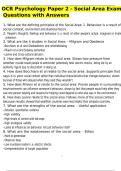
OCR Psychology Paper 2 - Social Area Exam
Questions with Answers
1. What are the defining principles of the Social Area: 1. Behaviour is a result of
social context, environment and situational factors.
2. People's thoughts, feelings and behaviour is a result of other people's actual, imagined or implie
presence.
2. What are the 4 studies in Social Area: - Milgram and Obedience
-Bocchiaro et al and Disobedience and whistleblowing
-Piliavin et al and Subway samaritan
-Levine and Cross-cultural altruism
3. How does Milgram relate to the social area: Shows how pressure from
another could lead people to administer potentially fatal electric shocks, being led by an
authority figure due to discomfort in doing so.
4. How does Bocchiaro et al relate to the social area: Supports principle that
says it is your social context rather than individual characteristics that changes behaviour, shown
by level of those who obeyed when they said they wouldn't.
5. How does Piliavin et al relate to the social area: Proves people in surrounding
environment can influence someone's behaviour, shown by fact that people would help after they
saw one person helping and reasons for helping could depend on who else was in the environment.
6. How does Levine relate to the social area: Follows more of the social context
because results showed that wealthier countries were less helpful than simpatia countries.
7. What are the strengths of the social area: - Useful applications
-Detailed, quantitative evidence
-High validity
-High levels of control with lab exps
-High ecological validity
-Looks at influences on behaviour not just behaviour itself
8. What are the weaknesses of the social area: - Ethics
-Hard to generalise
-Observer bias
-Low mundane realism i.e. electric shocks
-Unrepresentative of target population
1/
1
Questions with Answers
1. What are the defining principles of the Social Area: 1. Behaviour is a result of
social context, environment and situational factors.
2. People's thoughts, feelings and behaviour is a result of other people's actual, imagined or implie
presence.
2. What are the 4 studies in Social Area: - Milgram and Obedience
-Bocchiaro et al and Disobedience and whistleblowing
-Piliavin et al and Subway samaritan
-Levine and Cross-cultural altruism
3. How does Milgram relate to the social area: Shows how pressure from
another could lead people to administer potentially fatal electric shocks, being led by an
authority figure due to discomfort in doing so.
4. How does Bocchiaro et al relate to the social area: Supports principle that
says it is your social context rather than individual characteristics that changes behaviour, shown
by level of those who obeyed when they said they wouldn't.
5. How does Piliavin et al relate to the social area: Proves people in surrounding
environment can influence someone's behaviour, shown by fact that people would help after they
saw one person helping and reasons for helping could depend on who else was in the environment.
6. How does Levine relate to the social area: Follows more of the social context
because results showed that wealthier countries were less helpful than simpatia countries.
7. What are the strengths of the social area: - Useful applications
-Detailed, quantitative evidence
-High validity
-High levels of control with lab exps
-High ecological validity
-Looks at influences on behaviour not just behaviour itself
8. What are the weaknesses of the social area: - Ethics
-Hard to generalise
-Observer bias
-Low mundane realism i.e. electric shocks
-Unrepresentative of target population
1/
1