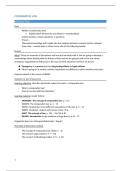
COMPARATIVE LAW
INTRODUCTION
EXAM
- Written closed books exam
o English/dutch dictionaries are allowed = woordenlijsten
- Limited number of open questions: 5 questions
- 3 hours
- Theoretical knowledge with insight into the relations between concepts and/or methods
- Essay style – sample exam in Ufora course site (in the following weeks)
EMERGE
What? Focus on moments of disruptions and how the law dealt with it. We are going to develop a
methodology about dealing with the history of that and we are going to look at the way which
emergency regulations has left traces in the way we think about law and how we do law.
Emergency as a process that has long-lasting effects on legal cultures.
What is going on in another country: regulations are different in other countries and areas
General outlook of the course: EMERGE
OVERVIEW OF THIS INTRODUCTION
Learning objective: describe and situate subject of course = comparative law
- What is comparative law?
- How do we deal with this discipline?
Learning material: reader (Ufora)
- ZWEIGERT: The concept of comparative law: p. 1-12
- KOKKINI: The comparative law: p. 3 – 13
- DAVID: Introduction in the different conceptions of the law: p. 3 – 13
- GREEN: Positivism, realism and sources of law: 35 p.
- HART: The concept of law: p. 136 – 156 (5A & B)
- KELSEN: Introduction to the problems of legal theory: p.55 – 75
Vetgedrukt lezen ter achtergrondinformatie + begrip!
Overview of the lecture content
- The concept of comparative law (slides 1 – 3)
- The research object (slides 1-4 => 1-8)
- The research methodology (slides 1-9 => 1-15)
1
,TO START
HOW TO COMPARE TWO LEGAL SYSTEMS?
Law = object of research of comparative law
Focus: how do we compare two different legal systems? In order to explain that, putting two
things together, we need to first understand what law is and how we do law.
How? In an organized way: we organize through the means of science. Organised knowledge
- Science: legal discipline
- Practice: we practice law
- Art: we do/feel art
Basically the traditional way to compare law is to compare law to other sciences. Law interacts with
other things in the law:
- E.g. public international law, private international law. = law science
- E.g. sociology, anthropology = other sciences that have nothing to do with law
Comparative law has less to do with law then it has to do with other things.
What is the thing we compare? = essence = object
2
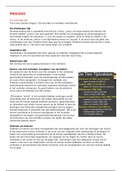
,CHAPTER 1: THE CONCEPT OF COMPARATIVE LAW
COMPARISON OF LAW / LEGAL COMPARISON
The term comparative law = misleading => because it’s not about law and it is about comparison.
It is NOT a
- Body of law (objective law) or branch of law
o Comparative law is not a branch of the law like criminal law!
o Comparative law is not “RECHT”
- Type of claim or specific power (subjective right)
- Way of resolving conflicts compulsorily (functional law)
Comparative law is NOT (a type of) law.
Some designations are therefore misleading:
- Comparative law
- Droit comparé (compared law)
IT IS = comparative legal studies = the way of studying the law through the process of comparison
=> “an intellectual activity with law as its object and comparison as its process” (ZWEIGERT-KÖTZ)
- Different way/manner of understanding the law: “existing law is not just a theory”
- Comparative law enables us to do things differently and therefore we need to think different.
- Comparative law is about the act of comparing with law as its object. But we might
understand different things about what law is. So comparison as its process, is the essence.
= a comparison (= research method) of law (research object)
CHAPTER 2: THE RESEARCH OBJECT: WHAT IS LAW?
IMPORTANCE OF THE QUESTION
Before we compare law, we need to first have an idea about what law is. Because the most important
question before starting to compare legal systems is that we need to have an idea about what to
compare. The comparandum = most important thing.
- What can/may be compared to give meaningful result?
- What must be included in comparison to give meaningful result?
Law = “set of rules ordering society” = hollow description
If law is for example morality then this means that the analyses of comparative law, considering the
law of sexual regulation in the UK and the law of sexual regulation in Saoudi-Arabia, is very different.
The most common stand we have as lawyers is that we are legal positivists. If we want to become
practicing lawyers we need to believe that. The law that counts is the law that has been put down by
the state. This is the default position.
But we need to think about the law in a more deeper way. Where does these rules come from and
who put them there?
3
, - Law = Sollen (an ought) v. law = Sein (a being – is)
o “An ought” = law as a normative order: how people should behave
Natural theoretical position = there is a true law and everything should be in
consistence with this true law and if it is not then it is not true law.
E.g. the Nazi-order => is it binding or not? Is an illegitimite order binding?
= moral question
This natural theoretical position is under attack today: “law is different from
morality and law has nothing to do with morals”. So moral arguments can not
be made in a court of law in Belgium.
o Law is here, law is and law exists = an ought.
E.g. the Belgian law Belgium on property => this law is binding on anyone
who lives in Belgium.
o “A being” = law as it actually exists in society: world of social facts + empirical reality
- Law belongs to the world of ideas v. law belongs to the world of social facts
- Legal positivism: a rule exists if it is valid = as promulgated/recognised by real/authorised
ruler (law is posited) = as based on higher norm of formal sourve of law (all law is source-
based)
o A rule exists if it is valid
o Validity derives form a higher norm or a formal source of law
o Law = what is posited
o Focus: formal sources (legislation, judicial precedent)
- Sociological positivism (= legal realism): a rule exists if it appears enforced
o A rule exists if it is actually enforced
o If a rule is not applied in practice, is it not real law
o Focus: effectiveness and practice = the living law
- Law as practive v. law as theoretical representation of practive (= doctrine – teaching)
o Law as practice = law as it functions in real life
o Law as theoretical representation of practice (doctrine) = law as described,
systematized
- Law as enforced settlement of conflicts
o By government: courts, administratoin…
o By third party (to conflict): arbitration, mediation
o By any means (ie all conflict resolution, incl. concilition, right of the strongest)
Only by defining the perspective (Sollen or Sein; validity or effectiveness) can we reach a meaningful
understanding of what law “is.”
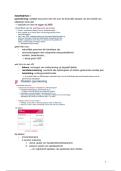
WHAT IS LAW? TWO DIFFERENT WAYS OF UNDERSTANDING WHAT LAW IS
What is the object of our analyses or what is law? There are two fundamentally different ways of
understanding what law is.
- Hans Kelsen’s: grundnorm
o In Belgium
- Hart: rule of recognition
o In common law countries: UK
4
INTRODUCTION
EXAM
- Written closed books exam
o English/dutch dictionaries are allowed = woordenlijsten
- Limited number of open questions: 5 questions
- 3 hours
- Theoretical knowledge with insight into the relations between concepts and/or methods
- Essay style – sample exam in Ufora course site (in the following weeks)
EMERGE
What? Focus on moments of disruptions and how the law dealt with it. We are going to develop a
methodology about dealing with the history of that and we are going to look at the way which
emergency regulations has left traces in the way we think about law and how we do law.
Emergency as a process that has long-lasting effects on legal cultures.
What is going on in another country: regulations are different in other countries and areas
General outlook of the course: EMERGE
OVERVIEW OF THIS INTRODUCTION
Learning objective: describe and situate subject of course = comparative law
- What is comparative law?
- How do we deal with this discipline?
Learning material: reader (Ufora)
- ZWEIGERT: The concept of comparative law: p. 1-12
- KOKKINI: The comparative law: p. 3 – 13
- DAVID: Introduction in the different conceptions of the law: p. 3 – 13
- GREEN: Positivism, realism and sources of law: 35 p.
- HART: The concept of law: p. 136 – 156 (5A & B)
- KELSEN: Introduction to the problems of legal theory: p.55 – 75
Vetgedrukt lezen ter achtergrondinformatie + begrip!
Overview of the lecture content
- The concept of comparative law (slides 1 – 3)
- The research object (slides 1-4 => 1-8)
- The research methodology (slides 1-9 => 1-15)
1
,TO START
HOW TO COMPARE TWO LEGAL SYSTEMS?
Law = object of research of comparative law
Focus: how do we compare two different legal systems? In order to explain that, putting two
things together, we need to first understand what law is and how we do law.
How? In an organized way: we organize through the means of science. Organised knowledge
- Science: legal discipline
- Practice: we practice law
- Art: we do/feel art
Basically the traditional way to compare law is to compare law to other sciences. Law interacts with
other things in the law:
- E.g. public international law, private international law. = law science
- E.g. sociology, anthropology = other sciences that have nothing to do with law
Comparative law has less to do with law then it has to do with other things.
What is the thing we compare? = essence = object
2
,CHAPTER 1: THE CONCEPT OF COMPARATIVE LAW
COMPARISON OF LAW / LEGAL COMPARISON
The term comparative law = misleading => because it’s not about law and it is about comparison.
It is NOT a
- Body of law (objective law) or branch of law
o Comparative law is not a branch of the law like criminal law!
o Comparative law is not “RECHT”
- Type of claim or specific power (subjective right)
- Way of resolving conflicts compulsorily (functional law)
Comparative law is NOT (a type of) law.
Some designations are therefore misleading:
- Comparative law
- Droit comparé (compared law)
IT IS = comparative legal studies = the way of studying the law through the process of comparison
=> “an intellectual activity with law as its object and comparison as its process” (ZWEIGERT-KÖTZ)
- Different way/manner of understanding the law: “existing law is not just a theory”
- Comparative law enables us to do things differently and therefore we need to think different.
- Comparative law is about the act of comparing with law as its object. But we might
understand different things about what law is. So comparison as its process, is the essence.
= a comparison (= research method) of law (research object)
CHAPTER 2: THE RESEARCH OBJECT: WHAT IS LAW?
IMPORTANCE OF THE QUESTION
Before we compare law, we need to first have an idea about what law is. Because the most important
question before starting to compare legal systems is that we need to have an idea about what to
compare. The comparandum = most important thing.
- What can/may be compared to give meaningful result?
- What must be included in comparison to give meaningful result?
Law = “set of rules ordering society” = hollow description
If law is for example morality then this means that the analyses of comparative law, considering the
law of sexual regulation in the UK and the law of sexual regulation in Saoudi-Arabia, is very different.
The most common stand we have as lawyers is that we are legal positivists. If we want to become
practicing lawyers we need to believe that. The law that counts is the law that has been put down by
the state. This is the default position.
But we need to think about the law in a more deeper way. Where does these rules come from and
who put them there?
3
, - Law = Sollen (an ought) v. law = Sein (a being – is)
o “An ought” = law as a normative order: how people should behave
Natural theoretical position = there is a true law and everything should be in
consistence with this true law and if it is not then it is not true law.
E.g. the Nazi-order => is it binding or not? Is an illegitimite order binding?
= moral question
This natural theoretical position is under attack today: “law is different from
morality and law has nothing to do with morals”. So moral arguments can not
be made in a court of law in Belgium.
o Law is here, law is and law exists = an ought.
E.g. the Belgian law Belgium on property => this law is binding on anyone
who lives in Belgium.
o “A being” = law as it actually exists in society: world of social facts + empirical reality
- Law belongs to the world of ideas v. law belongs to the world of social facts
- Legal positivism: a rule exists if it is valid = as promulgated/recognised by real/authorised
ruler (law is posited) = as based on higher norm of formal sourve of law (all law is source-
based)
o A rule exists if it is valid
o Validity derives form a higher norm or a formal source of law
o Law = what is posited
o Focus: formal sources (legislation, judicial precedent)
- Sociological positivism (= legal realism): a rule exists if it appears enforced
o A rule exists if it is actually enforced
o If a rule is not applied in practice, is it not real law
o Focus: effectiveness and practice = the living law
- Law as practive v. law as theoretical representation of practive (= doctrine – teaching)
o Law as practice = law as it functions in real life
o Law as theoretical representation of practice (doctrine) = law as described,
systematized
- Law as enforced settlement of conflicts
o By government: courts, administratoin…
o By third party (to conflict): arbitration, mediation
o By any means (ie all conflict resolution, incl. concilition, right of the strongest)
Only by defining the perspective (Sollen or Sein; validity or effectiveness) can we reach a meaningful
understanding of what law “is.”
WHAT IS LAW? TWO DIFFERENT WAYS OF UNDERSTANDING WHAT LAW IS
What is the object of our analyses or what is law? There are two fundamentally different ways of
understanding what law is.
- Hans Kelsen’s: grundnorm
o In Belgium
- Hart: rule of recognition
o In common law countries: UK
4