Lecture 1
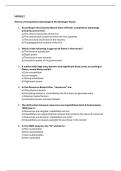
Theory of Competitive Advantage & The Strategic Tripod
1. According to the Industry-Based View of Porter, competitive advantage
primarily arises from:
a) The internal resources of the firm
b) The institutional context in which the firm operates
c) The structure and forces of the industry
d) The geographical location of the firm
2. Which of the following is not one of Porter’s five forces?
a) The threat of substitutes
b) Buyer power
c) The threat of new entrants
d) Innovation power of the government
3. A market with high entry barriers and significant fixed costs, according to
Porter, would likely exhibit:
a) Low competition
b) Low margins
c) Strong substitutes
d) High buyer power
4. In the Resource-Based View, “resources” are:
a) Only physical assets
b) Everything owned or controlled by the firm that can generate value
c) External market factors
d) Activities that are entirely tradable
5. The distinction between resources and capabilities (Amit & Schoemaker,
1993) lies in:
a) Resources are tangible; capabilities are not
b) Capabilities are organizational routines that enhance the value of resources
c) Resources are dynamic; capabilities are static
d) Capabilities are always available for purchase in the market’
6. In the VRIN analysis, the “N” stands for:
a) Non-sustainable
b) Non-standardized
c) Non-substitutable
d) Non-replicable
,7. According to Barney (1995), VRIN was expanded with the “O” for:
a) Operational efficiency
b) Organizational support
c) Opportunistic capability
d) Output advantage
8. A resource that is valuable and rare but easily imitable would lead to:
a) Sustained competitive advantage
b) Temporary competitive advantage
c) Competitive parity
d) Competitive disadvantage
9. Impediments to imitation include:
a) Learning organizations
b) High marketing expenditures
c) Intangible barriers such as causal ambiguity
d) Efficiency through economies of scale
10. Early-mover advantages arise primarily from:
a) Rapid access to raw materials
b) Delays in technology adoption
c) Higher risks from unfamiliar markets
d) Limited learning effects
11. Network effects create a competitive advantage because:
a) Costs decrease with more users
b) The value for customers increases as more people use the product
c) Government participation encourages it
d) Competitors cannot enter the market
12. Bounded reliability (in the transaction cost context) refers to:
a) Partners’ inability to be consistently reliable
b) Perfect contract enforcement
c) Complete rationality of managers
d) The need for perfect transparency in business relationships
13. The Institution-Based View highlights that firms are influenced by:
a) Only formal regulations
b) Cultural norms, values, and regulations
c) Market structure and rivalry
d) Technological innovation
14. According to North (1990), institutions are:
a) Organizations that seek profits
b) “Rules of the game” that constrain and guide behavior
c) Cultural aspects without economic relevance
d) Economic transactions between firms
, 15. Conformity to institutional expectations confers legitimacy according to
Meyer & Rowan (1977). This is a critical factor because:
a) It leads to higher profits
b) It ensures market leadership
c) It allows firms to operate efficiently and with social acceptance
d) It results in market saturation
Internationalisation
16. Home-country location advantages refer to:
a) Advantages arising from operating in the host country
b) The internal culture of the firm
c) National factors that drive innovation and competitiveness
d) Lower costs in developing countries
17. In Porter’s Diamond model, demand conditions refer to:
a) The institutional context
b) The characteristics of domestic customers and markets
c) The infrastructure of the host country
d) The capital structure of firms
18. According to Porter, domestic rivalry plays a crucial role in:
a) Discouraging innovation
b) Limiting economies of scale
c) Driving firms to innovate and improve to maintain competitive advantage
d) Causing market saturation
19. The role of government in the Diamond model includes:
a) Simply protecting the market
b) Stimulating infrastructure, education, and demand
c) Banning foreign trade
d) Replacing firms in the market
20. Dunning’s OLI-framework explains international investment through:
a) Operations, Labor, Investment
b) Opportunities, Legitimacy, Innovation
c) Ownership, Location, Internalization
d) Organizational, Local, Industrial factors
21. A firm that expands to find new customers and markets is:
a) Resource seeking
b) Market seeking
c) Efficiency seeking
d) Innovation seeking
Theory of Competitive Advantage & The Strategic Tripod
1. According to the Industry-Based View of Porter, competitive advantage
primarily arises from:
a) The internal resources of the firm
b) The institutional context in which the firm operates
c) The structure and forces of the industry
d) The geographical location of the firm
2. Which of the following is not one of Porter’s five forces?
a) The threat of substitutes
b) Buyer power
c) The threat of new entrants
d) Innovation power of the government
3. A market with high entry barriers and significant fixed costs, according to
Porter, would likely exhibit:
a) Low competition
b) Low margins
c) Strong substitutes
d) High buyer power
4. In the Resource-Based View, “resources” are:
a) Only physical assets
b) Everything owned or controlled by the firm that can generate value
c) External market factors
d) Activities that are entirely tradable
5. The distinction between resources and capabilities (Amit & Schoemaker,
1993) lies in:
a) Resources are tangible; capabilities are not
b) Capabilities are organizational routines that enhance the value of resources
c) Resources are dynamic; capabilities are static
d) Capabilities are always available for purchase in the market’
6. In the VRIN analysis, the “N” stands for:
a) Non-sustainable
b) Non-standardized
c) Non-substitutable
d) Non-replicable
,7. According to Barney (1995), VRIN was expanded with the “O” for:
a) Operational efficiency
b) Organizational support
c) Opportunistic capability
d) Output advantage
8. A resource that is valuable and rare but easily imitable would lead to:
a) Sustained competitive advantage
b) Temporary competitive advantage
c) Competitive parity
d) Competitive disadvantage
9. Impediments to imitation include:
a) Learning organizations
b) High marketing expenditures
c) Intangible barriers such as causal ambiguity
d) Efficiency through economies of scale
10. Early-mover advantages arise primarily from:
a) Rapid access to raw materials
b) Delays in technology adoption
c) Higher risks from unfamiliar markets
d) Limited learning effects
11. Network effects create a competitive advantage because:
a) Costs decrease with more users
b) The value for customers increases as more people use the product
c) Government participation encourages it
d) Competitors cannot enter the market
12. Bounded reliability (in the transaction cost context) refers to:
a) Partners’ inability to be consistently reliable
b) Perfect contract enforcement
c) Complete rationality of managers
d) The need for perfect transparency in business relationships
13. The Institution-Based View highlights that firms are influenced by:
a) Only formal regulations
b) Cultural norms, values, and regulations
c) Market structure and rivalry
d) Technological innovation
14. According to North (1990), institutions are:
a) Organizations that seek profits
b) “Rules of the game” that constrain and guide behavior
c) Cultural aspects without economic relevance
d) Economic transactions between firms
, 15. Conformity to institutional expectations confers legitimacy according to
Meyer & Rowan (1977). This is a critical factor because:
a) It leads to higher profits
b) It ensures market leadership
c) It allows firms to operate efficiently and with social acceptance
d) It results in market saturation
Internationalisation
16. Home-country location advantages refer to:
a) Advantages arising from operating in the host country
b) The internal culture of the firm
c) National factors that drive innovation and competitiveness
d) Lower costs in developing countries
17. In Porter’s Diamond model, demand conditions refer to:
a) The institutional context
b) The characteristics of domestic customers and markets
c) The infrastructure of the host country
d) The capital structure of firms
18. According to Porter, domestic rivalry plays a crucial role in:
a) Discouraging innovation
b) Limiting economies of scale
c) Driving firms to innovate and improve to maintain competitive advantage
d) Causing market saturation
19. The role of government in the Diamond model includes:
a) Simply protecting the market
b) Stimulating infrastructure, education, and demand
c) Banning foreign trade
d) Replacing firms in the market
20. Dunning’s OLI-framework explains international investment through:
a) Operations, Labor, Investment
b) Opportunities, Legitimacy, Innovation
c) Ownership, Location, Internalization
d) Organizational, Local, Industrial factors
21. A firm that expands to find new customers and markets is:
a) Resource seeking
b) Market seeking
c) Efficiency seeking
d) Innovation seeking