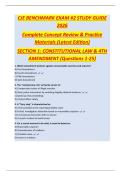
CJE BENCHMARK EXAM #2 STUDY GUIDE
2026
Complete Concept Review & Practice
Materials (Latest Edition)
SECTION 1: CONSTITUTIONAL LAW & 4TH
AMENDMENT (Questions 1-25)
1. Which amendment protects against unreasonable searches and seizures?
A) First Amendment
B) Fourth Amendment
C) Fifth Amendment
D) Sixth Amendment
2. The "exclusionary rule" primarily serves to:
A) Compensate victims of illegal searches
B) Deter police misconduct by excluding illegally obtained evidence
C) Speed up trial proceedings
D) Protect officer safety
3. A "Terry stop" is characterized as:
A) A full custodial arrest requiring probable cause
B) A brief, investigatory detention based on reasonable suspicion
C) A consensual encounter with no seizure
D) A search incident to lawful arrest
4. For a search warrant to be valid, it must be based on:
A) Reasonable suspicion
B) Preponderance of evidence
C) Probable cause
D) Hunch or intuition
,5. The "plain view" doctrine allows seizure of evidence when:
A) An officer has a warrant for a different location
B) An officer is lawfully present and the incriminating nature is immediately apparent
C) An officer suspects evidence might be present
D) An officer receives an anonymous tip
6. Which scenario describes a valid "exigent circumstance" justifying a warrantless entry?
A) To investigate a non-violent misdemeanor from yesterday
B) To prevent the imminent destruction of evidence
C) To conduct a routine property check
D) To follow up on an uncorroborated tip
7. The "automobile exception" to the warrant requirement is based on:
A) The reduced expectation of privacy in vehicles and their mobility
B) The assumption all vehicles contain contraband
C) The ease of obtaining vehicle warrants
D) State statutes overriding federal law
8. A "consent search" is valid only if:
A) The officer has reasonable suspicion
B) The consent is knowing and voluntary
C) The suspect is in custody
D) A supervisor approves
9. Which of the following is NOT a recognized exception to the warrant requirement?
A) Search incident to lawful arrest
B) Inventory search
C) Border search
D) Convenience search
10. The "good faith exception" to the exclusionary rule applies when:
A) An officer acts on a warrant later found defective, but obtained in good faith
B) An officer subjectively believes they are doing the right thing
C) Evidence would inevitably have been discovered
D) The suspect has a long criminal history
(Questions 11-25 continue in similar format covering 5th/6th Amendments, due process, etc.)
SECTION 2: CRIMINAL PROCEDURE & EVIDENCE (Questions 26-50)
, 26. The "Miranda warning" is required when:
A) An officer questions any suspect
B) There is custodial interrogation
C) A crime is a felony
D) An arrest is made
27. The "public safety exception" to Miranda allows questioning without warnings when:
A) The crime involves drugs
B) There's an immediate threat to public safety
C) The suspect appears cooperative
D) Questioning occurs at the police station
28. Hearsay is generally inadmissible because it violates the:
A) Right to speedy trial
B) Confrontation Clause
C) Protection against self-incrimination
D) Double jeopardy clause
29. Which statement about "Brady material" is CORRECT?
A) It refers to evidence favorable to the defense that must be disclosed
B) It refers to mandatory sentencing guidelines
C) It allows warrantless searches of vehicles
D) It establishes the inevitable discovery rule
30. A "motion to suppress" typically challenges:
A) The sufficiency of the charging document
B) The legality of obtained evidence
C) The venue of the trial
D) The competency of the defendant
(Questions 31-50 continue covering rules of evidence, discovery, pretrial motions, etc.)
SECTION 3: COURTROOM PROCEDURES & JUDICIAL ETHICS (Questions 51-75)
51. The primary duty of a judge is to:
A) Ensure convictions in criminal cases
B) Uphold and apply the law impartially
C) Advocate for crime victims
D) Reduce case backlogs
2026
Complete Concept Review & Practice
Materials (Latest Edition)
SECTION 1: CONSTITUTIONAL LAW & 4TH
AMENDMENT (Questions 1-25)
1. Which amendment protects against unreasonable searches and seizures?
A) First Amendment
B) Fourth Amendment
C) Fifth Amendment
D) Sixth Amendment
2. The "exclusionary rule" primarily serves to:
A) Compensate victims of illegal searches
B) Deter police misconduct by excluding illegally obtained evidence
C) Speed up trial proceedings
D) Protect officer safety
3. A "Terry stop" is characterized as:
A) A full custodial arrest requiring probable cause
B) A brief, investigatory detention based on reasonable suspicion
C) A consensual encounter with no seizure
D) A search incident to lawful arrest
4. For a search warrant to be valid, it must be based on:
A) Reasonable suspicion
B) Preponderance of evidence
C) Probable cause
D) Hunch or intuition
,5. The "plain view" doctrine allows seizure of evidence when:
A) An officer has a warrant for a different location
B) An officer is lawfully present and the incriminating nature is immediately apparent
C) An officer suspects evidence might be present
D) An officer receives an anonymous tip
6. Which scenario describes a valid "exigent circumstance" justifying a warrantless entry?
A) To investigate a non-violent misdemeanor from yesterday
B) To prevent the imminent destruction of evidence
C) To conduct a routine property check
D) To follow up on an uncorroborated tip
7. The "automobile exception" to the warrant requirement is based on:
A) The reduced expectation of privacy in vehicles and their mobility
B) The assumption all vehicles contain contraband
C) The ease of obtaining vehicle warrants
D) State statutes overriding federal law
8. A "consent search" is valid only if:
A) The officer has reasonable suspicion
B) The consent is knowing and voluntary
C) The suspect is in custody
D) A supervisor approves
9. Which of the following is NOT a recognized exception to the warrant requirement?
A) Search incident to lawful arrest
B) Inventory search
C) Border search
D) Convenience search
10. The "good faith exception" to the exclusionary rule applies when:
A) An officer acts on a warrant later found defective, but obtained in good faith
B) An officer subjectively believes they are doing the right thing
C) Evidence would inevitably have been discovered
D) The suspect has a long criminal history
(Questions 11-25 continue in similar format covering 5th/6th Amendments, due process, etc.)
SECTION 2: CRIMINAL PROCEDURE & EVIDENCE (Questions 26-50)
, 26. The "Miranda warning" is required when:
A) An officer questions any suspect
B) There is custodial interrogation
C) A crime is a felony
D) An arrest is made
27. The "public safety exception" to Miranda allows questioning without warnings when:
A) The crime involves drugs
B) There's an immediate threat to public safety
C) The suspect appears cooperative
D) Questioning occurs at the police station
28. Hearsay is generally inadmissible because it violates the:
A) Right to speedy trial
B) Confrontation Clause
C) Protection against self-incrimination
D) Double jeopardy clause
29. Which statement about "Brady material" is CORRECT?
A) It refers to evidence favorable to the defense that must be disclosed
B) It refers to mandatory sentencing guidelines
C) It allows warrantless searches of vehicles
D) It establishes the inevitable discovery rule
30. A "motion to suppress" typically challenges:
A) The sufficiency of the charging document
B) The legality of obtained evidence
C) The venue of the trial
D) The competency of the defendant
(Questions 31-50 continue covering rules of evidence, discovery, pretrial motions, etc.)
SECTION 3: COURTROOM PROCEDURES & JUDICIAL ETHICS (Questions 51-75)
51. The primary duty of a judge is to:
A) Ensure convictions in criminal cases
B) Uphold and apply the law impartially
C) Advocate for crime victims
D) Reduce case backlogs