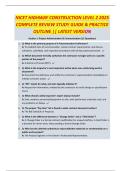
NICET HIGHWAY CONSTRUCTION LEVEL 2 2025
COMPLETE REVIEW STUDY GUIDE & PRACTICE
OUTLINE || LATEST VERSION
Section 1: Project Administration & Communication (15 Questions)
1. Q: What is the primary purpose of a Preconstruction Conference?
A: To establish lines of communication, review contract requirements, and discuss
schedules, submittals, and inspection procedures with all key project personnel.
2. Q: Which document formally authorizes the contractor to begin work on a specific
portion of the project?
A: A Notice to Proceed (NTP).
3. Q: What is the inspector's most important action when non-conforming work is
discovered?
A: Document the deficiency and notify the contractor's superintendent immediately to
initiate corrective action.
4. Q: "RFI" stands for what, and who typically initiates it?
A: Request for Information; initiated by the contractor to clarify design or specification
issues.
5. Q: What should a daily inspector's report always include?
A: Date, weather, personnel/equipment on site, work performed, materials used, and
any problems or delays.
6. Q: The project "Pay Item" list is found in what contract document section?
A: The Bid Schedule or Proposal.
7. Q: What is the difference between a "Change Order" and a "Field Order"?
A: A Change Order is a formal contract modification for scope/cost/time. A Field Order is
a directive for minor work, often pending a formal Change Order.
8. Q: Who has the ultimate authority to reject defective materials or workmanship on a
public works project?
A: The Project Engineer or the Owner's Authorized Representative.
, 9. Q: What is the purpose of a "Punch List"?
A: To itemize all incomplete or deficient work to be corrected prior to final project
acceptance.
10. Q: Verifying that work is performed in accordance with the contract is known as?
A: Compliance Inspection.
11. Q: What key information is found in the project's "Special Provisions"?
A: Requirements that modify, add to, or delete from the Standard Specifications for the
specific project.
12. Q: Photos used in inspection documentation should always include what?
A: A scale or reference object, a photo log with date/location/description, and should
show both overall context and specific detail.
13. Q: What does the acronym "MUTCD" stand for?
A: Manual on Uniform Traffic Control Devices.
14. Q: Who is responsible for providing and maintaining traffic control devices during
construction?
A: The Contractor, as detailed in their approved Traffic Control Plan (TCP).
15. Q: The formal process for resolving a contractor's disagreement over payment or
specification interpretation is called?
A: A Claims or Disputes Resolution process.
Section 2: Earthwork Inspection (20 Questions)
16. Q: What is the primary test to determine the maximum dry density and optimum
moisture content of soils for compaction?
A: The Proctor Test (Standard or Modified).
17. Q: Field compaction is most commonly measured by what method?
A: Nuclear density gauge or Sand Cone (ASTM D1556) test.
18. Q: A compaction test result of 98% of Modified Proctor indicates what?
A: The in-place soil density is 98% of the laboratory-determined maximum dry density
for that soil.
19. Q: What type of soil is described as "A-2-6" in the AASHTO Soil Classification System?
A: A silty or clayey gravel and sand soil.
,20. Q: "End haul" refers to?
A: Excavating material and transporting it to a disposal site not on the project.
21. Q: What is the primary purpose of proof-rolling a subgrade?
A: To detect soft or unstable areas that need correction before the next layer is placed.
22. Q: For embankment construction, soil should be placed in lifts not exceeding what
typical thickness?
A: 6 to 8 inches (150 to 200 mm) loose thickness.
23. Q: The difference between cut and fill volumes, accounting for shrinkage, is shown on
what plan?
A: The Mass Diagram.
24. Q: What is the minimum typical compaction requirement for a roadway subgrade?
A: 95% of Modified Proctor density.
25. Q: A slope of 2:1 (Horizontal:Vertical) is steeper than a slope of 3:1. (True/False)
A: False. 2:1 is steeper (0.5 slope ratio) than 3:1 (~0.33 slope ratio).
26. Q: What does a "CBR" (California Bearing Ratio) test measure?
A: The shear strength and bearing capacity of a subgrade soil relative to a standard
crushed rock.
27. Q: What is the primary function of a geotextile in a separation application?
A: To prevent the mixing of two dissimilar soil layers (e.g., subgrade and aggregate base).
28. Q: Rock excavation is typically defined as any material requiring what to remove?
A: Blasting or use of a ripper.
29. Q: What is the "optimum moisture content" for compaction?
A: The water content at which a soil can achieve its maximum dry density under a given
compactive effort.
30. Q: Standing water in an excavation prior to placing fill is a cause for rejection.
(True/False)
A: True. Water must be removed and the area dried or stabilized.
31. Q: A "bench" is cut into an existing slope to do what?
A: Provide a stable foundation for fill material on a hillside.
, 32. Q: What instrument is used to quickly check if aggregate base material is within
specification for moisture content prior to compaction?
A: A speedy moisture tester (calcium carbide gas pressure tester).
33. Q: What is "fluff factor" or "swell"?
A: The increase in volume of earth when it is excavated.
34. Q: The vertical height of a slope is called its?
A: Cut or Fill depth.
35. Q: What is the purpose of a "key" in embankment construction on a slope?
A: To prevent the fill from sliding along the natural ground surface.
Section 3: Base & Aggregate Surfaces (15 Questions)
36. Q: What is the primary function of an aggregate base course?
A: To provide stable support and distribute loads to the subgrade.
37. Q: The particle size distribution of an aggregate is determined by what test?
A: Sieve Analysis (Gradation Test).
38. Q: What does the "L.A. Abrasion" test measure?
A: The hardness and resistance to wear (degradation) of coarse aggregate.
39. Q: Aggregate for base course must typically have less than 1% passing the No. 200
sieve to control what?
A: The amount of fine, plastic soils that can retain water and reduce stability.
40. Q: What is the typical minimum compaction requirement for an aggregate base
course?
A: 100% of Modified Proctor density.
41. Q: "Dense Graded Aggregate" (DGA) is designed to do what?
A: Achieve maximum density and interlock by having a well-graded distribution of
particle sizes.
42. Q: What is a common field test for the plasticity of fines in an aggregate?
A: The plasticity index (PI) test, determined from Liquid and Plastic Limits (Atterberg
Limits).
43. Q: Segregation in stockpiled aggregate can be minimized by what method?
A: Stockpiling in layers and using proper placement techniques (not end-dumping).
COMPLETE REVIEW STUDY GUIDE & PRACTICE
OUTLINE || LATEST VERSION
Section 1: Project Administration & Communication (15 Questions)
1. Q: What is the primary purpose of a Preconstruction Conference?
A: To establish lines of communication, review contract requirements, and discuss
schedules, submittals, and inspection procedures with all key project personnel.
2. Q: Which document formally authorizes the contractor to begin work on a specific
portion of the project?
A: A Notice to Proceed (NTP).
3. Q: What is the inspector's most important action when non-conforming work is
discovered?
A: Document the deficiency and notify the contractor's superintendent immediately to
initiate corrective action.
4. Q: "RFI" stands for what, and who typically initiates it?
A: Request for Information; initiated by the contractor to clarify design or specification
issues.
5. Q: What should a daily inspector's report always include?
A: Date, weather, personnel/equipment on site, work performed, materials used, and
any problems or delays.
6. Q: The project "Pay Item" list is found in what contract document section?
A: The Bid Schedule or Proposal.
7. Q: What is the difference between a "Change Order" and a "Field Order"?
A: A Change Order is a formal contract modification for scope/cost/time. A Field Order is
a directive for minor work, often pending a formal Change Order.
8. Q: Who has the ultimate authority to reject defective materials or workmanship on a
public works project?
A: The Project Engineer or the Owner's Authorized Representative.
, 9. Q: What is the purpose of a "Punch List"?
A: To itemize all incomplete or deficient work to be corrected prior to final project
acceptance.
10. Q: Verifying that work is performed in accordance with the contract is known as?
A: Compliance Inspection.
11. Q: What key information is found in the project's "Special Provisions"?
A: Requirements that modify, add to, or delete from the Standard Specifications for the
specific project.
12. Q: Photos used in inspection documentation should always include what?
A: A scale or reference object, a photo log with date/location/description, and should
show both overall context and specific detail.
13. Q: What does the acronym "MUTCD" stand for?
A: Manual on Uniform Traffic Control Devices.
14. Q: Who is responsible for providing and maintaining traffic control devices during
construction?
A: The Contractor, as detailed in their approved Traffic Control Plan (TCP).
15. Q: The formal process for resolving a contractor's disagreement over payment or
specification interpretation is called?
A: A Claims or Disputes Resolution process.
Section 2: Earthwork Inspection (20 Questions)
16. Q: What is the primary test to determine the maximum dry density and optimum
moisture content of soils for compaction?
A: The Proctor Test (Standard or Modified).
17. Q: Field compaction is most commonly measured by what method?
A: Nuclear density gauge or Sand Cone (ASTM D1556) test.
18. Q: A compaction test result of 98% of Modified Proctor indicates what?
A: The in-place soil density is 98% of the laboratory-determined maximum dry density
for that soil.
19. Q: What type of soil is described as "A-2-6" in the AASHTO Soil Classification System?
A: A silty or clayey gravel and sand soil.
,20. Q: "End haul" refers to?
A: Excavating material and transporting it to a disposal site not on the project.
21. Q: What is the primary purpose of proof-rolling a subgrade?
A: To detect soft or unstable areas that need correction before the next layer is placed.
22. Q: For embankment construction, soil should be placed in lifts not exceeding what
typical thickness?
A: 6 to 8 inches (150 to 200 mm) loose thickness.
23. Q: The difference between cut and fill volumes, accounting for shrinkage, is shown on
what plan?
A: The Mass Diagram.
24. Q: What is the minimum typical compaction requirement for a roadway subgrade?
A: 95% of Modified Proctor density.
25. Q: A slope of 2:1 (Horizontal:Vertical) is steeper than a slope of 3:1. (True/False)
A: False. 2:1 is steeper (0.5 slope ratio) than 3:1 (~0.33 slope ratio).
26. Q: What does a "CBR" (California Bearing Ratio) test measure?
A: The shear strength and bearing capacity of a subgrade soil relative to a standard
crushed rock.
27. Q: What is the primary function of a geotextile in a separation application?
A: To prevent the mixing of two dissimilar soil layers (e.g., subgrade and aggregate base).
28. Q: Rock excavation is typically defined as any material requiring what to remove?
A: Blasting or use of a ripper.
29. Q: What is the "optimum moisture content" for compaction?
A: The water content at which a soil can achieve its maximum dry density under a given
compactive effort.
30. Q: Standing water in an excavation prior to placing fill is a cause for rejection.
(True/False)
A: True. Water must be removed and the area dried or stabilized.
31. Q: A "bench" is cut into an existing slope to do what?
A: Provide a stable foundation for fill material on a hillside.
, 32. Q: What instrument is used to quickly check if aggregate base material is within
specification for moisture content prior to compaction?
A: A speedy moisture tester (calcium carbide gas pressure tester).
33. Q: What is "fluff factor" or "swell"?
A: The increase in volume of earth when it is excavated.
34. Q: The vertical height of a slope is called its?
A: Cut or Fill depth.
35. Q: What is the purpose of a "key" in embankment construction on a slope?
A: To prevent the fill from sliding along the natural ground surface.
Section 3: Base & Aggregate Surfaces (15 Questions)
36. Q: What is the primary function of an aggregate base course?
A: To provide stable support and distribute loads to the subgrade.
37. Q: The particle size distribution of an aggregate is determined by what test?
A: Sieve Analysis (Gradation Test).
38. Q: What does the "L.A. Abrasion" test measure?
A: The hardness and resistance to wear (degradation) of coarse aggregate.
39. Q: Aggregate for base course must typically have less than 1% passing the No. 200
sieve to control what?
A: The amount of fine, plastic soils that can retain water and reduce stability.
40. Q: What is the typical minimum compaction requirement for an aggregate base
course?
A: 100% of Modified Proctor density.
41. Q: "Dense Graded Aggregate" (DGA) is designed to do what?
A: Achieve maximum density and interlock by having a well-graded distribution of
particle sizes.
42. Q: What is a common field test for the plasticity of fines in an aggregate?
A: The plasticity index (PI) test, determined from Liquid and Plastic Limits (Atterberg
Limits).
43. Q: Segregation in stockpiled aggregate can be minimized by what method?
A: Stockpiling in layers and using proper placement techniques (not end-dumping).