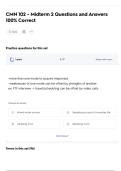
CMN 102 - Midterm 2 Questions and Answers
100% Correct
Save
Practice questions for this set
Learn 1 /7 Study with Learn
-more than one mode to acquire responses
-weaknesses of one mode can be offset by strengths of another
ex: FTF interview -> travel/scheduling can be offset by video calls
Choose an answer
1 Mixed mode surveys 2 Sampling as a part of everyday life
3 sampling error 4 Sampling: Cons
Don't know?
Terms in this set (96)
, -eating at a restaurant
*bad experience at Applebees
Sampling as a part of -we seek to know something about a whole group of
everyday life similar objects or things
-we observe these objects
-then extend findings
Sampling: Potential Over-generalization
problems
-want to make generalizations about a broad range of
Why sample: practical
people, but hard to actually observe or ask everyone
reasons
*ex: survey all 32,653 UCD students?
Why sample: can't assume population is homogenous (i.e. identical)
heterogeneity of in social science, as you can in the physical or natural
population sciences
Cons:
-trying to observe or question everyone might be
Sampling: Cons worse than just using a sample
*ex: US Census hired tons of interviewers, spent $$,
missed people, and counted some people twice
target population population to which generalizations want to be made
cases or units of which a target population is
element
comprised
actual population from which a sample is taken
frame population
*ex: Target - college kids; Frame: UC Davis
each element has as equal chance of selection
independent of any other event in the selection
Probability Theory:
process
Random Selection
(NOT colloquial sense of random, which typically
means haphazardly or by accident)
actual characteristic of a given variable in a
Probability Theory:
population
parameters
*ex: true mean height of US Citizens;
, Probability Theory: sample estimates of population parameters
statistics
calculating a statistic, searching for the mean: for all of
the possible samples of a particular size results in a
Sampling Distribution sampling distribution
-larger sample, smaller std. deviation
-larger sample, more accurate
the amount of a given sample statistic
*deviates from population parameter it estimates
sampling error
*the smaller the population, the higher the error; the
larger the sample, the lower the error
the estimated probability that a population parameter
lies within a given confidence interval
confidence level -the confidence level is higher with a larger sample
-confidence level is always a %
-the range within which the population is likely to fall
the range of values within which a population
parameter is estimated to lie
confidence interval
-decreases as number of people in your sample
increase
-every possible combination of cases has an equal
chance of being included in the sample
simple random sample *need:
-a complete list of population
-random selection of cases to be included in sample
steps:
1. subdivided into strata (at least two groups
stratified random sample depending on variable i.e. age or sex)
(probability sample) 2. draw random sample from each stratum
3. combine subsamples
look for sampling error
100% Correct
Save
Practice questions for this set
Learn 1 /7 Study with Learn
-more than one mode to acquire responses
-weaknesses of one mode can be offset by strengths of another
ex: FTF interview -> travel/scheduling can be offset by video calls
Choose an answer
1 Mixed mode surveys 2 Sampling as a part of everyday life
3 sampling error 4 Sampling: Cons
Don't know?
Terms in this set (96)
, -eating at a restaurant
*bad experience at Applebees
Sampling as a part of -we seek to know something about a whole group of
everyday life similar objects or things
-we observe these objects
-then extend findings
Sampling: Potential Over-generalization
problems
-want to make generalizations about a broad range of
Why sample: practical
people, but hard to actually observe or ask everyone
reasons
*ex: survey all 32,653 UCD students?
Why sample: can't assume population is homogenous (i.e. identical)
heterogeneity of in social science, as you can in the physical or natural
population sciences
Cons:
-trying to observe or question everyone might be
Sampling: Cons worse than just using a sample
*ex: US Census hired tons of interviewers, spent $$,
missed people, and counted some people twice
target population population to which generalizations want to be made
cases or units of which a target population is
element
comprised
actual population from which a sample is taken
frame population
*ex: Target - college kids; Frame: UC Davis
each element has as equal chance of selection
independent of any other event in the selection
Probability Theory:
process
Random Selection
(NOT colloquial sense of random, which typically
means haphazardly or by accident)
actual characteristic of a given variable in a
Probability Theory:
population
parameters
*ex: true mean height of US Citizens;
, Probability Theory: sample estimates of population parameters
statistics
calculating a statistic, searching for the mean: for all of
the possible samples of a particular size results in a
Sampling Distribution sampling distribution
-larger sample, smaller std. deviation
-larger sample, more accurate
the amount of a given sample statistic
*deviates from population parameter it estimates
sampling error
*the smaller the population, the higher the error; the
larger the sample, the lower the error
the estimated probability that a population parameter
lies within a given confidence interval
confidence level -the confidence level is higher with a larger sample
-confidence level is always a %
-the range within which the population is likely to fall
the range of values within which a population
parameter is estimated to lie
confidence interval
-decreases as number of people in your sample
increase
-every possible combination of cases has an equal
chance of being included in the sample
simple random sample *need:
-a complete list of population
-random selection of cases to be included in sample
steps:
1. subdivided into strata (at least two groups
stratified random sample depending on variable i.e. age or sex)
(probability sample) 2. draw random sample from each stratum
3. combine subsamples
look for sampling error