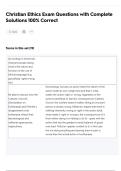
Christian Ethics Exam Questions with Complete
Solutions 100% Correct
Save
Terms in this set (19)
According to emotivism,
what are people doing
what is the nature and
function of the use of
ethical language (e.g.
good/bad, right/wrong,
etc.)
Deontology: focuses on action itself, the nature of the
action holds its own weight and and that is what
Be able to discuss how the makes the action right or wrong, regardless of the
Catholic Church's action's beneficial or harmful consequences-Catholic
(Declaration on Church: the context doesn't matter, killing an innocent
Euthanasia) and Fletcher's person is always wrong Utilitarian: argues that there is
disagreement over nothing inherently wrong or right in the action itself,
euthanasia reflect their what makes it right or wrong is the consequences of it
deontological and (from either doing it or failing to do it) - goes with the
utilitarian approaches, action that has the greatest overall balance of good
respectively. over bad- Fletcher: applies context to it, in this case
the not doing anything and leaving them in pain is
worse than the actual action of euthanasia
, Human nature is similar because humans have similar
needs and interests, which leads into similar moral
principles. Some of these moral principles better
Briefly outline Pojman's serve these human needs and interests, and promote
argument for an objective the best interest of humans and so they are
moral order, based on a objectively valid moral principles. Therefore, this set of
common human nature valid moral principles can be applied to all humanity.-
we all feel pain, value freedom, need food & water
(basic moral principles follow these), therefore these
values and principles that are objectively valid
pyschological egoism: all people act in their own self
interest (not a good thing or bad thing, but we are all
out for our selves) always trying to maximize reward
and minimize harmChristian sin: all actions tainted by
Compare and contrast sindiffers in that pysch believes all actions are
psychological egoism with selfish/sinful all the time (equally selfish) but Christians
the Christian notion of believe that some sins weigh more than others and
total depravity (that all our are given justice differently (ex: killing a child vs
actions are tainted by sin). stealing a lollipop). Christians also believe that sin is a
contradiction of our nature and we were created to
be like Jesus and serve (and not be selfish as psych
says). Christians would say its our nature to be loving,
but sin exists so we can't live up to that. Christians also
Solutions 100% Correct
Save
Terms in this set (19)
According to emotivism,
what are people doing
what is the nature and
function of the use of
ethical language (e.g.
good/bad, right/wrong,
etc.)
Deontology: focuses on action itself, the nature of the
action holds its own weight and and that is what
Be able to discuss how the makes the action right or wrong, regardless of the
Catholic Church's action's beneficial or harmful consequences-Catholic
(Declaration on Church: the context doesn't matter, killing an innocent
Euthanasia) and Fletcher's person is always wrong Utilitarian: argues that there is
disagreement over nothing inherently wrong or right in the action itself,
euthanasia reflect their what makes it right or wrong is the consequences of it
deontological and (from either doing it or failing to do it) - goes with the
utilitarian approaches, action that has the greatest overall balance of good
respectively. over bad- Fletcher: applies context to it, in this case
the not doing anything and leaving them in pain is
worse than the actual action of euthanasia
, Human nature is similar because humans have similar
needs and interests, which leads into similar moral
principles. Some of these moral principles better
Briefly outline Pojman's serve these human needs and interests, and promote
argument for an objective the best interest of humans and so they are
moral order, based on a objectively valid moral principles. Therefore, this set of
common human nature valid moral principles can be applied to all humanity.-
we all feel pain, value freedom, need food & water
(basic moral principles follow these), therefore these
values and principles that are objectively valid
pyschological egoism: all people act in their own self
interest (not a good thing or bad thing, but we are all
out for our selves) always trying to maximize reward
and minimize harmChristian sin: all actions tainted by
Compare and contrast sindiffers in that pysch believes all actions are
psychological egoism with selfish/sinful all the time (equally selfish) but Christians
the Christian notion of believe that some sins weigh more than others and
total depravity (that all our are given justice differently (ex: killing a child vs
actions are tainted by sin). stealing a lollipop). Christians also believe that sin is a
contradiction of our nature and we were created to
be like Jesus and serve (and not be selfish as psych
says). Christians would say its our nature to be loving,
but sin exists so we can't live up to that. Christians also