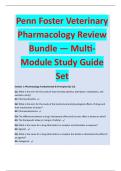
Penn Foster Veterinary
Pharmacology Review
Bundle — Multi-
Module Study Guide
Set
Section 1: Pharmacology Fundamentals & Principles (Q1-15)
Q1: What is the term for the study of how the body absorbs, distributes, metabolizes, and
excretes a drug?
A1: Pharmacokinetics
Q2: What is the term for the study of the biochemical and physiological effects of drugs and
their mechanisms of action?
A2: Pharmacodynamics
Q3: The difference between a drug's therapeutic effect and its toxic effect is known as what?
A3: The therapeutic index (or margin of safety).
Q4: What is the name for a drug that binds to a receptor and stimulates a response?
A4: Agonist.
Q5: What is the name for a drug that binds to a receptor but blocks or diminishes the effect of
an agonist?
A5: Antagonist.
,Q6: Which route of drug administration bypasses first-pass metabolism?
A6: Intravenous (IV), Subcutaneous (SC), Intramuscular (IM), Transdermal, and Sublingual
routes.
Q7: What term describes a drug's strength or concentration required to produce a specific
effect?
A7: Potency.
Q8: What is the primary organ for drug metabolism in most species?
A8: The liver.
Q9: What is the primary route of excretion for most drugs and their metabolites?
A9: The kidneys (via urine).
Q10: What does the abbreviation "PO" stand for in prescription directions?
A10: Per os (by mouth).
Q11: A drug's official, nonproprietary name is called its what?
A11: Generic name.
Q12: What type of drug interaction occurs when two drugs with similar effects are given,
resulting in an enhanced total effect?
A12: Additive or synergistic effect.
Q13: What is the term for a decreased response to a drug after repeated administrations?
A13: Tolerance.
Q14: A severe, life-threatening hypersensitivity reaction is known as what?
A14: Anaphylaxis.
Q15: The FDA-approved use of a drug is known as its what?
A15: Labeled (or on-label) use.
Section 2: Antimicrobials & Antiparasitics (Q16-35)
Q16: What class of antibiotics targets the bacterial cell wall and is often bactericidal?
A16: Penicillins (and Cephalosporins).
Q17: Why are aminoglycoside antibiotics like gentamicin typically used with caution?
A17: They can cause nephrotoxicity (kidney damage) and ototoxicity (inner ear damage).
,Q18: What is the primary mechanism of action of tetracycline antibiotics?
A18: They inhibit bacterial protein synthesis by binding to the 30S ribosomal subunit.
Q19: Fluoroquinolones (e.g., enrofloxacin) carry a class-specific warning for causing what type
of damage in young, growing animals?
A19: Cartilage damage (arthropathy).
Q20: What class of antifungal drugs, including ketoconazole and itraconazole, can cause
hepatotoxicity?
A20: Azole antifungals.
Q21: What is the drug of choice for treating serious systemic fungal infections like blastomycosis
in dogs?
A21: Itraconazole (or other azoles/amphotericin B).
Q22: What common antiparasitic class, including ivermectin, is contraindicated in some herding
breeds due to the MDR1 gene mutation?
A22: Macrocyclic lactones.
Q23: Praziquantel is the drug of choice for treating which type of parasites?
A23: Cestodes (tapeworms).
Q24: What class of drugs, including pyrantel pamoate, is effective against nematodes like
roundworms and hookworms?
A24: Anthelmintics (specifically, tetrahydropyrimidines).
Q25: Fenbendazole is a broad-spectrum anthelmintic effective against what types of parasites?
A25: Gastrointestinal nematodes (roundworms, hookworms, whipworms) and some cestodes.
Q26: What drug is commonly used to treat and prevent heartworm disease (Dirofilaria
immitis)?
A26: Macrocyclic lactones (e.g., ivermectin, milbemycin, selamectin, moxidectin).
Q27: What is the mechanism of action of sulfonamide antibiotics?
A27: They inhibit folic acid synthesis in bacteria (bacteriostatic).
Q28: Metronidazole is primarily used to treat what types of infections?
A28: Anaerobic bacterial infections and protozoal infections (e.g., Giardia, Trichomonas).
Q29: Clavamox is a combination of amoxicillin and what beta-lactamase inhibitor?
A29: Clavulanic acid.
, Q30: What class of antibiotics should be avoided in herbivores (rabbits, guinea pigs, horses) due
to disruption of GI flora?
A30: Oral penicillins, lincosamides (e.g., clindamycin), and some macrolides.
Q31: What topical antiparasitic is commonly used for flea and tick control and works as a
neonicotinoid insecticide?
A31: Imidacloprid.
Q32: What is the primary concern with the use of chloramphenicol in food animals and
humans?
A32: It can cause irreversible aplastic anemia in humans.
Q33: Fipronil is a common topical insecticide that primarily targets what neurotransmitter in
insects?
A33: GABA (gamma-aminobutyric acid).
Q34: What is the term for antibiotic resistance developed through the natural mutation of
bacteria?
A34: Intrinsic resistance.
Q35: What broad-spectrum parasiticide, often used in spot-on formulations, combines fipronil,
(S)-methoprene, eprinomectin, and praziquantel?
A35: Broad-spectrum parasiticides like "Revolution Plus" for cats (selamectin/sarolaner is
another combo, but this describes a specific multi-ingredient product).
Section 3: Anesthetics, Analgesics & Sedatives (Q36-55)
Q36: What drug is the pure mu-opioid receptor antagonist used to reverse opioid overdose?
A36: Naloxone.
Q37: What class of injectable anesthetics, including ketamine and tiletamine, are known as
dissociative anesthetics?
A37: Cyclohexamines.
Q38: Why is ketamine almost always combined with a sedative/tranquilizer (like a
benzodiazepine or alpha-2 agonist) in anesthesia?
A38: To reduce muscle rigidity, seizures, and provide smoother induction/recovery.
Q39: What is the reversal agent for benzodiazepines (e.g., diazepam, midazolam)?
A39: Flumazenil.
Pharmacology Review
Bundle — Multi-
Module Study Guide
Set
Section 1: Pharmacology Fundamentals & Principles (Q1-15)
Q1: What is the term for the study of how the body absorbs, distributes, metabolizes, and
excretes a drug?
A1: Pharmacokinetics
Q2: What is the term for the study of the biochemical and physiological effects of drugs and
their mechanisms of action?
A2: Pharmacodynamics
Q3: The difference between a drug's therapeutic effect and its toxic effect is known as what?
A3: The therapeutic index (or margin of safety).
Q4: What is the name for a drug that binds to a receptor and stimulates a response?
A4: Agonist.
Q5: What is the name for a drug that binds to a receptor but blocks or diminishes the effect of
an agonist?
A5: Antagonist.
,Q6: Which route of drug administration bypasses first-pass metabolism?
A6: Intravenous (IV), Subcutaneous (SC), Intramuscular (IM), Transdermal, and Sublingual
routes.
Q7: What term describes a drug's strength or concentration required to produce a specific
effect?
A7: Potency.
Q8: What is the primary organ for drug metabolism in most species?
A8: The liver.
Q9: What is the primary route of excretion for most drugs and their metabolites?
A9: The kidneys (via urine).
Q10: What does the abbreviation "PO" stand for in prescription directions?
A10: Per os (by mouth).
Q11: A drug's official, nonproprietary name is called its what?
A11: Generic name.
Q12: What type of drug interaction occurs when two drugs with similar effects are given,
resulting in an enhanced total effect?
A12: Additive or synergistic effect.
Q13: What is the term for a decreased response to a drug after repeated administrations?
A13: Tolerance.
Q14: A severe, life-threatening hypersensitivity reaction is known as what?
A14: Anaphylaxis.
Q15: The FDA-approved use of a drug is known as its what?
A15: Labeled (or on-label) use.
Section 2: Antimicrobials & Antiparasitics (Q16-35)
Q16: What class of antibiotics targets the bacterial cell wall and is often bactericidal?
A16: Penicillins (and Cephalosporins).
Q17: Why are aminoglycoside antibiotics like gentamicin typically used with caution?
A17: They can cause nephrotoxicity (kidney damage) and ototoxicity (inner ear damage).
,Q18: What is the primary mechanism of action of tetracycline antibiotics?
A18: They inhibit bacterial protein synthesis by binding to the 30S ribosomal subunit.
Q19: Fluoroquinolones (e.g., enrofloxacin) carry a class-specific warning for causing what type
of damage in young, growing animals?
A19: Cartilage damage (arthropathy).
Q20: What class of antifungal drugs, including ketoconazole and itraconazole, can cause
hepatotoxicity?
A20: Azole antifungals.
Q21: What is the drug of choice for treating serious systemic fungal infections like blastomycosis
in dogs?
A21: Itraconazole (or other azoles/amphotericin B).
Q22: What common antiparasitic class, including ivermectin, is contraindicated in some herding
breeds due to the MDR1 gene mutation?
A22: Macrocyclic lactones.
Q23: Praziquantel is the drug of choice for treating which type of parasites?
A23: Cestodes (tapeworms).
Q24: What class of drugs, including pyrantel pamoate, is effective against nematodes like
roundworms and hookworms?
A24: Anthelmintics (specifically, tetrahydropyrimidines).
Q25: Fenbendazole is a broad-spectrum anthelmintic effective against what types of parasites?
A25: Gastrointestinal nematodes (roundworms, hookworms, whipworms) and some cestodes.
Q26: What drug is commonly used to treat and prevent heartworm disease (Dirofilaria
immitis)?
A26: Macrocyclic lactones (e.g., ivermectin, milbemycin, selamectin, moxidectin).
Q27: What is the mechanism of action of sulfonamide antibiotics?
A27: They inhibit folic acid synthesis in bacteria (bacteriostatic).
Q28: Metronidazole is primarily used to treat what types of infections?
A28: Anaerobic bacterial infections and protozoal infections (e.g., Giardia, Trichomonas).
Q29: Clavamox is a combination of amoxicillin and what beta-lactamase inhibitor?
A29: Clavulanic acid.
, Q30: What class of antibiotics should be avoided in herbivores (rabbits, guinea pigs, horses) due
to disruption of GI flora?
A30: Oral penicillins, lincosamides (e.g., clindamycin), and some macrolides.
Q31: What topical antiparasitic is commonly used for flea and tick control and works as a
neonicotinoid insecticide?
A31: Imidacloprid.
Q32: What is the primary concern with the use of chloramphenicol in food animals and
humans?
A32: It can cause irreversible aplastic anemia in humans.
Q33: Fipronil is a common topical insecticide that primarily targets what neurotransmitter in
insects?
A33: GABA (gamma-aminobutyric acid).
Q34: What is the term for antibiotic resistance developed through the natural mutation of
bacteria?
A34: Intrinsic resistance.
Q35: What broad-spectrum parasiticide, often used in spot-on formulations, combines fipronil,
(S)-methoprene, eprinomectin, and praziquantel?
A35: Broad-spectrum parasiticides like "Revolution Plus" for cats (selamectin/sarolaner is
another combo, but this describes a specific multi-ingredient product).
Section 3: Anesthetics, Analgesics & Sedatives (Q36-55)
Q36: What drug is the pure mu-opioid receptor antagonist used to reverse opioid overdose?
A36: Naloxone.
Q37: What class of injectable anesthetics, including ketamine and tiletamine, are known as
dissociative anesthetics?
A37: Cyclohexamines.
Q38: Why is ketamine almost always combined with a sedative/tranquilizer (like a
benzodiazepine or alpha-2 agonist) in anesthesia?
A38: To reduce muscle rigidity, seizures, and provide smoother induction/recovery.
Q39: What is the reversal agent for benzodiazepines (e.g., diazepam, midazolam)?
A39: Flumazenil.