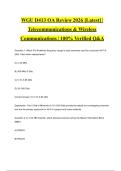
WGU D413 OA Review 2026 [Latest] |
Telecommunications & Wireless
Communications | 100% Verified Q&A
Question 1: Which ITU-R-defined frequency range is most commonly used for consumer Wi-Fi 6
(802.11ax) indoor deployments?
A) 3–30 MHz
B) 300 MHz–3 GHz
C) 5.15–5.85 GHz
D) 30–300 GHz
Correct Answer: C) 5.15–5.85 GHz
Explanation: The 5 GHz U-NII bands (5.15–5.85 GHz) provide the widest non-overlapping channels
and are the primary spectrum for Wi-Fi 6 campus and home networks.
Question 2: In a 5G NR downlink, which physical channel carries the Master Information Block
(MIB)?
A) PDSCH
B) PDCCH
,C) PBCH
D) PRACH
Correct Answer: C) PBCH
Explanation: The Physical Broadcast Channel (PBCH) is the only channel that transports the MIB,
enabling initial cell acquisition and frame timing.
Question 3: Which modulation scheme offers the highest bit-rate per symbol in the Wi-Fi 6
standard?
A) BPSK
B) QPSK
C) 16-QAM
D) 1024-QAM
Correct Answer: D) 1024-QAM
Explanation: 1024-QAM packs 10 bits per symbol, doubling the spectral efficiency of 256-QAM and
is mandatory for 802.11ax high-data-rate profiles.
Question 4: What is the typical guard-interval duration (in μs) used in 802.11ax OFDMA mode to
maintain inter-symbol immunity in indoor channels?
A) 0.4
B) 0.8
,C) 1.6
D) 3.2
Correct Answer: B) 0.8
Explanation: 0.8 μs GI is the default for OFDMA in 802.11ax, balancing ISI mitigation and
throughput; longer GI (1.6/3.2) is optional for outdoor/delay-spread channels.
Question 5: Which layer of the TCP/IP model is responsible for routing packets across
heterogeneous networks in 5G core (5GC)?
A) Data-link
B) Network (Internet)
C) Transport
D) Session
Correct Answer: B) Network (Internet)
Explanation: The Network layer (IP) handles global addressing and routing; 5GC user-plane
functions (UPF) route IP packets between gNB and data networks.
Question 6: Which multiple-access technique does 5G NR use on the uplink for high-efficiency data
transmission?
A) FDMA
B) TDMA
, C) SC-FDMA
D) CP-OFDM
Correct Answer: D) CP-OFDM
Explanation: 5G NR uplink uses Cyclic-Prefix OFDM (same as downlink) for high-throughput
scenarios, abandoning LTE’s SC-FDMA to enable higher-order QAM and wider bandwidths.
Question 7: In Wi-Fi 6, what is the maximum channel width (in MHz) supported in the 6 GHz band
(Wi-Fi 6E)?
A) 40
B) 80
C) 160
D) 320
Correct Answer: C) 160
Explanation: Wi-Fi 6E allows 160 MHz contiguous channels in the 6 GHz U-NII-5 to U-NII-8 bands,
doubling the 80 MHz max of legacy 5 GHz.
Question 8: Which 5G core function acts as the policy-control engine, enforcing QoS and charging
rules?
A) AMF
B) SMF
Telecommunications & Wireless
Communications | 100% Verified Q&A
Question 1: Which ITU-R-defined frequency range is most commonly used for consumer Wi-Fi 6
(802.11ax) indoor deployments?
A) 3–30 MHz
B) 300 MHz–3 GHz
C) 5.15–5.85 GHz
D) 30–300 GHz
Correct Answer: C) 5.15–5.85 GHz
Explanation: The 5 GHz U-NII bands (5.15–5.85 GHz) provide the widest non-overlapping channels
and are the primary spectrum for Wi-Fi 6 campus and home networks.
Question 2: In a 5G NR downlink, which physical channel carries the Master Information Block
(MIB)?
A) PDSCH
B) PDCCH
,C) PBCH
D) PRACH
Correct Answer: C) PBCH
Explanation: The Physical Broadcast Channel (PBCH) is the only channel that transports the MIB,
enabling initial cell acquisition and frame timing.
Question 3: Which modulation scheme offers the highest bit-rate per symbol in the Wi-Fi 6
standard?
A) BPSK
B) QPSK
C) 16-QAM
D) 1024-QAM
Correct Answer: D) 1024-QAM
Explanation: 1024-QAM packs 10 bits per symbol, doubling the spectral efficiency of 256-QAM and
is mandatory for 802.11ax high-data-rate profiles.
Question 4: What is the typical guard-interval duration (in μs) used in 802.11ax OFDMA mode to
maintain inter-symbol immunity in indoor channels?
A) 0.4
B) 0.8
,C) 1.6
D) 3.2
Correct Answer: B) 0.8
Explanation: 0.8 μs GI is the default for OFDMA in 802.11ax, balancing ISI mitigation and
throughput; longer GI (1.6/3.2) is optional for outdoor/delay-spread channels.
Question 5: Which layer of the TCP/IP model is responsible for routing packets across
heterogeneous networks in 5G core (5GC)?
A) Data-link
B) Network (Internet)
C) Transport
D) Session
Correct Answer: B) Network (Internet)
Explanation: The Network layer (IP) handles global addressing and routing; 5GC user-plane
functions (UPF) route IP packets between gNB and data networks.
Question 6: Which multiple-access technique does 5G NR use on the uplink for high-efficiency data
transmission?
A) FDMA
B) TDMA
, C) SC-FDMA
D) CP-OFDM
Correct Answer: D) CP-OFDM
Explanation: 5G NR uplink uses Cyclic-Prefix OFDM (same as downlink) for high-throughput
scenarios, abandoning LTE’s SC-FDMA to enable higher-order QAM and wider bandwidths.
Question 7: In Wi-Fi 6, what is the maximum channel width (in MHz) supported in the 6 GHz band
(Wi-Fi 6E)?
A) 40
B) 80
C) 160
D) 320
Correct Answer: C) 160
Explanation: Wi-Fi 6E allows 160 MHz contiguous channels in the 6 GHz U-NII-5 to U-NII-8 bands,
doubling the 80 MHz max of legacy 5 GHz.
Question 8: Which 5G core function acts as the policy-control engine, enforcing QoS and charging
rules?
A) AMF
B) SMF