Biol 3090 exam 4, Chapter 13- Questions and Answers
Who the heck is Günter Blobel? Simple Process of protein targeting or sorting:
question → elegant answers → Nobel - signals (zip codes) and sorting events.
Prize. - signals = short amino acid motifs
• Each is ~125 mega daltons in mass.
• ~16 X larger than a ribosome.
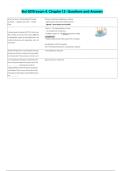
Nuclear pore complex (NPC): its structure.
• Multiple copies of ~30 different proteins called
(Fig. 13-32a, b and d). How many different
nucleoporins
nucleoprorins make up that bad boy? If we
• 8-fold rotational symmetry about the complex.
called a ribosome an organelle, why not
the NPC?
Nucleoporins with FG repeats
F/G: Phenylalanine/Glycine hydrophobic repeats
The ER membrane must be present during co-translational transport
protein synthesis in order for the proteins
to translocate. This process is known as ?
Co-translational transport of proteins into signal sequence, ribosome
the microsome allows the removal of the
____________ _. Microsomes must be
added before the first 70 amino acids are
synthesized. This is when 40 amino acids
protrude and 30 amino acids still remain in
the________ _.
, Nascent (still being synthesized) protein enters the
lumen of the ER co-translationally
What is meant by co-translational transport Proteins destined for secretion will be inserted
across the ER membrane (Fig. 13-2b, 13-3, completely into the lumen (space) within the ER,
13-4a and b)? free of the membrane.
ER membrane must be present during protein
synthesis in order for protein to translocate
There is one exception to the co- yeast alpha mating type protein, cytosol
translational requirement______________ _.
This protein is only 70 amino acids long and
is synthesized in its entirety in the_____ _.
It interacts with chaperones that keep it
from folding and is then delivered to the ER
by passing across the ER membrane into
the lumen where it then folds.
The signal sequence found on secretory ribosome, nascent protein
proteins directs the_______ to the ER and
directs the transport of the _________ _________
across the ER membrane.
Describe the properties of the signal Secretory proteins initially have a signal sequence on their amino terminal end.
sequence found on secretory proteins.
Table provided in lecture. signal sequence on nascent protein is critical
ER signal sequence is often the first ? 16 - 30 AA residues at the amino terminus of the nascent protein.
Signal sequence is? one or more basic (positively charged) AAs, followed by several hy drophobic AAs.
Synthesis of secretory proteins begins in cytoplasm on free ribosomes.
the?
The hydrophobic residues of the signal SRP (signal recognition particle) , necessary and sufficient
sequence are responsible for binding the
_____and if transferred onto a cytosolic
protein, the sequence will move this
protein into the ER. Therefore, the signal is
_____________ _________
The SRP, the SRP receptor, and the
translocon (lecture slide for SRP, Fig. 13-6,
Fig. 13-7).
The SRP is the signal recognition particle. It large ribosomal subunit (60S), ER membrane
is a cytosolic complex that transiently binds
the signal sequence and the_________ _.
It then directs them to the__________by
binding to the SRP receptor located in the
membrane.
SRP is a protein and a RNA complex that guanine nucleotide binding protein, methionine residues
consists of six proteins bound to a single
RNA molecule of 300 nucleotides and Alu
DNA elements derived from this RNA
molecule. One of the SRP proteins is P54,
which is a________________ and contains
____________ that bind to the signal
sequence.
Who the heck is Günter Blobel? Simple Process of protein targeting or sorting:
question → elegant answers → Nobel - signals (zip codes) and sorting events.
Prize. - signals = short amino acid motifs
• Each is ~125 mega daltons in mass.
• ~16 X larger than a ribosome.
Nuclear pore complex (NPC): its structure.
• Multiple copies of ~30 different proteins called
(Fig. 13-32a, b and d). How many different
nucleoporins
nucleoprorins make up that bad boy? If we
• 8-fold rotational symmetry about the complex.
called a ribosome an organelle, why not
the NPC?
Nucleoporins with FG repeats
F/G: Phenylalanine/Glycine hydrophobic repeats
The ER membrane must be present during co-translational transport
protein synthesis in order for the proteins
to translocate. This process is known as ?
Co-translational transport of proteins into signal sequence, ribosome
the microsome allows the removal of the
____________ _. Microsomes must be
added before the first 70 amino acids are
synthesized. This is when 40 amino acids
protrude and 30 amino acids still remain in
the________ _.
, Nascent (still being synthesized) protein enters the
lumen of the ER co-translationally
What is meant by co-translational transport Proteins destined for secretion will be inserted
across the ER membrane (Fig. 13-2b, 13-3, completely into the lumen (space) within the ER,
13-4a and b)? free of the membrane.
ER membrane must be present during protein
synthesis in order for protein to translocate
There is one exception to the co- yeast alpha mating type protein, cytosol
translational requirement______________ _.
This protein is only 70 amino acids long and
is synthesized in its entirety in the_____ _.
It interacts with chaperones that keep it
from folding and is then delivered to the ER
by passing across the ER membrane into
the lumen where it then folds.
The signal sequence found on secretory ribosome, nascent protein
proteins directs the_______ to the ER and
directs the transport of the _________ _________
across the ER membrane.
Describe the properties of the signal Secretory proteins initially have a signal sequence on their amino terminal end.
sequence found on secretory proteins.
Table provided in lecture. signal sequence on nascent protein is critical
ER signal sequence is often the first ? 16 - 30 AA residues at the amino terminus of the nascent protein.
Signal sequence is? one or more basic (positively charged) AAs, followed by several hy drophobic AAs.
Synthesis of secretory proteins begins in cytoplasm on free ribosomes.
the?
The hydrophobic residues of the signal SRP (signal recognition particle) , necessary and sufficient
sequence are responsible for binding the
_____and if transferred onto a cytosolic
protein, the sequence will move this
protein into the ER. Therefore, the signal is
_____________ _________
The SRP, the SRP receptor, and the
translocon (lecture slide for SRP, Fig. 13-6,
Fig. 13-7).
The SRP is the signal recognition particle. It large ribosomal subunit (60S), ER membrane
is a cytosolic complex that transiently binds
the signal sequence and the_________ _.
It then directs them to the__________by
binding to the SRP receptor located in the
membrane.
SRP is a protein and a RNA complex that guanine nucleotide binding protein, methionine residues
consists of six proteins bound to a single
RNA molecule of 300 nucleotides and Alu
DNA elements derived from this RNA
molecule. One of the SRP proteins is P54,
which is a________________ and contains
____________ that bind to the signal
sequence.