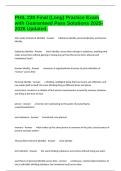
PHIL 230 Final (Long) Practice Exam
with Guaranteed Pass Solutions 2025-
2026 Updated.
John Locke (3 kinds of identity) - Answer substance identity, personal identity, and human
identity
Substance Identity - Answer strict identity; across time=change in substance; anything that
exists across time without gaining or losing any part has this across time; physical and
nonphysical (soul)
Human Identity - Answer sameness of organizational structure of parts indicative of
"human" across time
Personal Identity - Answer a thinking, intelligent being that has reason and reflection, and
can reside itself as itself; the same thinking thing in different times and places
across time: consists in a relation of first person consciousness secured by memory, between
any thing at the time at issue
person - Answer a forensic term pertaining to the justice of praise/blame,
reward/punishment
soul substance - Answer immaterial; non-physical
memory - Answer what makes up the same person as someone in the past; consciousness of
present and past actions
Thomas Reid (1 kind of identity) - Answer strict identity
strict identity - Answer the same thinking substance across time without losing any parts
soul theory of personal identity across time - Answer continuous, uninterrupted existence of
one's indivisible thinking substance (an immaterial soul) across time
, Dave Cohen - Answer Weirob's former student
Sam Miller - Answer hospital chaplain
seeming memory - Answer an experience as of something (x) having happened in the past
veridical memory - Answer (i) a seeming memory
(ii) x having happened in the past
circularity test - Answer Ask "Is any premise true only if the conclusion is true?; Does any
premise logically entail the conclusion?"
If yes: then the argument involves circular reasoning=fails
If no: argument passes
free will - Answer metaphysical freedom
connected to the will
freedom from physical restraint
political freedom
the ability of persons to control (not change) the future through their choices and actions
personal agent - Answer something that has free will (person)
the will - Answer the power that the mind has to order that a given idea be thought about or
that it not be thought about, or to prefer that a given part of the body in one rather than stay
still
What makes a person's will free? - Answer No true answer
heavily disputed
the control view - Answer the ability of persons to control the future through their actions
and choices
with Guaranteed Pass Solutions 2025-
2026 Updated.
John Locke (3 kinds of identity) - Answer substance identity, personal identity, and human
identity
Substance Identity - Answer strict identity; across time=change in substance; anything that
exists across time without gaining or losing any part has this across time; physical and
nonphysical (soul)
Human Identity - Answer sameness of organizational structure of parts indicative of
"human" across time
Personal Identity - Answer a thinking, intelligent being that has reason and reflection, and
can reside itself as itself; the same thinking thing in different times and places
across time: consists in a relation of first person consciousness secured by memory, between
any thing at the time at issue
person - Answer a forensic term pertaining to the justice of praise/blame,
reward/punishment
soul substance - Answer immaterial; non-physical
memory - Answer what makes up the same person as someone in the past; consciousness of
present and past actions
Thomas Reid (1 kind of identity) - Answer strict identity
strict identity - Answer the same thinking substance across time without losing any parts
soul theory of personal identity across time - Answer continuous, uninterrupted existence of
one's indivisible thinking substance (an immaterial soul) across time
, Dave Cohen - Answer Weirob's former student
Sam Miller - Answer hospital chaplain
seeming memory - Answer an experience as of something (x) having happened in the past
veridical memory - Answer (i) a seeming memory
(ii) x having happened in the past
circularity test - Answer Ask "Is any premise true only if the conclusion is true?; Does any
premise logically entail the conclusion?"
If yes: then the argument involves circular reasoning=fails
If no: argument passes
free will - Answer metaphysical freedom
connected to the will
freedom from physical restraint
political freedom
the ability of persons to control (not change) the future through their choices and actions
personal agent - Answer something that has free will (person)
the will - Answer the power that the mind has to order that a given idea be thought about or
that it not be thought about, or to prefer that a given part of the body in one rather than stay
still
What makes a person's will free? - Answer No true answer
heavily disputed
the control view - Answer the ability of persons to control the future through their actions
and choices