

Escrito por estudiantes que aprobaron Inmediatamente disponible después del pago Leer en línea o como PDF ¿Documento equivocado? Cámbialo gratis 4,6 TrustPilot
logo-home
Document preview thumbnail
Vista previa 1 fuera de 4 páginas
Examen

BIO 255 Comp Review Questions and Answers

Document preview thumbnail
Vista previa 1 fuera de 4 páginas

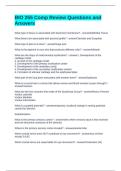
BIO 255 Comp Review Questions and Answers What type of tissue is associated with basement membrane? Epithelial Tissue What bones are associated with pectoral girdle? Clavicles and Scapulae What type of joint is a knee? hinge joint What is the pigment in your skin that produces different color? Melanin What are the steps of endochondral ossification? 1. Development of the cartilage model 2. Growth of the cartilage model 3. Development of the primary ossification center 4. Development of the medullary cavity 5. Development of the secondary ossification centers 6. Formation of articular cartilage and the epiphyseal plate What part of the long bone articulates with another bone? Epiphysis What is a round hole in a bone that allows nerves and blood vessels to pass through? Foramen What are the four muscles that make of the Quadricep Group? Rectus Femoris Vastus Lateralis Vastus Medialis Vastus Intermedius What is a graded potential? temporary, localized change in resting potential caused by stimulus Repolarization What is the primary sensory cortex? sites where sensory input is first received and one becomes conscious of the stimulus Where is the primary sensory cortex located? parietal lobe Which cranial nerve does NOT contribute to eye movement? Any of them except 3,4,&5 Which cranial nerve are responsible for eye movement? Oculomotor (III) Trochlear (IV) Abducens (IV) The Phrenic nerve is in what plexus? cervical plexus What binds to a receptor causing an action potential for muscle movement? Acetylcholine What is a muscle antagonist? muscle that opposes the prime mover Where is calcium stored within a muscle? sarcoplasmic reticulum When do muscle twitches occur? When an action potential travels down the motor neuron resulting in a contraction of the muscle fibers What requires ATP and is a form of active transport? Sodium Potassium Pump What is the function of the nervous system? transmits messages to and from the brain to regulate all of the body and its systems. What kind of movement is a hand flip? Supinated What are functions of connective tissue? physical protection, support and structural framework, binding of structures, storage, transport, immune protection What are three types of protein fibers in connective tissue? Collagen Fibers Reticular Fibers Elastin Fibers The tibia articulates with what other bones? Fibula Femur Talus What are sebaceous glands? Glands associated with hair follicles and secrete oil What are Eccrine Glands? sweat glands What are apocrine glands? glands that secrete fluid; secrete into hair follicle What are bone cells? osteoblasts, osteocytes, osteoclasts What is the function of osteoblasts? build bone What is the function of osteocytes? mature bone cells What is the function of osteoclast? bone resorption List how a muscle contracts 1. Calcium ion is released from the sarcoplasmic reticulum 2. Calcium ion binds to troponin 3. Myosin cross-bridges bind to the actin 4. The myosin head pivots toward the center of the sarcomere 5. The myosin head binds an ATP molecule and detaches from the actin 6. the free myosin head splits ATP Where is the cerebrospinal fluid found? between arachnoid mater and pia mater of the brain and spinal cord Subarachnoid Space What is the difference between parasympathetic and sympathetic system? Sympathetic: Fight or Flight parasympathetic: Rest and Digest What organ contains endocrine and exocrine cells? The Pancreas What can influence vascular resistance? Blood Viscosity Vessel length Vessel diameter What is normal atrial blood pressure? 100mmhg What are the events of a cardiac cycle? 1. Systole and Diastole of atrial and ventricular muscle 2. Pressure changes in chambers of heart and great vessels exiting heart 3. Changes in Blood volume in ventricles 4. Changes in Electrical activity through the heart (ECG) 5. Heart Sounds 6. Valves opening and closing What is the function of plasma cells? produce antibodies What is Ventilation? movement of air in and out of the lungs What secretes surfactant? Type II alveolar cells What is the function of the pons within the brain? Handles unconscious processes and jobs, sleep-wake cycle, breathing What are the heart valves? Mitral Tricuspid Pulmonary Aortic What organ does anemia affect? Kidney What is the universal donor? O negative What is the universal receiver? AB positive What type of blood vessels has the thickest middle layer? Tunica Media What is an adaptive immunity? protection from an infectious disease agent that is mediated by B and T cells following exposure to specific antigen and characterized by immunological memory

Vista previa del contenido

BIO 255 Comp Review Questions and
Answers
What type of tissue is associated with basement membrane? - answerEpithelial Tissue

What bones are associated with pectoral girdle? - answerClavicles and Scapulae

What type of joint is a knee? - answerhinge joint

What is the pigment in your skin that produces different color? - answerMelanin

What are the steps of endochondral ossification? - answer1. Development of the
cartilage model
2. Growth of the cartilage model
3. Development of the primary ossification center
4. Development of the medullary cavity
5. Development of the secondary ossification centers
6. Formation of articular cartilage and the epiphyseal plate

What part of the long bone articulates with another bone? - answerEpiphysis

What is a round hole in a bone that allows nerves and blood vessels to pass through? -
answerForamen

What are the four muscles that make of the Quadricep Group? - answerRectus Femoris
Vastus Lateralis
Vastus Medialis
Vastus Intermedius

What is a graded potential? - answertemporary, localized change in resting potential
caused by stimulus

Repolarization

What is the primary sensory cortex? - answersites where sensory input is first received
and one becomes conscious of the stimulus

Where is the primary sensory cortex located? - answerparietal lobe

Which cranial nerve does NOT contribute to eye movement? - answerAny of them
except 3,4,&5

Which cranial nerve are responsible for eye movement? - answerOculomotor (III)

Información del documento

Subido en
5 de diciembre de 2025
Número de páginas
4
Escrito en
2025/2026
Tipo
Examen
Contiene
Preguntas y respuestas
$17.49

¿Documento equivocado? Cámbialo gratis Dentro de los 14 días posteriores a la compra y antes de descargarlo, puedes elegir otro documento. Puedes gastar el importe de nuevo.
Escrito por estudiantes que aprobaron
Inmediatamente disponible después del pago
Leer en línea o como PDF

Seller avatar
Los indicadores de reputación están sujetos a la cantidad de artículos vendidos por una tarifa y las reseñas que ha recibido por esos documentos. Hay tres niveles: Bronce, Plata y Oro. Cuanto mayor reputación, más podrás confiar en la calidad del trabajo del vendedor.
Pogba119
3.9
(14)
Vendido
59
Seguidores
2
Artículos
5448
Última venta
1 mes hace


Por qué los estudiantes eligen Stuvia

Creado por compañeros estudiantes, verificado por reseñas

Calidad en la que puedes confiar: escrito por estudiantes que aprobaron y evaluado por otros que han usado estos resúmenes.

¿No estás satisfecho? Elige otro documento

¡No te preocupes! Puedes elegir directamente otro documento que se ajuste mejor a lo que buscas.

Paga como quieras, empieza a estudiar al instante

Sin suscripción, sin compromisos. Paga como estés acostumbrado con tarjeta de crédito y descarga tu documento PDF inmediatamente.

Student with book image

“Comprado, descargado y aprobado. Así de fácil puede ser.”

Alisha Student

Preguntas frecuentes
