https://www.stuvia.com/user/profgoodluck
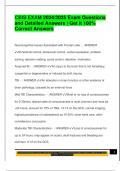
CES Final Exam V1 – NASM | 2025/2026 Edition |
High-Quality Practice Q&A Set | Corrective Exercise
Specialist Certification
NASM CES FINAL EXAM (2025/2026)
Practice Exam with Complete Study Questions and Answers | Corrective Exercise Specialist |
National Academy of Sports Medicine
Overview
This 2025/2026 study resource provides a comprehensive practice-style Corrective Exercise
Specialist exam modeled on NASM’s current standards. It supports learners in understanding the
principles of assessment, movement dysfunction analysis, program design, and corrective strategies
used within the NASM CES curriculum.
Key Features
✓ Practice-style questions aligned with NASM CES domains
✓ Updated corrective exercise strategies and movement science principles
✓ Step-by-step reasoning with correct answer explanations
✓ Aligned with 2025/2026 NASM performance and assessment standards
✓ Useful for learners preparing for college coursework or personal study
Content Domains
• Human Movement Science & Kinesiology
• Assessment & Dysfunction Identification
• Corrective Exercise Techniques
• Program Design & Implementation
• Client Interaction & Professional Practice
, Answer Format
Answers are provided with:
• Technique explanations
• Movement-compensation breakdowns
• Evidence-based exercise rationales
• Clear step-by-step reasoning
Critical Updates 2025/2026
◆ NEW – Expanded guidance on kinetic chain checkpoints
◆ UPDATED – Movement assessment models and evidence-based practice
◆ REVISED – Corrective flexibility, activation, and integration strategies
◆ MODERNIZED – Industry applications for corrective programming
A runner who experiences reoccuring episodes of plantar fascitis, shin splints and patellar
tendonitis is most likely affected by which of the following postural distortion syndromes?
pronation distortion syndrome
An estimated ACL injuries occur annually in the general U.S. population.
80,000 to 100,000
During an overhead squat you notice an asymmetrical weight shift, which muscles could be
underactive?
gluteus medius on the side of the shift
During an overhead squat you have low back rounds compensation, which muscles could be
underactive?
erector spinae
During the overhead squat assessment, the compensation of knees move inward can be attributed
by overactivity of which muscles?
vastus lateralis
Florence and Henry Kendall addressed postural deviations through the relationship of ?
agonist-antagonist muscle groups
Flexion of the ankle is called
dorsiflexion
For a foot and ankle impairment what muscle should receive SMR?
biceps femoris
CES Final Exam V1 – NASM | 2025/2026 Edition |
High-Quality Practice Q&A Set | Corrective Exercise
Specialist Certification
NASM CES FINAL EXAM (2025/2026)
Practice Exam with Complete Study Questions and Answers | Corrective Exercise Specialist |
National Academy of Sports Medicine
Overview
This 2025/2026 study resource provides a comprehensive practice-style Corrective Exercise
Specialist exam modeled on NASM’s current standards. It supports learners in understanding the
principles of assessment, movement dysfunction analysis, program design, and corrective strategies
used within the NASM CES curriculum.
Key Features
✓ Practice-style questions aligned with NASM CES domains
✓ Updated corrective exercise strategies and movement science principles
✓ Step-by-step reasoning with correct answer explanations
✓ Aligned with 2025/2026 NASM performance and assessment standards
✓ Useful for learners preparing for college coursework or personal study
Content Domains
• Human Movement Science & Kinesiology
• Assessment & Dysfunction Identification
• Corrective Exercise Techniques
• Program Design & Implementation
• Client Interaction & Professional Practice
, Answer Format
Answers are provided with:
• Technique explanations
• Movement-compensation breakdowns
• Evidence-based exercise rationales
• Clear step-by-step reasoning
Critical Updates 2025/2026
◆ NEW – Expanded guidance on kinetic chain checkpoints
◆ UPDATED – Movement assessment models and evidence-based practice
◆ REVISED – Corrective flexibility, activation, and integration strategies
◆ MODERNIZED – Industry applications for corrective programming
A runner who experiences reoccuring episodes of plantar fascitis, shin splints and patellar
tendonitis is most likely affected by which of the following postural distortion syndromes?
pronation distortion syndrome
An estimated ACL injuries occur annually in the general U.S. population.
80,000 to 100,000
During an overhead squat you notice an asymmetrical weight shift, which muscles could be
underactive?
gluteus medius on the side of the shift
During an overhead squat you have low back rounds compensation, which muscles could be
underactive?
erector spinae
During the overhead squat assessment, the compensation of knees move inward can be attributed
by overactivity of which muscles?
vastus lateralis
Florence and Henry Kendall addressed postural deviations through the relationship of ?
agonist-antagonist muscle groups
Flexion of the ankle is called
dorsiflexion
For a foot and ankle impairment what muscle should receive SMR?
biceps femoris