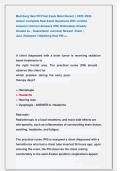
Med-Surg Hesi PN Final Exam Most Recent || 2025 /2026
Actual Complete Real Exam Questions With verified
Answers (Correct Answers With Rationales) Already
Graded A+ , Guaranteed success| Newest Exam |
Just Released !! MedSurg Hesi PN*++
A client diagnosed with a brain tumor is receiving radiation
beam treatments to
the right frontal area. The practical nurse (PN) should
observe this client for
which problem during the early post-
therapy days?
a. Hemiplegia
b. Headache
c. Hearing loss
d. Dysphagia - ANSWER-b. Headache
Rationale:
Radiotherapy is a local treatment, and most side effects are
site-specific, such as inflammation of surrounding brain tissue,
swelling, headache, and fatigue.
The practical nurse (PN) is assigned a client diagnosed with a
hemothorax who had a chest tube inserted 36 hours ago; upon
entering the room, the PN observes the client resting
comfortably in the semi-Fowler position; respirations appear
,even and unlabored; the water in the suction chamber is
bubbling; and there is serous drainage noted in the collection
chamber. What is the best initial action for the PN to take?
a. Measure and document in the drainage in the chamber.
b. Clamp the chest tube while assessing for air leaks.
c. "Milk" the tube to remove any excessive blood clot buildup.
d. Decrease the bubbling in the suction chamber. - ANSWER-d.
Decrease the bubbling in the suction chamber.
Rationale:
Follow the ABC's (airway, breathing, and circulation) to
determine that the airway and breathing are stable, and the next
step is to evaluate the extent of the bleeding. It is not necessary
to change the amount of bubbling in the suction chamber.
The nurse has reinforced teaching regarding postoperative care
for a client who
has had a prostatectomy. Which statements indicate the
need for further
instructions? (Select all that
apply.)
a. "If I feel the need to void while the catheter is still in, I should
try to void around the catheter."
b. "I should drink about 12 glasses of water a day, once the
indwelling catheter is removed."
c. "I should only have intercourse twice weekly once I return
home after surgery."
,d. "I should report bright red blood and large clots in my urine
to my surgeon."
e. "I can expect to have urine that is lightly tinged with blood
when I get home." - ANSWER-a. "If I feel the need to void
while the catheter is still in, I should try to void around the
catheter."
c. "I should only have intercourse twice weekly once I return
home after surgery."
Rationale:
After prostatectomy, the client should not try to void around the
catheter. It is common to feel pressure inside the bladder while
the irrigating catheter is still in the bladder. The client should
not have intercourse immediately after surgery. The client
should drink 12 to 14 glasses of fluid once the catheter is
removed. Urine that is lightly blood tinged is common; bright
red blood in the urine should be reported to the surgeon.
A client is walking in the hallway and begins experiencing
an acute angina
attack. Which is the first action for the
nurse to take?
a. Administer a nitroglycerine tablet sublingually.
b. Notify the local emergency medical services. (EMS).
c. Assist the client to walk back to the client's room.
d. Ask the client if this attack occurred at the same time as
yesterday's. - ANSWER-a. Administer a nitroglycerine tablet
sublingually.
, Rationale:
The first action is to administer nitroglycerine sublingually, in
order to dilate the coronary arteries so that more oxygenated
blood can be provided to the myocardium. It is not necessary
to notify EMS unless the angina pain is unrelieved by three
nitroglycerine tablets. The client should rest immediately, not
walk back to the room. It is not a priority to determine whether
or not the attack occurred at the same time as yesterday's.
A client has had a gastrectomy to treat stomach cancer. The
nurse has reinforced instructions on ways to prevent "dumping
syndrome." Which client statement indicates the need for
further instruction?
a. "My meals need to be mostly protein."
b. "I should walk around after each meal."
c. "I should eat fewer carbohydrates."
d. "I should eat smaller, more frequent meals." - ANSWER-b. "I
should walk around after each meal."
Rationale:
The client should lie down after meals to avoid syncope. The
client should eat more protein and less carbohydrates, and
smaller more frequent meals
An adult client is admitted to the emergency department with
partial-thickness and full-thickness burns over 40% of the body
surface area resulting from a car collision fire. After the health
Actual Complete Real Exam Questions With verified
Answers (Correct Answers With Rationales) Already
Graded A+ , Guaranteed success| Newest Exam |
Just Released !! MedSurg Hesi PN*++
A client diagnosed with a brain tumor is receiving radiation
beam treatments to
the right frontal area. The practical nurse (PN) should
observe this client for
which problem during the early post-
therapy days?
a. Hemiplegia
b. Headache
c. Hearing loss
d. Dysphagia - ANSWER-b. Headache
Rationale:
Radiotherapy is a local treatment, and most side effects are
site-specific, such as inflammation of surrounding brain tissue,
swelling, headache, and fatigue.
The practical nurse (PN) is assigned a client diagnosed with a
hemothorax who had a chest tube inserted 36 hours ago; upon
entering the room, the PN observes the client resting
comfortably in the semi-Fowler position; respirations appear
,even and unlabored; the water in the suction chamber is
bubbling; and there is serous drainage noted in the collection
chamber. What is the best initial action for the PN to take?
a. Measure and document in the drainage in the chamber.
b. Clamp the chest tube while assessing for air leaks.
c. "Milk" the tube to remove any excessive blood clot buildup.
d. Decrease the bubbling in the suction chamber. - ANSWER-d.
Decrease the bubbling in the suction chamber.
Rationale:
Follow the ABC's (airway, breathing, and circulation) to
determine that the airway and breathing are stable, and the next
step is to evaluate the extent of the bleeding. It is not necessary
to change the amount of bubbling in the suction chamber.
The nurse has reinforced teaching regarding postoperative care
for a client who
has had a prostatectomy. Which statements indicate the
need for further
instructions? (Select all that
apply.)
a. "If I feel the need to void while the catheter is still in, I should
try to void around the catheter."
b. "I should drink about 12 glasses of water a day, once the
indwelling catheter is removed."
c. "I should only have intercourse twice weekly once I return
home after surgery."
,d. "I should report bright red blood and large clots in my urine
to my surgeon."
e. "I can expect to have urine that is lightly tinged with blood
when I get home." - ANSWER-a. "If I feel the need to void
while the catheter is still in, I should try to void around the
catheter."
c. "I should only have intercourse twice weekly once I return
home after surgery."
Rationale:
After prostatectomy, the client should not try to void around the
catheter. It is common to feel pressure inside the bladder while
the irrigating catheter is still in the bladder. The client should
not have intercourse immediately after surgery. The client
should drink 12 to 14 glasses of fluid once the catheter is
removed. Urine that is lightly blood tinged is common; bright
red blood in the urine should be reported to the surgeon.
A client is walking in the hallway and begins experiencing
an acute angina
attack. Which is the first action for the
nurse to take?
a. Administer a nitroglycerine tablet sublingually.
b. Notify the local emergency medical services. (EMS).
c. Assist the client to walk back to the client's room.
d. Ask the client if this attack occurred at the same time as
yesterday's. - ANSWER-a. Administer a nitroglycerine tablet
sublingually.
, Rationale:
The first action is to administer nitroglycerine sublingually, in
order to dilate the coronary arteries so that more oxygenated
blood can be provided to the myocardium. It is not necessary
to notify EMS unless the angina pain is unrelieved by three
nitroglycerine tablets. The client should rest immediately, not
walk back to the room. It is not a priority to determine whether
or not the attack occurred at the same time as yesterday's.
A client has had a gastrectomy to treat stomach cancer. The
nurse has reinforced instructions on ways to prevent "dumping
syndrome." Which client statement indicates the need for
further instruction?
a. "My meals need to be mostly protein."
b. "I should walk around after each meal."
c. "I should eat fewer carbohydrates."
d. "I should eat smaller, more frequent meals." - ANSWER-b. "I
should walk around after each meal."
Rationale:
The client should lie down after meals to avoid syncope. The
client should eat more protein and less carbohydrates, and
smaller more frequent meals
An adult client is admitted to the emergency department with
partial-thickness and full-thickness burns over 40% of the body
surface area resulting from a car collision fire. After the health