Solutions Manual for
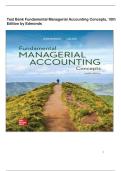
Fundamental Managerial
Accounting Concepts (2025
Release) 11th Edition By
Christopher Edmonds, Mark
Edmonds, Jennifer Edmonds (All
Chapters 1-14, 100% Original
Verified, A+ Grade)
All Chapters Arranged Reverse: 14-1
This is The Only Original and
Complete Solutions Manual for
2025 Release 11th Edition, All
Other Files in the Market are
Fake/Old/Wrong Edition.
,ANSWERS TO QUESTIONS – CHAPTER 14
1. The statement of cash flows explains how a company obtained
and used cash during some period of time. Understanding the
cash flows of a business is important in assessing the
company’s ability to pay its bills and fund operations in the
future.
2. The three categories of cash inflows and outflows are operating
activities, investing activities, and financing activities.
Operating activities include cash inflows and outflows that are
generated by operating the business. Example: Cash received
from the sale of goods; cash paid for salaries.
Investing activities include cash inflows and outflows that are
generated by the purchase and sale of long-term operational
assets, investments in other companies, and lending activities.
Example: Cash received from the sale of equipment previously
used by the business; cash paid for the purchase of new
equipment.
Financing activities include cash inflows and outflows
associated with a company's own equity transactions and
borrowing activities. Example: Cash received from the issue of
stock; cash paid for the principal repayment of a loan.
14-1
© McGraw Hill LLC. All rights reserved. No reproduction or distribution without the prior written consent of McGraw
Hill LLC.
,3. Noncash investing and financing activities are transactions that
do not require the receipt or payment of cash. For example, a
company may purchase an operating asset with a small down
payment and finance the balance. The part that is financed does
not require cash but is significant in terms of understanding the
financial position of a company. If only cash transactions are
included, then significant transactions like this would be omitted
from the statement of cash flows. These transactions are shown
in a separate schedule included in the statement of cash flows or
in the notes to the financial statements.
4. Since the ending balance of accounts receivable exceeded the
beginning balance by $2,000, less cash was provided by
operating activities than was included in accrual net income. The
amount of net cash flow from operating activities would equal
$108,000, the amount of net income, $110,000, less the increase
in the accounts receivable balance of $2,000.
5. Since the ending balance of utilities payable exceeded the
beginning balance by $1,900, more utility cost was used than
paid for. The amount of cash provided by operating activities
would be $1,900 more than was included in accrual net income.
Consequently, cash provided by operating activities would be
$88,900 ($87,000 + $1,900).
6. Since the ending balance of unearned revenue was less than the
beginning balance by $1,100, less cash was received in advance
than was earned. The amount of cash provided by operating
activities would be $1,100 less than was included in accrual net
income. Consequently, cash flow from operating activities (cash
net income) would be $52,900, ($54,000 −¿ $1,100).
14-2
© McGraw Hill LLC. All rights reserved. No reproduction or distribution without the prior written consent of McGraw
Hill LLC.
, 7. a. Payment of accounts payable −¿ operating activity.
b. Payment of interest on bonds payable −¿ operating activity.
c. Sale of common stock −¿ financing activity.
d. Sale of preferred stock at a premium −¿ financing activity.
e. Payment of a cash dividend −¿ financing activity.
c, d, and e are financing activities.
8. Depreciation expense is an allocation of the cost of an asset over
its estimated useful life; thus, the allocation does not affect cash
flows. Cash flows are affected at the time of purchase or sale of
the asset.
9. Cost of land $ 4,200
Gain on sale 500
Sales price $ 4,700 ($4,700 is the cash collected, assuming
the sale was not financed.)
10. Cost of office equipment $7,500
Accumulated depreciation (7,200)
Book value 300
Loss on sale (100)
Selling price $ 200
11. a. operating activities
b. investing activities, or operating activities if trading securities
c. investing activities
d. operating activities
e. financing activities
f. operating activities
g. financing activities
h. financing activities
i. investing activities
j. operating activities
14-3
© McGraw Hill LLC. All rights reserved. No reproduction or distribution without the prior written consent of McGraw
Hill LLC.
Fundamental Managerial
Accounting Concepts (2025
Release) 11th Edition By
Christopher Edmonds, Mark
Edmonds, Jennifer Edmonds (All
Chapters 1-14, 100% Original
Verified, A+ Grade)
All Chapters Arranged Reverse: 14-1
This is The Only Original and
Complete Solutions Manual for
2025 Release 11th Edition, All
Other Files in the Market are
Fake/Old/Wrong Edition.
,ANSWERS TO QUESTIONS – CHAPTER 14
1. The statement of cash flows explains how a company obtained
and used cash during some period of time. Understanding the
cash flows of a business is important in assessing the
company’s ability to pay its bills and fund operations in the
future.
2. The three categories of cash inflows and outflows are operating
activities, investing activities, and financing activities.
Operating activities include cash inflows and outflows that are
generated by operating the business. Example: Cash received
from the sale of goods; cash paid for salaries.
Investing activities include cash inflows and outflows that are
generated by the purchase and sale of long-term operational
assets, investments in other companies, and lending activities.
Example: Cash received from the sale of equipment previously
used by the business; cash paid for the purchase of new
equipment.
Financing activities include cash inflows and outflows
associated with a company's own equity transactions and
borrowing activities. Example: Cash received from the issue of
stock; cash paid for the principal repayment of a loan.
14-1
© McGraw Hill LLC. All rights reserved. No reproduction or distribution without the prior written consent of McGraw
Hill LLC.
,3. Noncash investing and financing activities are transactions that
do not require the receipt or payment of cash. For example, a
company may purchase an operating asset with a small down
payment and finance the balance. The part that is financed does
not require cash but is significant in terms of understanding the
financial position of a company. If only cash transactions are
included, then significant transactions like this would be omitted
from the statement of cash flows. These transactions are shown
in a separate schedule included in the statement of cash flows or
in the notes to the financial statements.
4. Since the ending balance of accounts receivable exceeded the
beginning balance by $2,000, less cash was provided by
operating activities than was included in accrual net income. The
amount of net cash flow from operating activities would equal
$108,000, the amount of net income, $110,000, less the increase
in the accounts receivable balance of $2,000.
5. Since the ending balance of utilities payable exceeded the
beginning balance by $1,900, more utility cost was used than
paid for. The amount of cash provided by operating activities
would be $1,900 more than was included in accrual net income.
Consequently, cash provided by operating activities would be
$88,900 ($87,000 + $1,900).
6. Since the ending balance of unearned revenue was less than the
beginning balance by $1,100, less cash was received in advance
than was earned. The amount of cash provided by operating
activities would be $1,100 less than was included in accrual net
income. Consequently, cash flow from operating activities (cash
net income) would be $52,900, ($54,000 −¿ $1,100).
14-2
© McGraw Hill LLC. All rights reserved. No reproduction or distribution without the prior written consent of McGraw
Hill LLC.
, 7. a. Payment of accounts payable −¿ operating activity.
b. Payment of interest on bonds payable −¿ operating activity.
c. Sale of common stock −¿ financing activity.
d. Sale of preferred stock at a premium −¿ financing activity.
e. Payment of a cash dividend −¿ financing activity.
c, d, and e are financing activities.
8. Depreciation expense is an allocation of the cost of an asset over
its estimated useful life; thus, the allocation does not affect cash
flows. Cash flows are affected at the time of purchase or sale of
the asset.
9. Cost of land $ 4,200
Gain on sale 500
Sales price $ 4,700 ($4,700 is the cash collected, assuming
the sale was not financed.)
10. Cost of office equipment $7,500
Accumulated depreciation (7,200)
Book value 300
Loss on sale (100)
Selling price $ 200
11. a. operating activities
b. investing activities, or operating activities if trading securities
c. investing activities
d. operating activities
e. financing activities
f. operating activities
g. financing activities
h. financing activities
i. investing activities
j. operating activities
14-3
© McGraw Hill LLC. All rights reserved. No reproduction or distribution without the prior written consent of McGraw
Hill LLC.