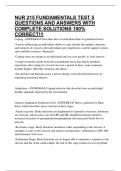
NUR 215 FUNDAMENTALS TEST 5
QUESTIONS AND ANSWERS WITH
COMPLETE SOLUTIONS 100%
CORRECT!!!
Coping -ANSWER✔✔-Describes how an individual deals w/ problems/issues
-Factors influencing an individuals ability to cope include the number, duration,
and intensity of stressors, the individuals past experiences, current support system,
and available resources (financial)
-Coping strats are unique to an individual and can vary greatly w/ each stressor
-Caregiver burden results from the accumulated stress that family members
experience after caring for a loved one over a period of time; some responses
include fatigue, difficulty sleeping, and illness
-Ego defense mechanisms assist a person during a stressful situation/crisis by
regulating emotional distress
Adaptation -ANSWER✔✔-Coping behavior that describes how an individual
handles demands imposed by the environment
General Adaptation Syndrome GAS -ANSWER✔✔-Stress syndrome by Hans
Selye which describes stress reaction in three stages
-Alarm reactions: Body functions are heightened to respond to stressors; hormones
are released, which causes elevated BP and HR, heightened mental alertness,
increased secretion of epinephrine/norepinephrine and increased blood flow to
muscles
-Resistance stage: Body functions normalize while responding to the stressor, it
attempts to cope w/ the stressor and return to homeostasis; stabilization of BP, HR
and hormones will occur
-Exhaustion Stage: Body functions are no longer able to maintain a response to the
stressor and the client cannot adapt; the end of this stage results in recovery/death
,Adherence -ANSWER✔✔-Commitment/ability of the client/family to follow
given treatment regimens
-Commitment to the regimen increases adherence
-Complicated regimen interferes w/ adherence
-Involvement of the client/significant support people in the planning stage
increases adherence
-Adverse effects of meds diminished adherence
-Coping mechanisms, such as denial can cause non adherence
-Available resources increases adherence
Assessment/Data collection Coping -ANSWER✔✔Ask the clients questions
related to:
-Current stress, perception of stressors and ability to cope
-Support systems
-Adherence to healthy behaviors and/or the treatment regimen
-Sleep patterns
-Altered elimination patterns, changes in appetite and weight loss/gain
Observe the clients appearance and eye contact, verbal motor and cognitive status
during assessment
Measure vital signs
Observe for irritability, anxiety and tension
Thoroughly assess each client to ensure client centered clinical decisions required
for safe nursing care
Stress nursing care -ANSWER✔✔-Encourage health promotion strats, including
regular exercise, optimal nutrition and adequate sleep/rest
,-Assist w/ time management and determine priority tasks
-Encourage appropriate relaxation techniques including breathing exercises,
massage, imagery, yoga and meditation
-Listen attentively and take the time to understand the clients perspective
-Control the environment to reduce the number of external stressors, including
noise and breaks in the continuity of care
-Identify available support systems
-Use effective communication techniques to foster expression of feelings
Coping nursing care -ANSWER✔✔-Be empathetic in communication, and
encourage the client to verbalize feelings
-Identify the client/family's strength and abilities
-Encourage the client's autonomy w/ decision making
-Discuss the client's/family's abilities to deal w/ the current situation
-Encourage the client to describe c oping skills used effectively in the past
-Identify available community resources, and refer the client for counseling if
needed
Adherence nursing care -ANSWER✔✔-Put instructions in writing
-Allow the client to give input into the treatment regimen
-Simplify treatment regimens as much as possible
-Follow up w/ the client to address any questions/problems
Family systems/family dynamics -ANSWER✔✔-Family is defined by the client,
and it consists of the individual structures and roles, it is typically two+ people
whose relationships create a bond and influence their mutual development,
support, goals and resources
, -COnsider five realms of processess involved in family function during a family
assessment: INTERACTIVE, DEVELOPMENTAL, COPING, INTEGRITY AND
HEALTH
-Assessment of a family can focus on family as a context, client or a system
-Families and clients are not mutually exclusive, family centered care creates a
holistic approach to nursing care
-Family dynamics are constantly evolving and due to the processes of family life
and developmental stages of family members
Current trends -ANSWER✔✔Fastest growing population: Those older than 65
years; leading to caregiver issues
Declining economic status of families: increased unemployment
Family violence: endless cycle
Any acute/chronic illness that disrupts the family unit: Can include end of life care
issues
Homelessness: Lack of stable environment, financial issues, inadequate access to
health care and it is increasing due to a lack of affordable housing
Attributes of families -ANSWER✔✔Structure dictates the families ability to cope:
-Rigid structure is dictatorial and strict
-Open structure includes a few/no boundaries, consistent behavior, or
consequences
-Either structure can provide positive/negative outcomes
Function describes the course of action the family uses to reach its goals, including
members communication skills, problem solving abilities and available resources
Assessment/Data collection for family structure/dynamics -ANSWER✔✔-Assess
all clients w/in the context of the family
QUESTIONS AND ANSWERS WITH
COMPLETE SOLUTIONS 100%
CORRECT!!!
Coping -ANSWER✔✔-Describes how an individual deals w/ problems/issues
-Factors influencing an individuals ability to cope include the number, duration,
and intensity of stressors, the individuals past experiences, current support system,
and available resources (financial)
-Coping strats are unique to an individual and can vary greatly w/ each stressor
-Caregiver burden results from the accumulated stress that family members
experience after caring for a loved one over a period of time; some responses
include fatigue, difficulty sleeping, and illness
-Ego defense mechanisms assist a person during a stressful situation/crisis by
regulating emotional distress
Adaptation -ANSWER✔✔-Coping behavior that describes how an individual
handles demands imposed by the environment
General Adaptation Syndrome GAS -ANSWER✔✔-Stress syndrome by Hans
Selye which describes stress reaction in three stages
-Alarm reactions: Body functions are heightened to respond to stressors; hormones
are released, which causes elevated BP and HR, heightened mental alertness,
increased secretion of epinephrine/norepinephrine and increased blood flow to
muscles
-Resistance stage: Body functions normalize while responding to the stressor, it
attempts to cope w/ the stressor and return to homeostasis; stabilization of BP, HR
and hormones will occur
-Exhaustion Stage: Body functions are no longer able to maintain a response to the
stressor and the client cannot adapt; the end of this stage results in recovery/death
,Adherence -ANSWER✔✔-Commitment/ability of the client/family to follow
given treatment regimens
-Commitment to the regimen increases adherence
-Complicated regimen interferes w/ adherence
-Involvement of the client/significant support people in the planning stage
increases adherence
-Adverse effects of meds diminished adherence
-Coping mechanisms, such as denial can cause non adherence
-Available resources increases adherence
Assessment/Data collection Coping -ANSWER✔✔Ask the clients questions
related to:
-Current stress, perception of stressors and ability to cope
-Support systems
-Adherence to healthy behaviors and/or the treatment regimen
-Sleep patterns
-Altered elimination patterns, changes in appetite and weight loss/gain
Observe the clients appearance and eye contact, verbal motor and cognitive status
during assessment
Measure vital signs
Observe for irritability, anxiety and tension
Thoroughly assess each client to ensure client centered clinical decisions required
for safe nursing care
Stress nursing care -ANSWER✔✔-Encourage health promotion strats, including
regular exercise, optimal nutrition and adequate sleep/rest
,-Assist w/ time management and determine priority tasks
-Encourage appropriate relaxation techniques including breathing exercises,
massage, imagery, yoga and meditation
-Listen attentively and take the time to understand the clients perspective
-Control the environment to reduce the number of external stressors, including
noise and breaks in the continuity of care
-Identify available support systems
-Use effective communication techniques to foster expression of feelings
Coping nursing care -ANSWER✔✔-Be empathetic in communication, and
encourage the client to verbalize feelings
-Identify the client/family's strength and abilities
-Encourage the client's autonomy w/ decision making
-Discuss the client's/family's abilities to deal w/ the current situation
-Encourage the client to describe c oping skills used effectively in the past
-Identify available community resources, and refer the client for counseling if
needed
Adherence nursing care -ANSWER✔✔-Put instructions in writing
-Allow the client to give input into the treatment regimen
-Simplify treatment regimens as much as possible
-Follow up w/ the client to address any questions/problems
Family systems/family dynamics -ANSWER✔✔-Family is defined by the client,
and it consists of the individual structures and roles, it is typically two+ people
whose relationships create a bond and influence their mutual development,
support, goals and resources
, -COnsider five realms of processess involved in family function during a family
assessment: INTERACTIVE, DEVELOPMENTAL, COPING, INTEGRITY AND
HEALTH
-Assessment of a family can focus on family as a context, client or a system
-Families and clients are not mutually exclusive, family centered care creates a
holistic approach to nursing care
-Family dynamics are constantly evolving and due to the processes of family life
and developmental stages of family members
Current trends -ANSWER✔✔Fastest growing population: Those older than 65
years; leading to caregiver issues
Declining economic status of families: increased unemployment
Family violence: endless cycle
Any acute/chronic illness that disrupts the family unit: Can include end of life care
issues
Homelessness: Lack of stable environment, financial issues, inadequate access to
health care and it is increasing due to a lack of affordable housing
Attributes of families -ANSWER✔✔Structure dictates the families ability to cope:
-Rigid structure is dictatorial and strict
-Open structure includes a few/no boundaries, consistent behavior, or
consequences
-Either structure can provide positive/negative outcomes
Function describes the course of action the family uses to reach its goals, including
members communication skills, problem solving abilities and available resources
Assessment/Data collection for family structure/dynamics -ANSWER✔✔-Assess
all clients w/in the context of the family