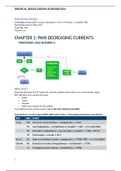
PHYSICAL APPLICATIONS: SUMMARY EPA
Examenverdeling
Schriftelijk examen (EPA + muscle stimulation + PA & CT Movant + E-health): 30%
Mondeling examen (EPA): 50%
Taak PDB: 15%
Taak JM: 5%
CHAPTER 1: PAIN DECREASING CURRENTS
Why PDC?
Given the final goal of a PT treatment: send the patient home cured or in a much better shape
PDC will allow us to achieve this goal:
o Easier
o Faster
o Cheaper
o With more comfort for the patient
Than without and in certain cases it will be the only treatment possible!
9 parameters, 2 current types (TENS, MET) and 3 levels = 7 decreasing mechanisms (see below)
1
,PHYSICAL APPLICATIONS: SUMMARY EPA
Electric current types and introductory concepts
1. Electric currents RK
Always answer 3 questions:
o What current?
o How do we set the parameters?
o What physiological effect have these currents?
Self-study module and PPT answer these
Mostly common: TENS, MET, interferential current (IF), high-voltage (HV), diadynamic current
(DIA) and ultra-reiz current (UR)
Most efficient and useful: TENS and MET
The endorphin experiment:
S – M – N threshold
o Sensory threshold = level of first perception = ‘ik voel hem’
o Motor threshold = level of first perception of motor activity = ‘ik voel spier’
o Nocisensory threshold = level of pain intolerance
2. Analgesia and pain pathways
= pain relief
2.1 Pain Decreasing Mechanisms (PDM) RK
3 anatomical places
Local/site of stimulation (peripheral effects)
Dorsal column (spinal effects)
Brain (central effects)
Local effects
1. Slowing down nerve conduction velocity
o TENS decreases conduction speed of the afferent nerve
o Less nociceptive stimuli will reach the spinal cord pain relief
o Significant, but short effect (5min)
2. Local hyperemia
o Increased amount of blood under the contact surface of the electrodes
o Only by monophasic mA (strong effect) & uA (weak effect),
being: DIA UR APS MET
o Increased blood flow reaches skin (< 500%) and muscles (< 300%)
more nutrients reach target site and more wastes to be washed away
o Increase of metabolism at electrode site tissue healing effect pain relief
o Constant ion transport of a direct current represents a threat to the cell release of
inflammatory mediators vasodilation
3. Reduction of substance-P
= Neuropeptide acting as a neurotransmitter
o Important element in pain perception
o TENS (all mA) is known to reduce substance-P
4. Tissue repair
o Only caused by MET and HV
2
,PHYSICAL APPLICATIONS: SUMMARY EPA
o Underlying effect not fully understood –categorized as cellular effects
o Tissue heals cause of pain disappears pain decreasing
o “gating” = the opening and closing of physiological channels in response to changes in
the membrane potential initiated by electrical stimuli
o MET can cause an opening in the ‘’voltage-sensitive channels’’
o MET: increase intracellular concentration of Ca and Na
= regulator of Ca and Na influx
o Changes in membrane potential altered intracellular Ca-concentrations
o Voltage-gated Na-channels are responsible for the AP for nerve impulses pain
decreasing effect from MET explained
o “Primary active transport” = cellular influence for transmembrane transport
o Transport protein guides substances through the membrane against an existing
electrical, chemical or pressure gradient. Energy = ATP (provided by metabolism)
o Study of Cheng et al (rats):
ATP in skin under the influence of MET: 500% higher
Peak values at 500 uA and decreased at 750 uA
Uptake of GABA increased at 10 uA, drastic decrease at 750 uA
o Fibroblasts are sensitive to electrical stimulation: impact on collagen production
o Fibroblasts = important role in tissue repair electrostimulation repairs tissue
o Other studies on p9, but not enough scientific background
Spinal effects
Spinal pain modulation (SPM)
“Gate control theory of pain”
o Nerve impulses reach thick and thin fibers from their receptors (each with their own
function)
o Both fibers activate the transmission cells (activated when a stimulus threshold is
reached) pass information to the brain
o Both fibers also reach the substantia gelatinosainhibits activity in T-cells
activity in thick fibers stimulates the SG
activity in thin fibers inhibits the SG
Result: a balance is created in both fibers activating/inhibiting SG
which will in turn inhibit or leave T-cells untouched
Inhibited: the info can’t pass on to the brain
Habituation to mild stimuli is regulated by this mechanism (thick f)
E.g.: you adjust to wearing skinny jeans, but not to sitting on keys Keys:
conduction through both fibers, this activity stimulates SG and T-cells pass
nociceptive info to the brain about the keys
= outlined way in which the gate is kept open for painful stimuli!
“Central control mechanism”
o Emotions can operate the gate from any part of the body
o This makes random motor activity possible, despite powerful pain stimuli
o TENS: good scientific and clinical evidence for the gate control mechanism
o MET: remains unclear whether mechanism works (effect seems minimal)
Central effects
Central pain modulation (CPS)
2 groups: ascending/descending and endorphins/enkephalins
Ascending and descending pathways
3
, PHYSICAL APPLICATIONS: SUMMARY EPA
o TENS activate large diameter afferent fibers
o This afferent input CNS activates descending inhibitory system reduces
hyperalgesia
o SO: descending inhibitory systems are activated by electrical stimulus of TENS
Endorphins and enkephalins (opiates)
o Enkephalins: peptides produced by the body, strong analgesic effect
o Endorphins: more powerful pain-relieving effect, present in the pituitary gland in high
concentrations.
o β- endorphins have the strongest analgesic properties, next enkephalin and dynorphine.
Only active opiate-like factor in the body (runner’s high).
o TENS can trigger this mechanism by stimulating IIIb and IV-type afferents.
o Enkephalins: produced in the brain (encephalon) and have similarities in chemical
structure to morphine, storage is provided in the nerve endings
o Reverse the effect of endorphins administering naloxone (opiate antagonist) which
has no analgesic effect
o Release of endorphins after the pain-relieving effect chemical changes in the peptide
chains lose their analgesic, opiate-like effect happens quite quickly with
enkephalins Endorphins have a longer lasting effect
2.2 Introductory concepts related to pain
The following sections describe (pain)stimuli pathways from the skin to the brain. Along this
pathway, electric stimuli will have their effects.
Stimulus response pathway
o Sensory stimuli in sensors afferent peripheral nerve fibers, plexus and spinal nerve
dorsal horn of the spinal cord cells in different layers = laminae
o Stimulus ascends thalamus and postcentral gyrus + frontal cortex and limbic system
to provide info to the brain AND to be diverted to the motor ventral horn AND to the
sympathetic lateral horn Motor ventral horn α- and γ-motor neuron activity
o Spinal cord is divided into 10 laminae and 2 laterally lying structures that divide stimulus
over different segments
In the laminae = so called gate control system
4
Examenverdeling
Schriftelijk examen (EPA + muscle stimulation + PA & CT Movant + E-health): 30%
Mondeling examen (EPA): 50%
Taak PDB: 15%
Taak JM: 5%
CHAPTER 1: PAIN DECREASING CURRENTS
Why PDC?
Given the final goal of a PT treatment: send the patient home cured or in a much better shape
PDC will allow us to achieve this goal:
o Easier
o Faster
o Cheaper
o With more comfort for the patient
Than without and in certain cases it will be the only treatment possible!
9 parameters, 2 current types (TENS, MET) and 3 levels = 7 decreasing mechanisms (see below)
1
,PHYSICAL APPLICATIONS: SUMMARY EPA
Electric current types and introductory concepts
1. Electric currents RK
Always answer 3 questions:
o What current?
o How do we set the parameters?
o What physiological effect have these currents?
Self-study module and PPT answer these
Mostly common: TENS, MET, interferential current (IF), high-voltage (HV), diadynamic current
(DIA) and ultra-reiz current (UR)
Most efficient and useful: TENS and MET
The endorphin experiment:
S – M – N threshold
o Sensory threshold = level of first perception = ‘ik voel hem’
o Motor threshold = level of first perception of motor activity = ‘ik voel spier’
o Nocisensory threshold = level of pain intolerance
2. Analgesia and pain pathways
= pain relief
2.1 Pain Decreasing Mechanisms (PDM) RK
3 anatomical places
Local/site of stimulation (peripheral effects)
Dorsal column (spinal effects)
Brain (central effects)
Local effects
1. Slowing down nerve conduction velocity
o TENS decreases conduction speed of the afferent nerve
o Less nociceptive stimuli will reach the spinal cord pain relief
o Significant, but short effect (5min)
2. Local hyperemia
o Increased amount of blood under the contact surface of the electrodes
o Only by monophasic mA (strong effect) & uA (weak effect),
being: DIA UR APS MET
o Increased blood flow reaches skin (< 500%) and muscles (< 300%)
more nutrients reach target site and more wastes to be washed away
o Increase of metabolism at electrode site tissue healing effect pain relief
o Constant ion transport of a direct current represents a threat to the cell release of
inflammatory mediators vasodilation
3. Reduction of substance-P
= Neuropeptide acting as a neurotransmitter
o Important element in pain perception
o TENS (all mA) is known to reduce substance-P
4. Tissue repair
o Only caused by MET and HV
2
,PHYSICAL APPLICATIONS: SUMMARY EPA
o Underlying effect not fully understood –categorized as cellular effects
o Tissue heals cause of pain disappears pain decreasing
o “gating” = the opening and closing of physiological channels in response to changes in
the membrane potential initiated by electrical stimuli
o MET can cause an opening in the ‘’voltage-sensitive channels’’
o MET: increase intracellular concentration of Ca and Na
= regulator of Ca and Na influx
o Changes in membrane potential altered intracellular Ca-concentrations
o Voltage-gated Na-channels are responsible for the AP for nerve impulses pain
decreasing effect from MET explained
o “Primary active transport” = cellular influence for transmembrane transport
o Transport protein guides substances through the membrane against an existing
electrical, chemical or pressure gradient. Energy = ATP (provided by metabolism)
o Study of Cheng et al (rats):
ATP in skin under the influence of MET: 500% higher
Peak values at 500 uA and decreased at 750 uA
Uptake of GABA increased at 10 uA, drastic decrease at 750 uA
o Fibroblasts are sensitive to electrical stimulation: impact on collagen production
o Fibroblasts = important role in tissue repair electrostimulation repairs tissue
o Other studies on p9, but not enough scientific background
Spinal effects
Spinal pain modulation (SPM)
“Gate control theory of pain”
o Nerve impulses reach thick and thin fibers from their receptors (each with their own
function)
o Both fibers activate the transmission cells (activated when a stimulus threshold is
reached) pass information to the brain
o Both fibers also reach the substantia gelatinosainhibits activity in T-cells
activity in thick fibers stimulates the SG
activity in thin fibers inhibits the SG
Result: a balance is created in both fibers activating/inhibiting SG
which will in turn inhibit or leave T-cells untouched
Inhibited: the info can’t pass on to the brain
Habituation to mild stimuli is regulated by this mechanism (thick f)
E.g.: you adjust to wearing skinny jeans, but not to sitting on keys Keys:
conduction through both fibers, this activity stimulates SG and T-cells pass
nociceptive info to the brain about the keys
= outlined way in which the gate is kept open for painful stimuli!
“Central control mechanism”
o Emotions can operate the gate from any part of the body
o This makes random motor activity possible, despite powerful pain stimuli
o TENS: good scientific and clinical evidence for the gate control mechanism
o MET: remains unclear whether mechanism works (effect seems minimal)
Central effects
Central pain modulation (CPS)
2 groups: ascending/descending and endorphins/enkephalins
Ascending and descending pathways
3
, PHYSICAL APPLICATIONS: SUMMARY EPA
o TENS activate large diameter afferent fibers
o This afferent input CNS activates descending inhibitory system reduces
hyperalgesia
o SO: descending inhibitory systems are activated by electrical stimulus of TENS
Endorphins and enkephalins (opiates)
o Enkephalins: peptides produced by the body, strong analgesic effect
o Endorphins: more powerful pain-relieving effect, present in the pituitary gland in high
concentrations.
o β- endorphins have the strongest analgesic properties, next enkephalin and dynorphine.
Only active opiate-like factor in the body (runner’s high).
o TENS can trigger this mechanism by stimulating IIIb and IV-type afferents.
o Enkephalins: produced in the brain (encephalon) and have similarities in chemical
structure to morphine, storage is provided in the nerve endings
o Reverse the effect of endorphins administering naloxone (opiate antagonist) which
has no analgesic effect
o Release of endorphins after the pain-relieving effect chemical changes in the peptide
chains lose their analgesic, opiate-like effect happens quite quickly with
enkephalins Endorphins have a longer lasting effect
2.2 Introductory concepts related to pain
The following sections describe (pain)stimuli pathways from the skin to the brain. Along this
pathway, electric stimuli will have their effects.
Stimulus response pathway
o Sensory stimuli in sensors afferent peripheral nerve fibers, plexus and spinal nerve
dorsal horn of the spinal cord cells in different layers = laminae
o Stimulus ascends thalamus and postcentral gyrus + frontal cortex and limbic system
to provide info to the brain AND to be diverted to the motor ventral horn AND to the
sympathetic lateral horn Motor ventral horn α- and γ-motor neuron activity
o Spinal cord is divided into 10 laminae and 2 laterally lying structures that divide stimulus
over different segments
In the laminae = so called gate control system
4